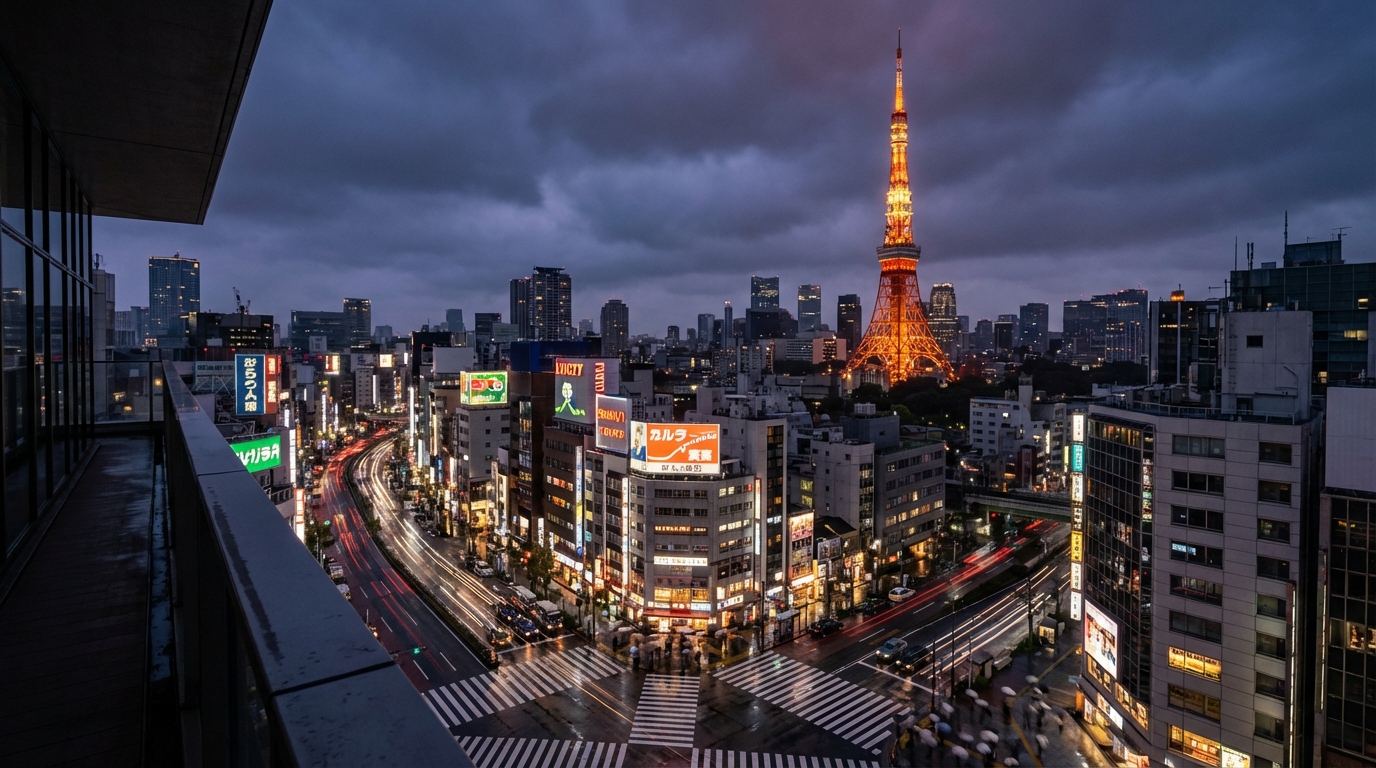
The Counter as Theater
The most important piece of furniture in Tokyo is not a chair but a counter — a slab of hinoki cypress or worn oak, eight to twelve seats wide, separating you from a person who has spent decades mastering a single act of preparation. At a sushi counter in Ginza, the itamae slices fish with a knife he has owned for twenty years, places it on a mound of hand-pressed rice, and sets it before you with a gesture that is simultaneously offering and instruction: eat now, with your hands, while the temperature of the fish and the warmth of the rice are in their thirty-second window of perfection. At a tempura counter, the chef lifts a shrimp from oil that is precisely 180 degrees, places it on paper that absorbs the excess, and slides it across the wood. You are not watching cooking. You are watching a performance that has been rehearsed ten thousand times until the rehearsal and the performance have become indistinguishable.
The counter format exists because Tokyo understood something fundamental about the relationship between maker and eater: proximity creates accountability. When the chef can see your face as you bite, and you can see his hands as he works, both parties are elevated. The chef cannot hide behind a kitchen door; the diner cannot hide behind indifference. This mutual exposure produces an intensity that no open kitchen, no chef's table, no Instagram-era theatre of cooking can replicate, because the counter is not a stage — it is a workbench that you happen to be sitting at. The greatest sushi chefs, the tempura masters, the yakitori grillers who turn chicken skin into something ethereal over bincho-tan charcoal — they do not perform for you. They work in front of you, and the distinction is everything.
What strikes the first-time visitor is the silence. At a serious counter, conversation is minimal. The chef speaks to announce what is being served. You speak to express preference or appreciation. The sounds that fill the space are functional: the slice of a knife, the sizzle of oil, the click of chopsticks, the sigh of rice being pressed. This silence is not awkwardness; it is respect — for the ingredient, for the craft, for the time that has passed since this person first picked up a knife and decided that this, and only this, would be their life's work. In a world that celebrates multitasking and disruption, the Tokyo counter is a monument to the radical proposition that doing one thing, in one place, for one lifetime, is enough.
Shokunin: One Thing, Perfectly, Forever
The word shokunin translates inadequately as 'artisan' or 'craftsman,' but it carries a weight that neither English word can bear. A shokunin is not someone who is good at making things; a shokunin is someone who has surrendered to the process of making one thing — a knife, a bowl of ramen, a cocktail, a wooden joint — and has pursued that singular discipline long enough that the distinction between the person and the practice has dissolved. The ramen master at Fuunji has been making tsukemen for decades, refining the broth by fractions of a degree, adjusting the noodle thickness by millimeters, and when you eat the bowl, you are eating the accumulated weight of all those decisions. The knife forger in Kappabashi has been hammering steel since he was a teenager, and the blade he sells you carries the muscle memory of fifty years of strikes. This is not nostalgia for premodern craftsmanship; it is a living philosophy that operates daily in a city of fourteen million people.
Tokyo's food culture is the most visible expression of shokunin philosophy, and it explains why the city has more Michelin stars than any other on earth — not because the food is fancier, but because the depth of specialization is incomprehensible to cultures that value variety over mastery. A tonkatsu restaurant serves tonkatsu. A tempura restaurant serves tempura. A ramen shop serves one style of ramen, prepared the same way, every day, for years or decades. The chef does not get bored because boredom implies that the craft has been exhausted, and a true shokunin understands that the craft is inexhaustible — there is always a refinement to find, a fraction of improvement to chase, a version of the dish that is marginally closer to the ideal that recedes perpetually ahead. The customers understand this contract: they return not for novelty but for consistency, and the highest compliment is not 'that was different' but 'that was exactly the same, and exactly right.'
The shokunin ethic extends beyond food into every corner of Tokyo life, though visitors encounter it most viscerally through eating and drinking. The bartender at Bar High Five who asks about your mood before building a cocktail has been reading faces and mixing spirits for decades. The man at Cafe de l'Ambre who roasts beans aged for twenty years is following a philosophy his predecessor established in 1948. The tamagoyaki vendor at Tsukiji who grills the same sweet omelette on the same griddle in the same motion, hundreds of times a day, is not trapped in repetition — he is inhabiting a practice. To eat in Tokyo is to be confronted, meal after meal, with the question of how much human attention a single bowl, a single slice, a single pour can hold. The answer, it turns out, is more than you imagined possible.
Golden Gai and the Archaeology of Drinking
Golden Gai is not a bar district; it is a preserved ruin of postwar Tokyo that happens to serve alcohol. Six narrow alleys in Shinjuku's Kabukicho ward, lined with two-story wooden buildings that hold over 200 bars, most seating between four and eight people, some seating only the bartender and whatever mood descends on the evening. The buildings date from the black market era that followed Japan's defeat in 1945, when Shinjuku's west side was a chaotic warren of illegal stalls, drinking dens, and survival economies. The rest of Shinjuku was rebuilt — paved over, built up, turned into the neon canyon of department stores and skyscrapers that defines the district today. Golden Gai was not rebuilt because it was too small to interest developers, too fragile to demolish without protest, and too stubbornly occupied by bar owners who refused to sell. The result is a living archaeological site: a physical remnant of a Tokyo that no longer exists anywhere else, tucked between the robot restaurants and karaoke towers like a time capsule someone forgot to open.
Each bar in Golden Gai is a private universe with its own master or mama-san, its own aesthetic, its own rules. One bar plays only vinyl records from the 1960s and will not serve you if you request otherwise. Another is decorated entirely with Godzilla memorabilia. A third is wallpapered with photographs of writers who have drunk there since the 1970s — Mishima, Murakami, the literary ghosts who used these tiny rooms as offices of the imagination. The cover charge system — typically 500 to 1,500 yen for first-time visitors — is not a scam but a survival mechanism: when your bar seats six and your building has no insulation, you need every customer to contribute to the economics of the evening. Some bars welcome foreigners with open doors and English signs; others cater exclusively to regulars and will politely redirect you. Both responses are legitimate. Golden Gai is not a tourist attraction that happens to contain bars; it is a community of bars that has reluctantly accommodated tourists.
The threat to Golden Gai is not demolition — the alleys achieved a kind of cultural protection through sheer fame — but the slow transformation of its character. As older mama-sans retire and their leases become available, the bars that replace them tend to be more tourist-oriented, more Instagram-ready, less idiosyncratic. The jazz bar becomes a cocktail bar with English menus. The literary drinking hole becomes a sake-tasting experience. Each transition is individually reasonable and collectively erosive, and the Golden Gai of 2030 will inevitably be a curated version of the Golden Gai that existed when nobody was paying attention. Visit now, drink at a bar with an owner who has been there for thirty years, and understand that what you are experiencing is not a permanent installation but a temporary condition sustained by stubbornness, alcohol, and the Tokyo habit of preserving things that should have been demolished decades ago.
The Train as Lifestyle
The JR Yamanote Line is a green circle drawn around central Tokyo, and everything important happens on it or within walking distance of it. Shinjuku. Shibuya. Harajuku. Tokyo. Akihabara. Ueno. The stations are not stops; they are cities within the city, each one a destination with its own commercial ecosystem, its own food courts, its own character. Understanding Tokyo begins with understanding the Yamanote Line, because the train does not merely connect the districts — it defines them. A neighborhood's identity is inseparable from its station: Shibuya is the scramble crossing and the Hachiko statue at the station exit; Shinjuku is the labyrinthine station with 200 exits; Harajuku is the wooden station building (recently rebuilt, controversially) that deposits you at the entrance to Meiji Shrine's forest. The station is the threshold between public and private Tokyo, the point where the precise rail network delivers you to the improvised human scale of the street.
Japanese trains are not merely punctual; they operate on a temporal precision that approaches the philosophical. The average delay on the Tokaido Shinkansen over a year is measured in seconds, not minutes. The Yamanote Line runs every two to three minutes during rush hour, and when a train arrives eight seconds late, the platform announcements apologize. This is not a performance of efficiency; it is the lived reality of a system that was designed around the premise that people's time has value and that any failure to respect that value is a professional failure requiring correction. The rush-hour experience — white-gloved pushers compressing passengers into carriages that exceed their nominal capacity by 180 percent — is a daily spectacle that visitors find horrifying and commuters find normal, and the fact that the system continues to function under these conditions is a testament to the social contract that holds it together: stand in line, board in order, do not speak, do not eat, give up your seat for the elderly, and trust that the train will deliver you where it promised, when it promised.
The last train runs around midnight, and this fact organizes Tokyo's nightlife as definitively as any closing law. Miss the last train and you face a choice: an expensive taxi (3,000 to 10,000 yen depending on distance), a capsule hotel or manga cafe for the night, or the 5am first train after a long night of making the most of the situation. The last-train deadline creates a natural rhythm — the bars fill after work, the restaurants turn over between 7pm and 10pm, and by 11:30pm the stations are flooded with commuters making the calculation between one more drink and the cost of getting home. The ones who miss the last train populate a shadow Tokyo that exists between midnight and dawn: the all-night ramen shops, the 24-hour manga cafes with their reclining chairs and unlimited drinks, the karaoke boxes that serve as makeshift bedrooms, and the convenience stores where salarymen in rumpled suits eat onigiri at 3am with the resigned dignity of people who chose the extra beer and now must live with the consequences.
The IC card — Suica or Pasmo, functionally identical — is the single most important object you will carry in Tokyo. Charge it at any station machine and it becomes a universal key: tap in at the turnstile, tap out at your destination, and the fare is deducted automatically. The card works on JR trains, Metro lines, buses, and — critically — at convenience stores, vending machines, and many restaurants. The system is so seamless that after three days you will stop thinking about payment entirely, which is the point: the IC card reduces the friction of moving through Tokyo to zero, and in a city this large and this complex, friction reduction is the difference between exhaustion and pleasure.
Seasons as Menu
Tokyo does not eat the same food year-round, and the insistence on seasonal ingredients is not a chef's marketing conceit but a cultural principle so deeply embedded that violating it — serving a summer fruit in winter, for instance — carries the quiet disapproval that other cultures reserve for more serious transgressions. The Japanese calendar is organized around seventy-two micro-seasons, each lasting roughly five days, each associated with specific natural phenomena: the first cherry blossom, the first firefly, the ripening of persimmons, the first frost. This granularity is not decorative; it is operational. A kaiseki chef in March is working with ingredients that differ from those available in April, and the menu reflects this with a specificity that most Western diners find either enchanting or exhausting, depending on their relationship with being told what to eat.
Spring is cherry blossom and the foods that celebrate it — sakura mochi (rice cake wrapped in a pickled cherry leaf), sakura-flavored everything from Kit-Kats to lattes, the hanami picnics under the blooming trees where the food is secondary to the act of sitting beneath transience made visible. Summer brings kakigori (shaved ice with syrup), cold soba noodles, unagi (grilled eel, believed to combat summer fatigue), and the night festivals where yakitori smoke rises into warm evening air. Autumn is the season of abundance: matsutake mushrooms, sanma (Pacific saury grilled whole with a squeeze of sudachi citrus), new-harvest rice, persimmons, and the sweet potatoes that Tempura Kondo transforms into something transcendent. Winter is nabe (hot pot), oden (the stew of fish cakes and vegetables simmered in dashi that convenience stores serve from steaming vats), and the citrus fruits — yuzu, mikan, sudachi — that brighten the cold months with acid and fragrance.
The seasonal principle extends to drinks. Sake is released in seasonal cycles — the fresh, unpasteurized nama-zake of spring, the light summer varieties designed for chilling, the warming aged styles of autumn and winter. Cocktail bars like Gen Yamamoto build their entire omakase around whatever Japanese fruit or herb is at its peak that week — yuzu in December, shiso in July, persimmon in October. Even the convenience stores rotate their onigiri fillings and bento selections seasonally, and the limited-edition snack releases (seasonal Kit-Kat flavors have become a collecting phenomenon) track the calendar with a precision that makes them cultural markers as much as products. To eat in Tokyo is to be perpetually aware of time's passage, written not in clocks but in ingredients.
The Hidden City
Tokyo rewards the vertical gaze. The city's best bars are on the ninth floor. Its finest restaurants are in basements. A whisky shrine hides under a railway bridge. A world-class cocktail bar announces itself with nothing more than a brass plate beside an elevator. The horizontal logic that organizes Western cities — facades facing streets, signage at eye level, the assumption that what you see from the sidewalk represents what exists inside — does not apply here. Tokyo is stacked, not spread, and every building is a vertical village of businesses connected by elevators, staircases, and the understanding that floor number is an address component as essential as street name. A single Ginza building might hold a sushi counter on the basement level, a shoe shop at street level, a gallery on the third floor, a cocktail bar on the seventh, and a members' club on the ninth, and none of these businesses will acknowledge the others' existence.
This vertical architecture of commerce is not an accident but a consequence of Tokyo's land economics. When real estate costs more per square metre than almost anywhere on earth, the only affordable direction is up — or down. Basement restaurants (known as chika, literally 'underground') are common not because they are atmospheric (though they often are) but because basement rent is lower than street-level rent, which allows a chef to invest in ingredients rather than location. Similarly, the ninth-floor bars that define Tokyo's cocktail scene — BenFiddich, Tempura Kondo, dozens of others — exist at altitude because the rent at altitude is manageable and the exclusivity of being hard to find is, in Tokyo, a form of quality control. If you can locate a bar on the ninth floor of a building with no English signage, you have demonstrated the minimum commitment required to deserve a drink there.
The practical consequence for the visitor is this: you must look up, look down, and look behind. Study the building directories posted at street level — they are vertical menus of what lives above you, written in Japanese but increasingly with English supplements. Follow the narrow staircases between buildings. Take the elevator to the floor that the concierge whispered about. Push the unmarked door. The most memorable meals and drinks in Tokyo are not found by walking along a street scanning for restaurant facades; they are found by entering a building lobby, consulting a directory, and ascending into a space that the street gives no indication exists. The city's hiddenness is not hostile; it is a filter, and passing through it is the first act of participation in whatever experience waits on the other side.
Depachika: The Basement Food Halls
Beneath every major department store in Tokyo lies a depachika — a basement food hall that operates as a curated museum of Japanese culinary craft, a prepared-food market of staggering quality, and a social institution where grandmothers and businessmen queue with equal patience for the wagashi (traditional sweets) that a particular shop has been making since the Meiji era. The depachika at Isetan Shinjuku, Mitsukoshi Ginza, Takashimaya Nihonbashi, and Daimaru Tokyo Station are not grocery stores in any Western sense. They are edited collections of Japan's finest food producers, each allocated a counter or a vitrine, each presenting their specialty with the precision of a jeweler displaying diamonds. The bento boxes are architectural. The wagashi are sculptural. The fruit — a single Yubari melon for 10,000 yen, a box of twelve strawberries for 5,000 yen — are not priced by their nutrition but by their perfection.
The depachika routine follows a specific pattern for the initiated. You arrive in the late morning, when the displays are freshest and the staff have had time to arrange but the lunch rush has not yet begun. You circle the entire floor once, assessing options with the detachment of a general surveying terrain. Then you commit: a bento from a vendor that has caught your eye (the Mitsukoshi basement in Ginza holds over a hundred food counters), a portion of wagashi from a producer whose lineage extends back centuries, and perhaps a piece of fruit from the corner where perfection is sold by the unit. The bento culture here deserves its own attention — each box is a composition, balanced in color, texture, flavor, and nutrition, assembled with an attention to visual harmony that makes eating it feel almost destructive. You buy one, take it to a nearby park bench, open the lid, and confront the fact that someone arranged this for you to dismantle in fifteen minutes.
The depachika also functions as a barometer of Japanese food culture's current obsessions. When a new confectionery trend emerges — the croissant donut, the butter sandwich, the specific regional cheese tart — the depachika reflect it within weeks, allocating counter space to the trending producer and generating the queues that Tokyo interprets as quality validation. The seasonal rotations are strict: cherry blossom wagashi in March, summer jelly sweets in July, chestnut everything in October. The department store food hall is, in this sense, an edible calendar, and navigating it over the course of a year would give you a more complete understanding of Japanese food culture than any cookbook or restaurant guide. For the visitor with a single afternoon, the Isetan Shinjuku depachika is the most accessible introduction — the concentration of quality in a single basement floor is, frankly, overwhelming, and the correct response is to surrender to it.
Kissaten vs Third Wave
Two coffee cultures coexist in Tokyo, separated by philosophy, aesthetic, and approximately forty years of roasting theory, and they regard each other with the polite incomprehension of neighbors who share a wall but not a language. The kissaten — the traditional Japanese coffee house — dates from the early twentieth century, reached its cultural peak in the postwar decades, and survives today in the form of dark-paneled rooms where the coffee is hand-dripped through flannel filters, the toast is thick-cut and buttered, and the atmosphere is deliberately anachronistic. Cafe de l'Ambre in Ginza has been aging and roasting beans since 1948. Kayaba Coffee in Yanaka pours from a 1938 building with original woodwork. These are not retro-themed establishments performing nostalgia; they are institutions that never changed and therefore never needed to rediscover themselves.
The third-wave specialty cafes arrived in Tokyo in the 2010s and found a city uniquely prepared to receive them. The Japanese attention to precision, the existing infrastructure of pour-over brewing (which the kissaten had practiced for decades before the specialty world claimed it), and the cultural respect for the shokunin model of single-product excellence meant that specialty coffee did not disrupt Tokyo's coffee culture so much as graft onto it. Koffee Mameya in Omotesando treats bean selection with the omakase logic of a sushi counter. Onibus Coffee in Nakameguro brings the community-cafe model to a warehouse with Melbourne's openness but Tokyo's precision. Fuglen imports Norwegian light-roast philosophy and finds that it harmonizes unexpectedly with the Japanese palate for clarity and subtlety.
The tension between the two schools is real but productive. Kissaten coffee is dark-roasted, full-bodied, and brewed through nel (flannel) drip for a heavy, almost syrupy texture. Specialty coffee is light-roasted, origin-focused, and brewed through paper filters or espresso machines for clarity and brightness. A kissaten regular would find a specialty pour-over thin and acidic; a specialty devotee would find a kissaten blend over-roasted and indistinct. Both are correct within their own frameworks, and Tokyo is large enough to hold both without requiring either to concede. The visitor's task is not to choose between them but to experience both — to drink the aged beans at Cafe de l'Ambre one morning and the single-origin pour-over at Koffee Mameya the next, and to understand that Tokyo's coffee culture, like its food culture, is not a single tradition but a conversation between traditions, conducted across counters, in small rooms, with the seriousness that this city brings to everything it cares about.
The Dark Room
Tokyo's cinema culture is deep, particular, and scattered across the city in rooms that range from 40-seat neighbourhood treasuries to underground experimental vaults. Theatre Image Forum in Shibuya has been programming independent and avant-garde film since 1970 — two small screens where the international arthouse releases that bypass mainstream Japanese distribution find their Tokyo audience, and where the annual Image Forum Festival brings experimental film from around the world. Laputa Asagaya, a miniature repertory cinema in a residential neighbourhood, programmes Japanese classics with the curation of a film professor — themed seasons recovering forgotten studio-era directors, postwar genre treasures, and the deep catalogue that lies beyond the Kurosawa and Ozu canon that foreign audiences know.
The broader circuit extends from the arthouse screens at Eurospace in Shibuya to the Waseda Shochiku revival house, from the National Film Archive in Kyobashi to the independent cinemas of Shimokitazawa. What connects them is an audience that treats cinema-going as a distinct activity from home viewing — the act of choosing a specific film, travelling to a specific room, and watching in the dark with strangers who made the same choice. In a city that perfects every ritual it adopts, the cinema ritual is no exception: arrive on time (Japanese screenings start precisely), silence your phone (this is not a suggestion), and stay for the credits (the audience does). The reward is experiencing film culture in a city that brings the same precision and devotion to a screening that it brings to a sushi counter or a tea ceremony.
Izakaya After Dark
The izakaya is Japan's democratic drinking institution — the place where the hierarchy of the office dissolves in beer foam and the social lubricant of shared small plates. The format is simple: you sit, you order a beer (the first drink is always beer, always; this is not a suggestion but a social law), you shout 'kanpai' with your table, and then the evening's eating-and-drinking begins in earnest. The menu is a sprawl of small dishes designed to accompany alcohol: edamame, karaage (fried chicken), yakitori, sashimi, agedashi tofu, takoyaki, grilled fish, potato salad (the Japanese version, sweeter and creamier than its Western ancestor), and whatever seasonal specials the kitchen has decided to run. You order in rounds, the table shares everything, and the bill at the end is split evenly regardless of who ate what, because the izakaya is not a restaurant — it is a social contract disguised as a restaurant.
The izakaya hierarchy mirrors Tokyo's social landscape. At the top are the refined izakaya — establishments with curated sake lists, seasonal menus, and prices that approach fine dining — where the format is preserved but the execution is elevated. In the broad middle are the chain izakaya (Torikizoku, Watami, Ippudo) that serve as Tokyo's after-work decompression chambers, filling every evening with salarymen loosening ties and shouting across tables with a volume that the same men would find mortifying in daylight. At the base are the standing izakaya (tachinomiya) where you drink at a counter or a barrel, the food is simple, the pours are generous, and the evening costs less than a single cocktail at a Ginza bar. The tachinomiya are the closest Tokyo comes to the European pub — informal, affordable, and patronized by regulars who know each other's orders without asking.
The ritual matters as much as the food. The first beer is poured for others, never yourself — you fill your neighbor's glass and they fill yours, and this reciprocal act establishes the evening's social contract. Sake, when it arrives, follows the same protocol: you pour for the person next to you, they pour for you, and the act of giving drink to another person is the physical expression of shared time. The bill arrives as a single total, divided by headcount, and any attempt to calculate individual contributions is met with the gentle disapproval reserved for people who have missed the point. You did not come to the izakaya to eat your food; you came to share an evening, and the shared bill is the accounting of that shared time. The food is excellent, the drink is generous, and the noise level after the third round is magnificent.
The Convenience Store as Institution
The Japanese convenience store — konbini — is the most underrated cultural institution in Tokyo and arguably the most useful. The holy trinity of 7-Eleven, Lawson, and Family Mart operate on every second block, open 24 hours, and provide a quality of prepared food that would embarrass most fast-casual restaurants in other countries. The onigiri (rice balls) are wrapped in a three-layer packaging system that keeps the nori crisp and separate from the rice until the moment you eat it, and the fillings — salmon, umeboshi (pickled plum), tuna mayo, mentaiko (spicy cod roe) — are made fresh daily. The egg sandwich (tamago sando) at 7-Eleven is a minor miracle of soft white bread, seasoned egg salad, and kewpie mayonnaise that has achieved cult status among food writers who should probably be embarrassed by how much they have written about a convenience store sandwich but are not, because it is genuinely that good.
The konbini functions as Tokyo's twenty-four-hour infrastructure. At 2am, when the last train is a memory and the next is four hours away, the konbini provides hot coffee, onigiri, and a warm room. At 7am, it provides a breakfast of fresh pastry and drip coffee that rivals most cafes. At noon, it provides a bento lunch (500-700 yen for a complete meal) that is nutritionally balanced, aesthetically composed, and available in dozens of regional and seasonal variations. The fried chicken (karaage) at Lawson, branded as 'Kara-age Kun,' has a cult following that treats a convenience store snack with the reverence usually reserved for artisanal products. The seasonal limited editions — oden (stew) from October, ice cream flavors that rotate monthly, Christmas cake orders in December — make the konbini a calendar of Japanese food culture compressed into 100 square metres.
Beyond food, the konbini provides services that in other countries require separate trips to separate institutions: ATMs that accept international cards (7-Eleven's ATMs are the most reliable), copy and fax machines, ticket purchasing for concerts and events, utility bill payment, package shipping and receiving, and a level of customer service that involves the cashier touching your change with both hands and placing it precisely in your palm. The toilet at a Japanese convenience store is cleaner than the bathroom at most hotels. The staff are trained to a standard that makes the interaction feel less like a transaction and more like a minor act of hospitality. After a week in Tokyo, you will develop a konbini loyalty — 7-Eleven for onigiri and ATMs, Lawson for fried chicken, Family Mart for the Famichiki and the particular sandwich that you discovered at midnight and now cannot live without.
The Politeness Contract
Japanese politeness is not kindness, though it often produces kindness as a byproduct. It is a social operating system — a set of protocols that allows fourteen million people to share a metropolitan area without the friction that would, in other cultures, produce daily confrontation. The protocols are specific: do not speak on your phone on the train. Do not eat while walking. Do not tip. Do not cut a queue. Do not blow your nose loudly in public. Do not raise your voice in most indoor settings. Do not hand someone money directly — place it in the tray provided. Do not pour your own drink when dining with others. Do not leave chopsticks standing upright in rice. Each rule has a logic rooted in either Shinto concepts of purity, Buddhist ideas of consideration, or the pragmatic reality of dense urban living, and most of them are intuitive once you understand the organizing principle: minimize the imposition of your existence on others.
The visitor who follows these protocols — who queues patiently, speaks quietly on trains, bows slightly when receiving change, and does not tip — will find that Tokyo opens with a warmth that is invisible to the boorish. Restaurant staff become more attentive. Shopkeepers offer help without being asked. Strangers give directions with a thoroughness that borders on the cartographic, sometimes walking you to your destination rather than pointing. The politeness is reciprocal: your consideration of the system generates the system's consideration of you. The visitor who ignores the protocols — who speaks loudly on the Yamanote Line, who walks while eating a rice ball, who hands cash directly to a cashier — will not be confronted, because confrontation itself violates the politeness contract. Instead, they will experience a subtle withdrawal of warmth, a thinning of the air around them, and the particular discomfort of being treated with perfect courtesy that somehow communicates disapproval.
The most important protocol for visitors to understand is the queue. Tokyo queues for everything — ramen, trains, temple entry, limited-edition sneakers, seasonal pastries — and the queue is not an annoyance to be endured but a social institution to be respected. The queue announces that what is at its end has value. The queue ensures fairness — first come, first served, no exceptions for status or impatience. The queue is silent, orderly, and moves at the pace the system dictates. To cut a queue in Tokyo is to commit a social violence that will generate not shouting but something worse: the collective, quiet judgment of everyone who witnessed it. To join a queue without knowing what it is for, and to wait patiently until you reach the front and discover that you have been waiting for the best melon pan in Asakusa, is one of the more authentic Tokyo experiences available. Trust the queue. Join the queue. Respect the queue.
Shibuya vs Shinjuku
The two great neon districts of Tokyo are separated by two train stops on the Yamanote Line and by a philosophical divide that locals feel keenly but rarely articulate. Shinjuku is the city's working engine — the busiest train station on earth, the government buildings, the department stores, the red-light district of Kabukicho, the postwar drinking alleys of Golden Gai and Omoide Yokocho, and the cocktail bars of Nishi-Shinjuku. It is older, rougher, more layered, and more comfortable with its own contradictions. A Shinjuku evening can begin with artisanal absinthe at BenFiddich on the ninth floor and end with yakitori smoke on Memory Lane, and the transit between sophistication and grit takes less than ten minutes. The neon here is not decorative; it is functional, commercial signage scaled to match the sheer density of what is being advertised.
Shibuya is younger, louder, more self-conscious, and more concerned with the present tense. The scramble crossing is its icon — a spectacle of organized chaos that Tokyo has embraced as its global brand image. The district has been in perpetual reconstruction for a decade, with Shibuya Stream, Shibuya Scramble Square, and Miyashita Park replacing the scruffier buildings that gave the area its earlier character. The result is cleaner, taller, and more corporate than the old Shibuya, though pockets of independence survive: Nonbei Yokocho's tiny bars behind the station, the love hotels of Dogenzaka, the record shops of Udagawacho. Shibuya's energy skews younger than Shinjuku's — the crowds on Center Gai are high school and university students performing social identity in a way that Shinjuku's salaryman crowds have long since abandoned.
The choice between them is temperamental. Shinjuku is for the drinker who wants depth — who wants to move from whisky bar to yokocho to speakeasy over the course of an evening, each stop revealing a different stratum of Tokyo's nightlife archaeology. The layers are visible: postwar alleys beside 1960s department stores beside 1990s skyscrapers beside 2020s redevelopment, each era leaving its sediment. Shibuya is for the drinker who wants energy — who wants to be swept into the crossing's current, who wants the view from 229 metres, who wants the new Tokyo that is being built in real time. Neither district is better; they are answers to different questions. Shinjuku asks: where have we been? Shibuya asks: where are we going? A proper Tokyo evening begins at one and ends at the other, and the Yamanote Line will deliver you between them in four minutes, which is precisely enough time to adjust your expectations for whatever comes next.