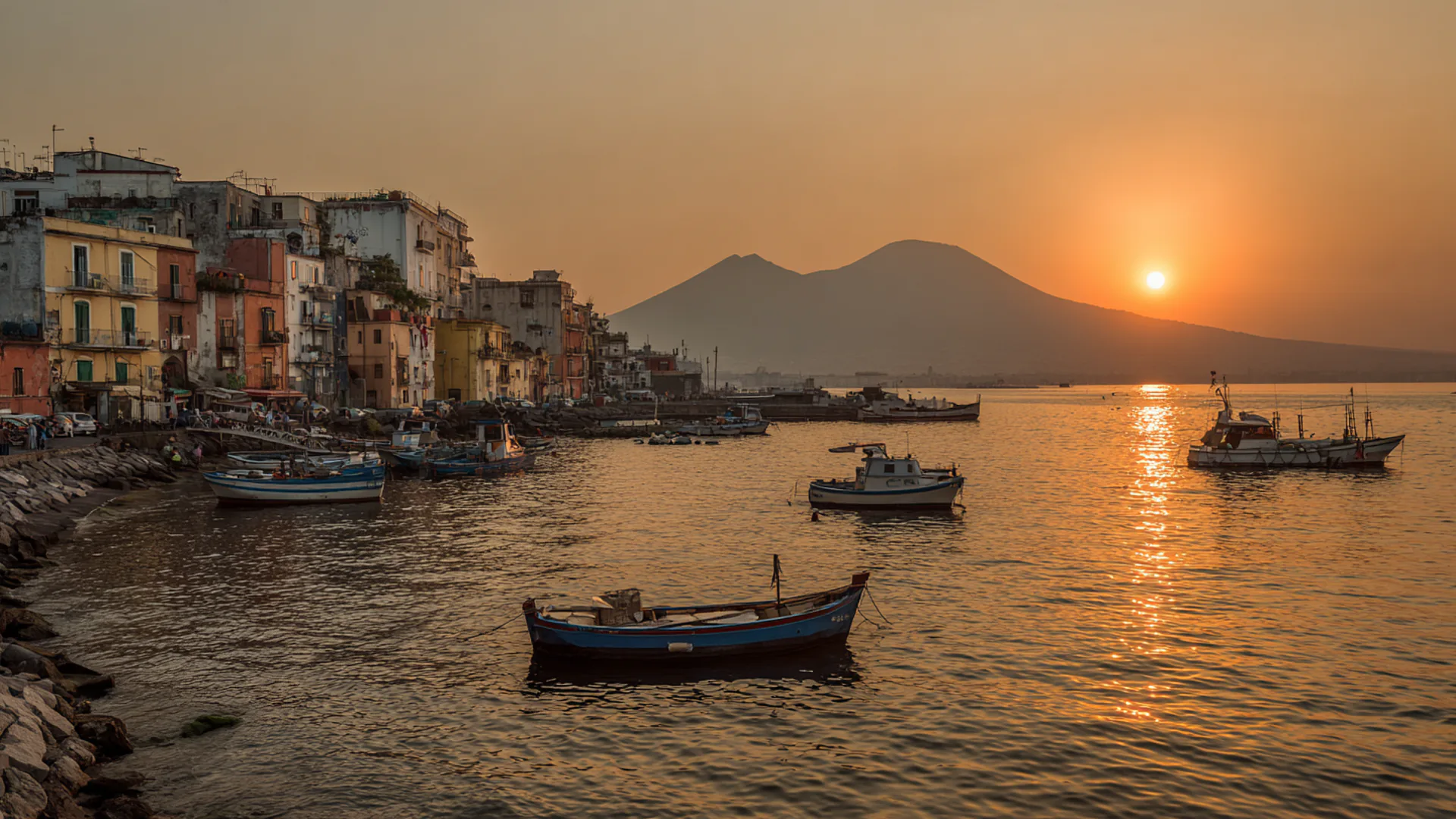
You land and the city tells you you're here, no easing in. This is Italy intensified, a place built in layers: Greek foundations, Roman ruins, Baroque churches. Navigation is about landmarks, not maps—a Maradona mural, a specific pastry shop. Stand at the bar for coffee; it's faster, cheaper, and the local way.
The city has a second, older city 40 metres beneath it: a labyrinth of Greek aqueducts and WWII bomb shelters.
The world's first pizzeria, Antica Pizzeria Port'Alba, has served from this spot since 1830 — though pizza vendors worked these streets from 1738. Da Michele's two-pizza menu (Margherita, Marinara) since 1870 is the true test of faith.
The main train station sits on the grittier, eastern side of the Centro Storico; the farther west you walk, the more the city's character shifts.
Every pick, at a glance
A hidden garden and a pool behind a nondescript door, an impossible oasis of Art Nouveau calm in the heart of the city.
Museo / DecumaniOverlook the aperitivo-hour crowds from a balcony, then retreat into a 16th-century palazzo reimagined with bold, contemporary design.
Piazza BelliniStay where Bogart and Wilde did. The real draw is the view from your room: the bay, Castel dell'Ovo, and Vesuvius in a single frame.
LungomareSleep within a 13th-century cloister, where stone arches and vaulted ceilings meet contemporary warmth in the city's grittier, more genuine heart.
Centro StoricoTake a number and wait. Your reward is one of only two pizzas served since 1870: the Margherita or the Marinara. No distractions allowed.
Centro StoricoDrink your espresso standing at the marble bar. Follow with a warm sfogliatella riccia in the Belle Époque salon where intellectuals once vexed Mussolini.
Piazza del PlebiscitoA controlled detonation of Neapolitan joy where waiters sing, the pasta e fagioli is profound, and plates might actually fly.
Piazza DanteIn the Quartieri Spagnoli, find the essential Pasta e Patate con Provola, a smoky, starchy bowl of comfort that proves simplicity is a discipline.
Quartieri SpagnoliDine surrounded by hand-painted majolica tiles while eating the kitchen's quiet masterpiece: a slow-cooked ragù that feels like a family secret.
ChiaiaStand in a narrow Chiaia alley with a glass of volcanic Aglianico, joining a local institution that has outlasted every trend by doing one thing perfectly.
ChiaiaJoin the after-lecture crowd for a generous, no-nonsense Aperol Spritz on a piazza that feels like the university's public living room.
Centro StoricoFind Naples' cultural pulse in a former wool factory, where DJ nights and live concerts are fueled by simple drinks in a vast industrial space.
CentroLet a bartender guide you through a 'travel diary' menu where cocktails are inspired by Vesuvian myths in an artful, literary Chiaia boutique.
ChiaiaDescend 40 metres into the city’s Greek-Roman aqueducts, a 2,400-year-old labyrinth that later served as a WWII bomb shelter. Essential.
Centro StoricoFind the city's most unexpected moment of peace in a 14th-century cloister garden covered in 66,000 hand-painted majolica tiles.
Centro StoricoSee Caravaggio and Titian in a Bourbon palace, then walk through the 134-hectare park that offers a royal escape from the city below.
CapodimonteThe Farnese Hercules, mosaics from Pompeii, and the secret cabinet of erotic art. This is the context that makes the ruins sing.
Centro StoricoFind the nondescript side alley in Chiaia, order a Negroni made with Campanian vermouth, and stay until the candles burn down.
ChiaiaWaste time at a bar that's also a publishing house, where student-priced beer fuels nights of indie rock, DJ sets, and zine launches.
Centro StoricoDescend into a Centro Storico basement that's been a live jazz institution since the 90s, where the intimacy of the room is part of the sound.
Centro Storico- Drink your coffee standing at the bar ('al banco'). It’s faster, cheaper, and the way locals do it. Leave a small coin as a tip.
- Watch for scooters. Always. They are the city's bloodstream and follow no predictable path. Move with purpose or get out of the way.
- A single 'Biglietto Orario' ticket covers a 90-minute journey across the metro, funicular, and bus system. The 'Toledo' metro station is an art installation in itself.
- When the chaos is too much, duck into a church courtyard. The cloister of Santa Chiara is the ultimate refuge, a silent garden in the city's heart.
- Dinner starts late, around 8:30 or 9 PM. Many traditional trattorias are only open for lunch, which is often the main meal of the day.
Where Things Are
Four neighborhoods to orient your first visit
Centro Storico
Historic core: university streets, classic cafés, rock nooks and negronerie.
Quartieri Spagnoli
Dense grid of trattorie, bohemian bars, and small clubs.
Chiaia
Elegant waterfront district with boutique cocktail bars and aperitivo spots.
Vomero
Hilltop neighborhood with refined bars and viewpoints.