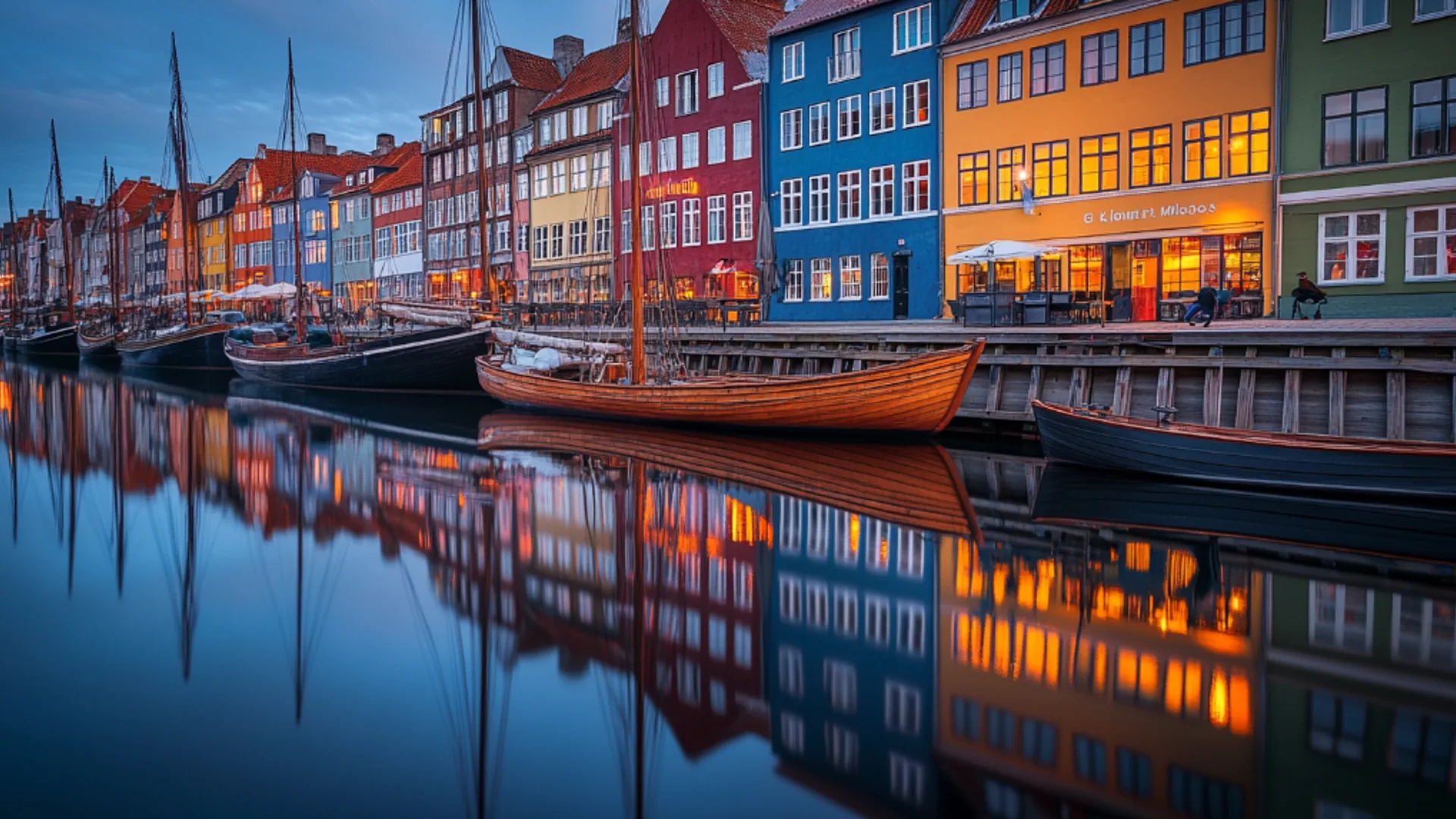
Light on Water
Copenhagen is a flat city that lives on reflections. The canals of Christianshavn double every facade; the harbor at Nyhavn catches afternoon sun and throws it sideways across painted gables. In June, light stretches past ten at night, turning the sky a pale lavender that refuses to commit to darkness. Winter reverses the deal: by three in the afternoon the streetlamps take over, and the city's brass-warm interiors become the real architecture. You feel the season in how people walk — summer strolls are long and directionless, winter routes are purposeful sprints between heated rooms. The water is always there, always reflecting whatever the sky offers. Even on an overcast Tuesday, a canal bridge in Christianshavn will stop you with the way clouds pool beneath your feet.
This relationship to light explains half of Copenhagen's design instincts. The obsession with clean windows, the pale wood interiors, the candles that appear on every restaurant table by October — it is all an ongoing negotiation with a sky that gives generously for four months and then retreats. If you arrive in summer, you will wonder why anyone ever leaves. If you arrive in January, you will understand the candles, the wool, and the deep investment in making indoor spaces feel like shelter rather than enclosure. Either way, the water catches whatever is available and multiplies it. Walk the harbor promenade at Islands Brygge or cross the Knippelsbro bridge at dusk and watch Copenhagen turn into its own postcard — except the postcard moves, ripples, and smells faintly of salt.
Cycling as Grammar
In most cities, cycling is an alternative. In Copenhagen, it is the first language. More than half the population rides daily, and the infrastructure treats bikes not as guests of the road but as its primary occupants. Rush hour on Nørrebrogade moves in a silent river of steel frames, panniers, cargo bikes carrying children, suits holding coffee, and a grandmother who somehow maintains a conversational phone call while navigating a roundabout. The etiquette is precise: signal with your arm, don't stop in the lane, and never ride side by side when traffic thickens. Tourists on rental bikes learn quickly or get a sharp bell. The system works because everyone participates, and it reshapes your experience of distance. Vesterbro to Nørrebro is twelve minutes. Indre By to Refshaleøen is fifteen along the waterfront.
What the bicycle gives you beyond speed is intimacy. You smell the bakeries on Jægersborggade before you see them. You feel the shift from Vesterbro's tight grid to Frederiksberg's leafy avenues in your handlebars. You notice the art on walls, the courtyard gardens, the way a neighborhood changes block by block. A car seals you off; a bike makes you part of the current. Rent one from any Donkey Republic stand, or borrow from your hotel — most have them. Just remember: the locals are fast, the lanes are sacred, and if you stop to take a photo of Nyhavn from the bridge, pull fully to the right. Copenhagen forgives most tourist errors. Blocking the bike lane is not among them.
Coffee and Corners
Copenhagen did not follow the third-wave coffee movement — it helped start it. Coffee Collective on Jægersborggade roasts beans with the seriousness of a wine estate, pouring single-origin filters that taste like someone cared about every variable from altitude to extraction time. Prolog Coffee Bar in Vesterbro does the same with a quieter hand, its small room filled with morning light and the particular hush of people concentrating on their first cup. Democratic Coffee near Nørreport runs the espresso side with Italian precision. Andersen & Maillard pairs excellent coffee with pastries that justify queuing in the rain. This is not a trend; the quality has held for over a decade because Copenhagen treats coffee as a domestic ritual, not a novelty.
The cafe itself matters as much as the cup. Danes use coffee shops as living rooms — hours-long stays are expected, laptops are welcomed without side-eye, and the lighting is always warm enough to make you forget whatever is happening outside. A corner table at Emmerys with a kanelsnegl and a flat white is not a break; it is the structure of the day. In winter, the windows fog, and the room turns inward; in summer, the chairs spill onto the sidewalk, and the boundary between inside and street dissolves. Find your cafe on the first morning and return to it each day. Copenhagen rewards this kind of loyalty — the barista will notice, and your coffee may quietly improve.
The New Nordic Table
Noma changed the conversation, but Copenhagen had been eating well before Rene Redzepi forged his manifesto. Smørrebrød — open-faced sandwiches layered with pickled herring, roast beef, remoulade, and rye so dense it could anchor a ship — remains the city's most honest meal. Torvehallerne market stacks the range: artisan cheese, fresh oysters shucked to order, Grød's Nordic porridge, and Hija de Sanchez tacos from a Noma alumnus who realized that tortillas and fermented salsa could be just as precise. Reffen on Refshaleøen sprawls across the old shipyard with food stalls from every latitude. The city eats across tiers without snobbery — a pølsevogn hot dog cart at midnight carries no less cultural weight than a twelve-course tasting at Geranium.
The fine dining tier is extraordinary and worth the booking effort. Alchemist runs a theatrical multi-course performance; Geranium holds its Michelin stars with Scandinavian purity; Kadeau ferments and smokes with Bornholm intensity; Amass on Refshaleøen cooks with sustainability as structure rather than slogan. A tier below, Bæst makes mozzarella in-house and fires sourdough pizza in Nørrebro, Manfreds serves vegetable-forward plates with natural wine, and Barr at the old Noma building turns Nordic grain into beer and schnitzel. Fiskebar in Vesterbro handles seafood with the confidence of a harbor city. The common thread is care: ingredients respected, portions considered, waste managed. Copenhagen feeds you with intent.
Beer, Wine, and the Long Evening
Copenhagen's drinking culture has a particular rhythm: it starts slow and stretches. A natural wine at Ved Stranden 10, sitting canalside in Indre By with a glass of something orange and unfiltered, is a different opening act than Warpigs in the meatpacking district, where Texas barbecue meets Danish craft beer in a room loud enough to feel like a rally. Mikkeller's empire began here and still runs bars across the city — Mikkeller Bar Viktoriagade in Vesterbro for the taps, Mikropolis in Nørrebro for the neighborhood version. Brus in Nørrebro pairs its own brewery with a restaurant and a bottle shop. The beer knowledge is deep, but never aggressive; Copenhagen bartenders recommend rather than lecture.
The cocktail rooms are where the evening sharpens. Ruby, in a candlelit Indre By townhouse, makes drinks with the quiet confidence of a city that has done this for a long time. Lidkoeb in Vesterbro stacks three floors of atmosphere — a ground-floor bar, a middle den, and an attic whiskey room with leather chairs and low ceilings. K-Bar and Curfew work the same register with different moods. What connects them is the Danish habit of venue migration: you do not stay all night in one place. You begin with wine, shift to beer, and end at a cocktail bar or a late spot in the meatpacking district. The night is a sequence, not a destination. By the time you leave Kødbyen at one in the morning, you have been in four places and none of them felt rushed.
Canals and Cobblestones
Christianshavn was built by a king who admired Amsterdam, and the resemblance holds: narrow canals lined with houseboats, brick warehouses converted into flats, bridges that lift for masted boats, and a particular quality of stillness when the water is flat. Cross the Knippelsbro bridge from Indre By and the density changes. The streets are quieter, the sky opens over water, and the spire of Vor Frelsers Kirke spirals overhead like a corkscrew invitation to climb. Do climb it — the view from the external staircase is one of Copenhagen's great earned rewards. Below, the canal towpaths lead past Kadeau, past old rope factories, past gardens where residents have planted climbing roses against stone walls. The area feels like a village that happens to be ten minutes from a metro station.
Nyhavn is the postcard, and there is no shame in standing on the bridge and admitting that the colored facades genuinely are that beautiful. But the city's relationship to water extends far beyond one famous row. The harbor baths at Islands Brygge let you swim in clean seawater with the city skyline as backdrop. The Cirkelbroen bridge by Olafur Eliasson turns a pedestrian crossing into a piece of public art. Houseboats along the canals host dinner parties visible through curtainless windows. The harbor bus functions as both transit and sightseeing, ferrying commuters past the Opera House and the Royal Library's Black Diamond extension. Water is not scenery in Copenhagen; it is infrastructure, recreation, and the thread that stitches the islands together into something that feels, against all cartographic evidence, like a single continuous city.
The Screening Room
Copenhagen's cinema culture mirrors its design culture: considered, institutional, and quietly confident in its own taste. Cinemateket, operated by the Danish Film Institute on Gothersgade, is the anchor — three screens programming restored classics, Dreyer and von Trier retrospectives, and international cinema with the curatorial depth of a national archive. The café doubles as the Danish film community's informal canteen, its walls covered in posters from decades of programming. Grand Teatret near Rådhuspladsen has been screening since 1913 in a picture-palace auditorium that retains its original plasterwork and balcony — the room alone justifies attendance. Gloria Bio offers the neighbourhood alternative: a single screen, community-driven programming, and the intimacy of a cinema sustained by regulars rather than algorithms.
The Scandinavian model — a national cinematheque backed by a film institute that also funds production and preservation — gives Copenhagen's film culture an institutional stability that commercial cinema circuits cannot provide. Cinemateket's programme assumes its audience cares about Dreyer as much as contemporary Danish independent film, and the assumption is correct. The city that produced Lars von Trier, Thomas Vinterberg, and the Dogme 95 movement watches its own cinema with the critical attention it deserves. Combine a screening at Cinemateket with dinner at one of the canal-side restaurants and you have an evening that feels distinctly Copenhagen: warm, considered, and shaped by taste rather than trend.
Design in Everything
You will notice the chairs first. In a cafe, in a hotel lobby, in someone's living room glimpsed through a ground-floor window — the chair is always deliberate. An Arne Jacobsen egg, a Hans Wegner wishbone, a Børge Mogensen bench. Danish design is not a museum category; it is the way objects get made when a culture decides that function and beauty are the same thing. The PH lamps by Poul Henningsen cast layered light without glare — you will find them in restaurants, offices, and the airport. Street furniture is clean: bus shelters, bicycle racks, park benches all share a vocabulary of restrained lines and durable materials. The Royal Danish Playhouse and the new Blox building continue the conversation: public architecture that respects its setting rather than shouting over it.
This sensibility infiltrates daily life in ways you stop consciously noticing after two days. The grocery store packaging is considered. The metro stations use consistent typography. Your hotel room, if it is any good, will have a reading lamp that positions light exactly where you need it and nothing on the bedside table that does not earn its place. Designmuseum Danmark shows the historical arc — Viking craft, industrial modernism, contemporary textile — but the real museum is the city itself. Walk through Frederiksberg and watch how garden gates, letterboxes, and doorknobs participate in the same aesthetic. It is not precious; it is simply what happens when good design is expected rather than celebrated. Copenhagen does not point at its chairs. It just sits in them.
Hygge Without the Cliché
The word has been exported, diluted, printed on candles in airports, and drained of most useful meaning. But in Copenhagen, hygge is not a product category — it is a social agreement. It means making a cold, dark Tuesday evening feel human: candles on the table, a meal that took effort, a room where no one is checking the time. It shows up in the way Café Intime in Frederiksberg keeps its piano bar dim and its cocktails strong, in the blankets draped over restaurant chairs for outdoor diners in October, in the habit of baking for friends instead of buying. The mechanics are simple — light, warmth, attention — but the commitment is genuine. Danes build hygge into restaurants, workplaces, and public spaces because they have learned that a society facing five months of limited daylight needs deliberate warmth.
You will feel it most in the places you are invited rather than the places you pay to enter. A Danish home in winter — shoes removed at the door, wool socks on wooden floors, a table set with more candles than a church — is hygge operating at full capacity. But even as a visitor, the principle applies: choose the smaller restaurant over the louder one, the corner table over the window, the second glass of wine over the quick exit. Copenhagen rewards lingering. Stay until the candles gutter. Let the conversation slow. The city is not trying to entertain you into submission; it is offering the conditions under which ordinary hours become memorable. That is hygge — not a feeling you purchase, but an atmosphere you participate in.
Parks and Breathing Room
Frederiksberg Have is the green lung that Frederiksberg wraps around like a protective arm: a romantic English garden with canals, hillocks, a Chinese pavilion, and a view of the elephants in Copenhagen Zoo from across the water. Families picnic here with the dedication of people who know that a clear afternoon in June should not be wasted indoors. King's Garden — Kongens Have — surrounds Rosenborg Castle and serves as Indre By's living room: students, chess players, sunbathers, and the occasional guard patrol coexist on the same lawn. Fælledparken in Østerbro is the democratic commons, hosting football matches, festivals, and the kind of aimless walking that Danes call hygge but that you might just call relief.
Superkilen in Nørrebro is something else entirely: a public park designed as a global collage, with objects sourced from sixty countries — swings from Iraq, benches from Brazil, neon signs from Russia — arranged across a red square, a black market, and a green park. It is loud, opinionated, and exactly the kind of civic investment that makes Copenhagen feel like a city that thinks about public space as seriously as private comfort. Even the cemetery — Assistens Kirkegård in Nørrebro, where Hans Christian Andersen and Søren Kierkegaard rest — functions as a park, with joggers and readers weaving between headstones. Green space here is not decoration; it is infrastructure, maintained with the same rigor as the bike lanes and the metro, because the city understands that density without breathing room is just crowding.
Movement and Bridges
Copenhagen is an island city stitched together by bridges, and understanding the connections unlocks the geography. The metro runs two main lines — M1 and M2 — through the city center and out to the airport, clean and driverless and arriving every few minutes. The S-tog suburban trains reach further, connecting to Helsingør, Hillerød, and the northern coast. Buses fill the gaps, and the harbor buses — small ferries running routes 991 and 992 — are perhaps the most pleasurable commute in northern Europe, sliding past the Opera House and the Royal Library at water level. But the bicycle remains the default: faster than transit for most cross-city trips, free from timetables, and deeply embedded in the city's self-image.
The bridges themselves deserve attention. Inderhavnsbroen connects Nyhavn to the Opera House on a pedestrian and cycling bridge that swings open for ships. Cirkelbroen, designed by Olafur Eliasson, turns five circular platforms into a piece of art you walk across daily. Knippelsbro connects Indre By to Christianshavn with a lift mechanism that pauses traffic for tall masts. Each bridge is a seam between neighborhoods, and crossing one always shifts the texture of the city — from the medieval compression of Indre By to the canal width of Christianshavn, from the residential calm of Østerbro to the industrial grit of Refshaleøen. Read the bridges and you read the city. The metro is efficient; the bike is liberating; but the bridges are how Copenhagen explains its own shape.
Seasons and Survival
Copenhagen in July and Copenhagen in January are two different propositions. Summer turns the city inside out: restaurant tables migrate onto sidewalks, the harbor baths overflow, every park becomes a living room, and the light — that relentless, flattering Nordic light — makes everything look like a film still from a life you want to be living. You eat outdoors at Manfreds, drink on the canal at Ved Stranden 10, ride to Refshaleøen for Reffen, and do not think about darkness because there barely is any. The solstice week feels like a city-wide exhale, a collective agreement that these hours are precious and no one should be indoors.
Winter demands different skills. The sun sets before four, the wind off the Øresund cuts through insufficient layers, and the city retreats into its interiors. This is when Copenhagen's investment in warm spaces pays off: the candlelit bars, the heated restaurant terraces, the libraries and museums designed to make staying feel better than leaving. Locals manage the dark months with ritual discipline — morning swims at Kastrup sea bath, Friday hygge dinners, weekend walks through Frederiksberg Have with thermal cups of coffee. Vitamin D supplements are a shelf staple; light therapy lamps are not unusual desk accessories. The city does not pretend winter is pleasant. It simply builds a life around it that makes January bearable and February survivable, until March cracks the sky open again and the bikes return in force.
Markets and Everyday Ritual
Torvehallerne is the market that anchors the daily rhythms of Indre By: two glass halls flanking Israels Plads, packed with stalls selling oysters, artisan bread, fresh pasta, smoked fish, Danish cheese, seasonal berries, and coffee good enough to build a morning around. It is not a tourist market with a local veneer — you will see neighborhood regulars buying Tuesday dinner alongside visitors navigating with cameras. Grød serves porridge as a serious food group; the fish counter wraps salmon so fresh it looks offended to be on ice. The quality is high and the prices match, but this is Copenhagen's version of the grocery run: careful, quality-obsessed, and treated as part of the day rather than a chore to minimize.
Beyond Torvehallerne, the market habit runs deeper. Weekend flea markets appear at Nørrebro's Ravnsborggade, where vintage furniture and Danish ceramics change hands over coffee. Hart Bageri in Frederiksberg — founded by a Noma alum — produces bread and pastries that people cross the city for, queuing before the doors open as if attendance were a civic duty. La Glace, operating since 1870, serves layered cakes in rooms that feel like stepping into a novel. Emmerys bakes organic sourdough in multiple locations with the consistency of a bakery that knows it is part of someone's morning architecture. These are not destinations; they are rituals. Copenhagen's relationship to food shopping is a form of daily aesthetics — the commitment to good ingredients, well made, available on every corner, treated as a birthright rather than a luxury.
Day Trips by Train
Louisiana Museum of Modern Art sits on the coast at Humlebæk, thirty-five minutes north by regional train, and it is the best reason to leave Copenhagen for a day. The collection is strong — Giacometti, Calder, Warhol — but the architecture is the real exhibit: low-slung pavilions connected by glass corridors that frame the Øresund and the Swedish coast beyond. The sculpture garden slopes down to the water, and on a clear day you can sit on the grass with a Giacometti bronze and the sea in the same frame and feel the particular luxury of art placed in landscape. The cafeteria is unexpectedly good. Bring time; you will want three hours minimum.
Malmö is twenty minutes across the Øresund Bridge by train — a border crossing that feels like changing channels. Swedish kronor, different coffee culture, a city center compact enough to walk in an afternoon. Dragør, south of Copenhagen, is a fishing village preserved in amber: thatched roofs, narrow lanes, yellow-washed houses, and a harbor where you can eat shrimp and watch the ferries. Roskilde, thirty minutes west, has the Viking Ship Museum and a cathedral that houses the tombs of Danish monarchs. Helsingør has Kronborg Castle — Hamlet's Elsinore — and a ferry to Helsingborg in Sweden if you want to double your countries in a day. All of these work as half-day trips from Central Station, returning in time for dinner at Barr or a cocktail at Ruby.
Farvel, for Now
Copenhagen does not stage a dramatic goodbye. Your last morning will likely follow the pattern of every other: a coffee at the place that became yours, a kanelsnegl from Hart Bageri or Andersen & Maillard wrapped in paper for the train, one more canal crossing on foot because the light is doing something worth noticing. You might walk through Kongens Have past the rose garden, or take the harbor path from Nyhavn toward the Little Mermaid — not because the statue justifies the walk but because the harbor does. The airport train leaves from Central Station every ten minutes, and the ride takes thirteen. There is no reason to rush, which is itself a Copenhagen lesson.
What you carry out is less a highlight reel than a rhythm: the pace of an evening that moved from Torvehallerne to Ved Stranden 10 to Lidkoeb without any of it feeling hurried; the way a Tuesday morning at Coffee Collective felt like an event because the light through the window was good and the pour-over was careful; the sensation of cycling Nørrebrogade in the stream of commuters and feeling, for ten minutes, like someone who lived here and always had. Copenhagen does not perform for visitors. It simply maintains a city so considered, so attentive to the daily texture of how people eat, move, sit, and gather, that being there for a week feels like being let in on a secret that everyone already knows. Farvel. You will be back when the light changes.