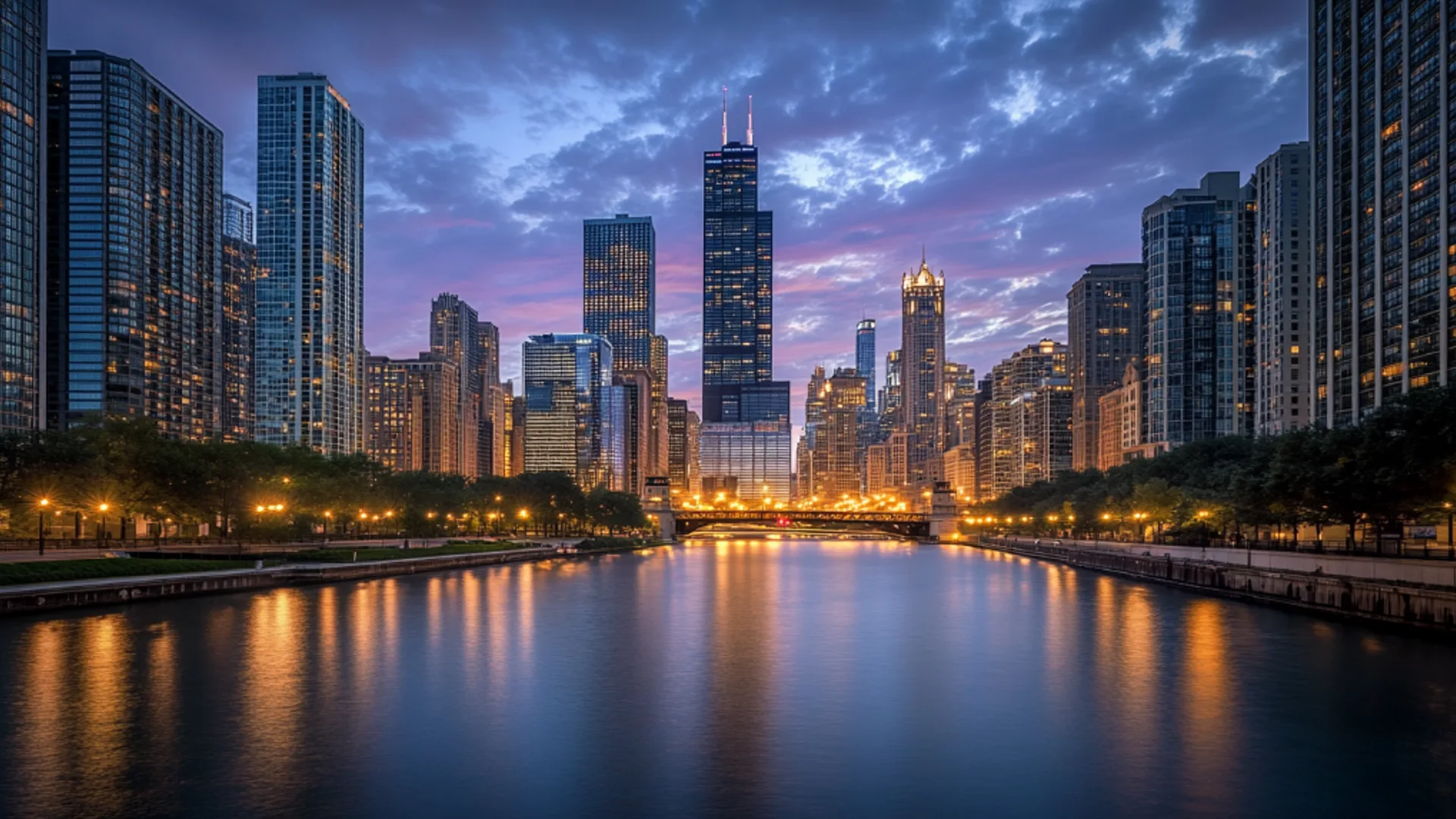
A city invented by necessity after the Great Fire, Chicago became a laboratory for the skyscraper and the birthplace of modern architecture. The elevated 'L' train offers the best view of this conversation between buildings, while at street level, a fiercely independent food and comedy scene thrives in neighbourhoods built on a grid so logical you can navigate by arithmetic.
Chicagoans eat tavern-style thin-crust pizza cut in squares, not the deep-dish casserole served to tourists.
The best architecture tour is the public 'L' train, which loops through the downtown canyon at third-story height for the price of a transit fare.
The city's grid is based on a zero point at State and Madison. Every 8 blocks is a mile, making any address a coordinate.
Every pick, at a glance
Sleep inside a 1893 Venetian Gothic landmark where Gilded Age history meets modern design. A lake-view room watches Cloud Gate reflect the sunrise.
The LoopA converted belt factory where industrial bones meet rooftop glamour. The pool is the city's summer social apex.
West LoopAn Art Deco tower rising over Wicker Park, offering a rare, wide-angle skyline view from its rooftop. The city unfolds from a different direction here.
Wicker ParkLocal Chicago art on the walls and the city's green front yard—Lincoln Park—at your feet. A park-facing room feels like a treetop retreat.
Lincoln ParkThis is not dinner; it is a three-hour argument that food can be high art. Grant Achatz's tasting menu is a ticketed performance.
Lincoln ParkStephanie Izard's bold, umami-rich cooking, where wood-roasted pig face and goat empanadas have commanded a full house for over a decade.
West LoopChicago's third-wave coffee obsession was effectively launched by this roaster. Order a single-origin pour-over to witness the baristas preparing your brew with the exacting precision of a chemistry lab.
LakeviewRick Bayless's edible scholarship, where regional Mexican moles are treated with the reverence of French sauces and the tortillas are made by hand.
River NorthThe deep dish for locals, defined by its 'caramelized crown'—a blackened, crunchy ring of cheese that's more important than the pizza itself.
Lincoln ParkBehind an unmarked facade, the bar that started Chicago's cocktail renaissance. Order a Juliet & Romeo and taste the recipe that launched a thousand imitations.
Wicker ParkGrant Achatz's cocktail laboratory, where drinks arrive in chemistry beakers and puffs of smoke. Expect invention, not just a beverage.
West LoopA taxidermy-adorned former social club serving serious cocktails without the serious attitude. The back patio and amaro machine are local legends.
Ukrainian VillageDescend through a back alley into a subterranean tiki world of rum and fire, built by one of America's foremost rum authorities.
River NorthStand before Seurat's 'A Sunday on La Grande Jatte' and feel the entire art world pivot. The Impressionist collection alone is worth the flight.
The LoopWalk through a captured German U-505 submarine and ride a coal elevator into a recreated mine at the largest science museum in the hemisphere.
Hyde Park'The Bean' holds its gravity for a reason. Go at sunrise to see the city's skyline warp and bend on its polished surface before the masses arrive.
The LoopThe one tourist activity locals insist you do. Ninety minutes on the river, learning why Chicago's buildings argue with each other across decades.
The LoopAl Capone's former haunt, where the ghosts are friendly and the live jazz is the city's gold standard. Sit in the boss's favorite booth and order a gin martini.
UptownA cocktail bar, record label, and art gallery in one narrow room. The cocktail menu changes weekly, and the music is always new.
Logan SquareA rescued 1930s tavern where the terrazzo floor and neon glow feel unchanged by time. The mood is dark, the music is live, and the cocktails are classic.
Humboldt Park- Get a Ventra card for the 'L' train. The Brown Line loop is the best free architecture tour in the city, no docent required.
- Book the Chicago Architecture Center's river cruise specifically. Their docents are the most rigorously trained and respected.
- Eat deep dish once for the experience (Pequod's for the crust), then switch to tavern-style thin crust, cut in squares, to eat like a local.
- Second City mainstage is polished, but the late-night improv sets are where the real comedy alchemy happens.
- There is no 'bad weather,' only bad clothing. From October to April, pack layers you can add or shed as the lake effect changes the forecast by the hour.
Where Things Are
Four neighborhoods to orient your first visit
The Loop
Downtown core defined by the elevated train tracks that circle it overhead, giving the neighbourhood both its name and its perpetual soundtrack of screeching steel. The Art Institute anchors the south end, Millennium Park gleams to the east, and the architecture — Sullivan, Mies, SOM, Gang — rises in a timeline of American ambition.
West Loop / Fulton Market
Former meatpacking district reborn as Chicago's most concentrated dining neighbourhood. Randolph Street is Restaurant Row — Girl & the Goat, Au Cheval, The Aviary all within blocks. The industrial bones remain in loading docks and cold-storage facades, but the tenants are now tech companies, boutique hotels, and tasting menus.
Wicker Park / Bucktown
The creative engine that has been cycling through waves of gentrification since the 1990s without losing its edge entirely. The Violet Hour set the cocktail standard. Damen and Milwaukee avenues cross at the six-corners intersection that functions as the neighbourhood's Times Square — louder, messier, more alive than anywhere on the North Side.
Lincoln Park
The lakefront neighbourhood that balances affluence with genuine civic beauty. The park itself stretches four miles along the shore — free zoo, conservatory, North Pond, and running paths. Halsted Street runs the commercial spine with Alinea at the top of the dining hierarchy and neighbourhood bistros filling the blocks below.