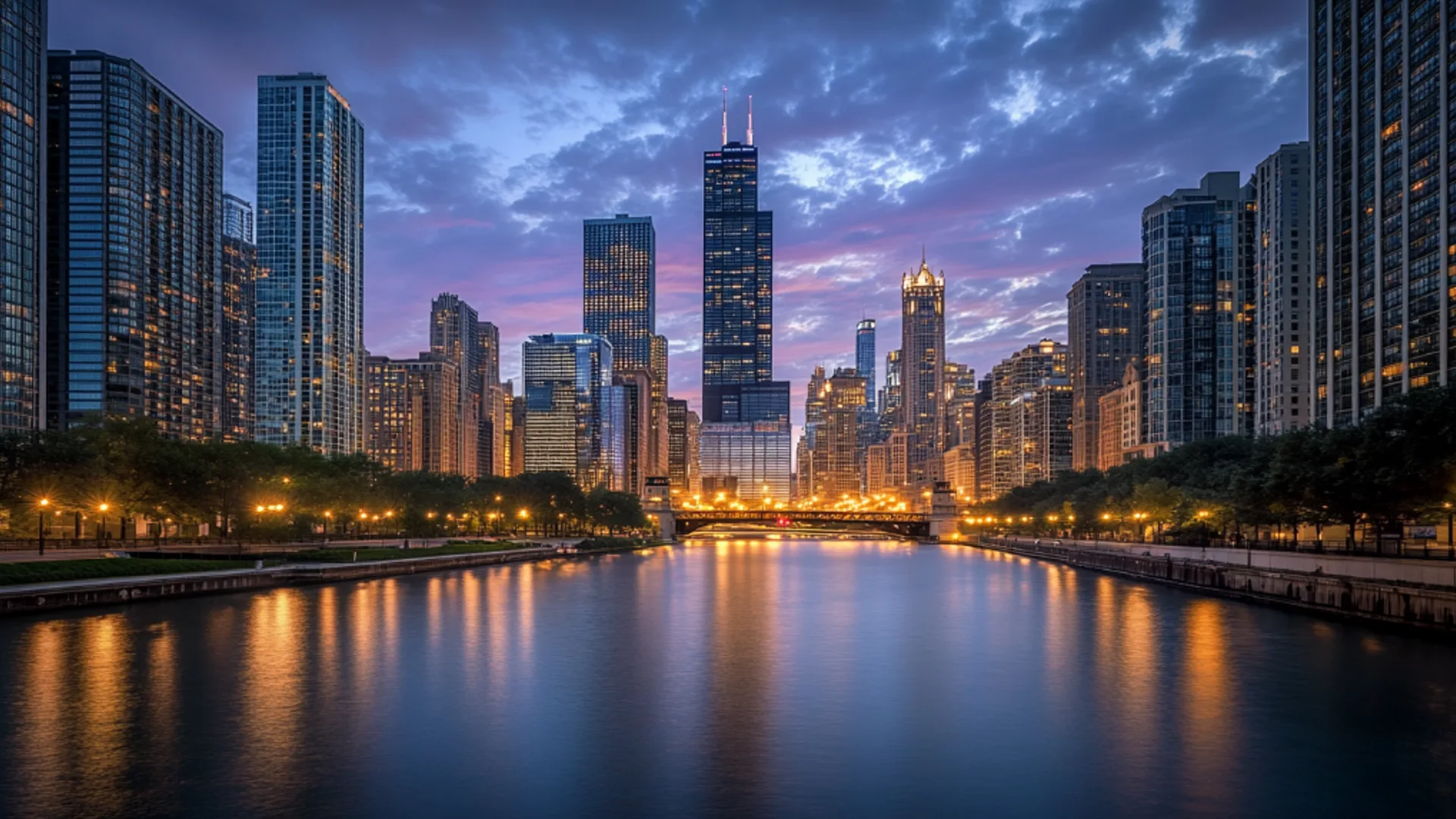
The Architecture Obsession
Chicago did not invent the skyscraper by choice but by necessity. The Great Fire of 1871 levelled four square miles of the city centre and killed 300 people, and what rose from the ashes was not merely a rebuilt city but a laboratory for vertical ambition. William Le Baron Jenney's Home Insurance Building in 1885 — the first steel-frame structure — proved that buildings could rise without bearing walls, and the race upward began. Louis Sullivan added ornament and philosophy, declaring that form follows function while decorating his facades with organic terracotta that proved form could follow beauty simultaneously. Daniel Burnham built the Reliance Building in 1895 with a glass-and-terracotta curtain wall that anticipated modernism by fifty years. Frank Lloyd Wright, working from his Oak Park studio, rejected the vertical entirely and invented the horizontal Prairie Style that would influence domestic architecture worldwide. All of this happened within a twenty-mile radius, within a single generation, in a city that was younger than most European churches.
The timeline did not stop. Mies van der Rohe arrived in 1938, fleeing Nazi Germany, and remade the skyline in steel and glass with a severity that still defines the Loop. His Illinois Institute of Technology campus on the South Side is a masterclass in proportion. His 860-880 Lake Shore Drive apartments — twin glass towers on the lakefront — became the most copied residential buildings in history. The Farnsworth House in Plano, an hour southwest, is arguably the most important house of the twentieth century: a glass box floating above a floodplain, a building that is simultaneously inhabitable and uninhabitable, a philosophical argument made in steel and glass. Decades later, Jeanne Gang's Aqua Tower rippled onto the skyline in 2009, its undulating balconies breaking the grid with a fluidity that proved Chicago still had things to say about how buildings should move through air. The city's architecture is not a museum collection — it is an ongoing conversation, and the buildings argue with each other across decades.
To understand Chicago's relationship with architecture, ride the Brown Line. The elevated train loops through the downtown canyon at third-storey height, passing close enough to the facades to read the stone carvings, the terracotta details, the joints between steel and glass. It is the best free architecture tour in the city, available for the price of a transit fare, and the buildings parade past the windows in chronological order as you round the Loop. The architecture cruise on the Chicago River is the formal education — docent-led, historically sequenced, essential — but the Brown Line is the daily experience, the way the city's residents encounter their own architectural heritage as commuters rather than tourists. Chicagoans argue about buildings the way other cities argue about sports teams, which tells you everything about priorities.
The obsession extends below the skyline. The bungalow belt — the ring of modest brick bungalows that surrounds the city's inner neighbourhoods — is the largest collection of Arts and Crafts-era homes in the country. The greystone two-flats and three-flats that line Logan Square and Humboldt Park are a vernacular architecture of limestone facades and bay windows that gives the Northwest Side its distinctive character. The Prairie-style houses in Beverly and Hyde Park translate Wright's ideas into residential scale. Even the L stations — particularly the Quincy and Library stations on the Brown Line — are architectural survivors worth studying. This is a city that thinks about the built environment at every scale, from the glass tower to the corner tavern, and the thinking has not stopped since the fire cleared the canvas.
The Deep Dish War
The single most contentious food argument in Chicago is not about deep dish — it is about what Chicagoans actually eat versus what they serve to tourists. Deep dish pizza, that thick-crusted, cheese-laden, tomato-topped casserole baked in a cast-iron pan, was invented at Pizzeria Uno in 1943 by Ike Sewell, and it became the symbol of Chicago pizza for the same reason the Eiffel Tower became the symbol of Paris: it was big, dramatic, and photographed well. But Chicagoans do not eat deep dish regularly. They eat tavern-style thin crust — a thin, cracker-crisp base cut in squares (not triangles, never triangles) and served at neighbourhood taverns with pitchers of beer. Pat's Pizza in Lincoln Park, Vito & Nick's on the South Side, Marie's Pizza and Liquors in Bridgeport — these are the pizzerias that sustain Chicago's daily pizza habit, and the square-cut thin crust is as much a regional style as deep dish, just less photogenic.
The deep-dish landscape itself is factional. Lou Malnati's partisans point to the buttercrust — flaky, buttery, almost pastry-like — as the defining innovation that keeps the dish from becoming the heavy casserole its critics (mostly New Yorkers) describe. Giordano's represents the stuffed pizza variant, with a second layer of dough on top that creates an even denser construction. Pequod's in Lincoln Park takes a different approach entirely: the caramelized cheese crust, where mozzarella is pressed against the edge of the pan and cooked until it forms a blackened, crunchy crown that is arguably more important than the pizza it surrounds. Pizzeria Uno is the historical original and worth a visit for the pilgrimage, though the quality has drifted from the founding recipe. The correct strategy is to eat deep dish once at Pequod's (for the crust revelation) and once at Lou Malnati's (for the butter crust classic), then switch to tavern-style for the remainder of your visit. Chicagoans will argue the specifics of this recommendation, which is itself proof that the taxonomy matters.
What unites all Chicago pizza factions is the rejection of New York-style pizza as a legitimate competitor. This is not a rational position — New York pizza is excellent — but it is a deeply held one, rooted in the same civic tribalism that sustains Bears fandom through decades of losing and Cubs loyalty through 108 years without a championship. The pizza war is a proxy for a larger argument about Chicago's identity: a city that is perpetually compared to New York and perpetually insisting that the comparison is irrelevant because Chicago does things its own way. The deep dish, the tavern cut, the Italian beef, the Chicago-style hot dog — these are not just foods but assertions of independence, and defending them is a civic duty that Chicagoans take as seriously as shovelling their parking spots after a snowstorm.
Second City, First in Comedy
The Second City opened on Wells Street in Old Town in 1959, and the alumni list reads like a history of American comedy: John Belushi, Dan Aykroyd, Gilda Radner, Bill Murray, Chris Farley, Tina Fey, Amy Poehler, Stephen Colbert, Steve Carell, Keegan-Michael Key, Jordan Peele. The pipeline from Second City to Saturday Night Live to film and television is the most productive comedy infrastructure in the country, and it operates on a principle that Del Close codified and Harold Ramis perfected: yes, and. The improv philosophy — accept the premise offered by your scene partner and build on it — sounds simple until you try it under stage lights with an audience expecting to laugh, and the discipline required to do it well is the training ground that has produced more successful comedians per square foot than any institution in entertainment history.
But Second City is only the most famous node in a comedy ecosystem that permeates the city. iO Theater (formerly ImprovOlympic), founded by Close and Charna Halpern, developed the Harold — the long-form improv format that transformed improvisation from sketch comedy's warm-up act into a standalone art form. The Annoyance Theatre, founded by Mick Napier, pushed improv toward the transgressive and the absurd. ComedySportz introduced competitive improv for families. The comedy circuit in Chicago is dense enough that a performer can take classes at Second City in the morning, rehearse a Harold at iO in the afternoon, and perform at the Annoyance at night, cycling through the city's comedy institutions like a musician playing different clubs in Nashville. The training pipeline draws aspiring comedians from across the country, and the ones who survive the grind — years of unpaid or low-paid performances, day jobs as bartenders and baristas, the particular alchemy of learning to be funny on demand — emerge with a craft that the entertainment industry recognizes as the gold standard.
Seeing a show at Second City is different from seeing a show anywhere else because the audience is part of the tradition. The suggestion shouted from the third row might spark a scene that builds into something the performers themselves did not expect, and the electricity of that shared creation — audience and performers building something in real time that has never existed before and will never exist again — is improv's fundamental thrill. The mainstage shows are polished revues, partially scripted and partially improvised, and the quality is consistently high. But the late-night sets — the improv jams, the experimental formats, the shows where the performers are trying new material without the safety net of rehearsal — are where the tradition lives most dangerously and most honestly. The Old Town Ale House across the street serves as the unofficial after-show bar, where performers and audience decompress together, and the nude paintings on the walls include more than a few former Second City cast members.
The comedy pipeline's influence on Chicago culture extends beyond the stages. The city's conversational style — quick, self-deprecating, built on callbacks and escalation — reflects decades of improv permeating the social fabric. Chicago humour is drier than Los Angeles and less mean than New York, shaped by a Midwestern friendliness that the comedy tradition sharpens without destroying. When a bartender in Logan Square cracks a joke that builds on something you said three exchanges earlier, that is the improv training showing up in everyday life. The comedy is in the water.
The L and the Grid
The L — short for 'elevated,' though substantial portions now run underground or at grade — is Chicago's defining infrastructure and its most democratic public space. Eight colour-coded lines radiate from the Loop, the elevated track that circles the downtown core and gives it both its name and its perpetual soundtrack of screeching steel on tight curves. The Loop itself is the system's architectural signature: trains running at third-storey height between the canyon walls of the downtown buildings, steel pillars planted in the sidewalks, the overhead shadows striping the streets below. The system opened in 1892 and the oldest stations — with their wooden platforms, ornate ironwork, and historical signage — are transit architecture worth studying. The sound of the L is the sound of Chicago: the rumble approaching, the squeal through the curve, the doors opening with a pneumatic hiss, the recorded voice announcing the next stop over the ambient noise of a city in motion.
What the L creates is a city of distinct neighbourhoods connected by steel. The Blue Line runs northwest from the Loop through Wicker Park (Damen station) and Logan Square, and the character of each stop is different enough that exiting at the wrong station delivers you to a different city. The Brown Line runs north through Lincoln Park and Lakeview, curving through residential streets at rooftop height where you can see directly into the lives of the people below — kitchens, living rooms, backyard barbecues, the intimate domestic landscape of the North Side exposed to every passing train. The Red Line is the city's spine, running north-south from Howard to 95th, and crossing it means crossing the demographic geography of Chicago: affluent Lakeview, the tourist core of the Loop, the historically Black South Side neighbourhoods that the Red Line connects but the city has systematically underserved. The L is not neutral infrastructure — it reflects Chicago's racial and economic geography as faithfully as any census map.
The grid system beneath the L is Chicago's other structural genius. Madison Street divides north from south, State Street divides east from west, and every eight blocks is a mile. The house numbers increase by 100 per block, so an address at 2400 North is three miles north of Madison. Once you learn the grid, you can navigate the entire city by arithmetic alone, which is why Chicagoans give directions by intersection rather than by street name: 'Damen and Division' means more than 'the corner near the Walgreens.' The grid makes Chicago legible in a way that few American cities achieve — the perpendicular streets create sightlines that extend for miles, and on a clear day standing on a North Side avenue you can see the downtown skyline framed at the vanishing point, the city asserting its geometry against the flatness of the prairie.
The Lakefront Commons
Daniel Burnham's 1909 Plan of Chicago included many proposals that were never executed, but the one that shaped the city more profoundly than any other was realized completely: the lakefront shall be public, forever. Burnham wrote, 'The lakefront by right belongs to the people,' and the city enshrined this principle with a force that has withstood a century of development pressure. The 26 miles of Lake Michigan shoreline within Chicago's boundaries are public land — no private homes, no gated communities, no exclusive beach clubs. The lakefront trail runs 18 miles from Ardmore Avenue on the North Side to 71st Street on the South Side, and on a summer Saturday it carries the full cross-section of Chicago: runners, cyclists, families, fishermen, volleyball players, swimmers, couples on blankets, old men playing chess, teenagers with boom boxes, dogs chasing tennis balls into the surf. It is the most democratic public space in America and it is not close.
The beaches are the lakefront's most egalitarian feature. North Avenue Beach, with its steamship-shaped beach house and volleyball courts, is the North Side scene — crowded, performative, alive with the energy of a city that has survived winter and is determined to extract every available minute of summer warmth. Oak Street Beach, tucked beneath the Gold Coast high-rises, is smaller and more intimate, with the skyline rising directly behind the sand in a composition that feels designed. Montrose Beach has the space and the kite-flyers. The South Side beaches — 31st Street, 57th Street, Promontory Point — are less crowded and more local, with a loyalty that reflects the South Side's relationship to the city: underserved but fiercely possessive. Promontory Point, the limestone peninsula jutting into the lake at Hyde Park, is where University of Chicago students and South Side families gather on summer evenings, and the sunset from its western shore, with the downtown skyline silhouetted against the fading light, is one of Chicago's defining views.
The lakefront's public character has survived attempts to privatize it because Chicagoans treat it as sacred ground. When proposals surface to build on the lakefront — and they do, periodically, with the inevitability of real estate ambition — the public response is immediate and ferocious. The convention that the lakefront is open space, not development space, is as close to a civic religion as Chicago possesses, and it was established not by accident but by the deliberate act of a city that understood, at the beginning of the twentieth century, that public land is the foundation of public life. Burnham's other famous directive — 'Make no little plans; they have not the magic to stir men's blood' — is quoted so often in Chicago that it borders on cliche, but the lakefront is the proof that the ambition was not empty. The plan worked. The commons held.
Immigrant Layers
Chicago's food geography is an atlas of immigration rendered in kitchens. The Polish community — once the largest outside Warsaw — built a sausage-and-pierogi infrastructure on the Northwest Side that persists in Avondale, Portage Park, and the remaining Polish delis along Milwaukee Avenue, where the kielbasa is house-smoked and the beet borscht is served without explanation to anyone unfamiliar. The Mexican immigration that transformed Pilsen, Little Village, and the Southwest Side created a taqueria density that rivals any city in America, with regional specificity that casual observers miss: the birria de chivo at Birrieria Zaragoza is a Jalisco tradition, the Oaxacan moles at certain back-street restaurants reflect a different migration pattern, and the panaderia pastries on 18th Street draw from a baking tradition that predates the European contact. The Italian community that settled Taylor Street and built the Italian beef sandwich left a culinary inheritance that persists at Al's #1 and Conte di Savoia, even as the neighbourhood has been bisected by the university campus expansion.
The layering continues into the twentieth century's later migrations. The Vietnamese community along Argyle Street on the North Side — once known as Little Saigon — maintains pho shops and banh mi counters that have survived the neighbourhood's transition from immigrant enclave to gentrifying destination. The Devon Avenue corridor on the far North Side is a continuous strip of Indian, Pakistani, and Bangladeshi restaurants, grocers, and jewellers that constitutes one of the most concentrated South Asian commercial districts outside the subcontinent. The Chinese community, originally centred on Wentworth Avenue in Chinatown, sustains one of the few expanding Chinatowns in the country — a neighbourhood that is growing rather than shrinking, with new development and restaurant openings that reflect ongoing immigration rather than historical preservation. The Korean restaurants along Lawrence Avenue, the Ethiopian and Eritrean kitchens in Uptown, the Guatemalan bakeries in Albany Park — each represents a specific wave of arrival and a specific culinary tradition transplanted, adapted, and sustained.
What makes Chicago's immigrant food landscape different from New York's or Los Angeles's is the neighbourhood structure. Chicago's grid and its history of ethnic neighbourhoods mean that these food traditions are geographically concentrated and accessible. You do not stumble upon a great taqueria in a random strip mall — you go to Pilsen or Little Village because that is where the Mexican community built its commercial infrastructure. You do not find pho by accident — you go to Argyle. The grid organises the eating, and the eating maps the history. A food crawl through Chicago is an immigration history lesson conducted through the mouth, and the layers — Polish, Italian, Mexican, Chinese, Vietnamese, Korean, Ethiopian, Indian — tell the story of a city that has been absorbing new arrivals and their kitchens for 180 years without losing the flavours of the generations before.
The Cocktail Renaissance
The Violet Hour changed everything. When Toby Maloney opened the curtain on Damen Avenue in 2007 — literally, the unmarked entrance was a velvet curtain in a blank facade — Chicago's cocktail culture was defined by the same vodka-cranberry mediocrity that plagued every American city. Maloney brought a programme built on seasonal ingredients, house-made syrups, proper ice, and a no-standing policy that treated the room as a space for serious drinking rather than a stage for drunken socialising. The impact was immediate and cascading: within five years, the craft cocktail bar had become Chicago's most prolific hospitality format, and the bartenders who trained at The Violet Hour dispersed across the city to open their own rooms.
The second wave was more interesting than the first because it moved beyond the speakeasy template and into formats that reflected Chicago's own character. Scofflaw built a gin bar in Logan Square that felt like a neighbourhood joint rather than a cocktail cathedral. The Whistler combined cocktails with art and live music in a narrow room on Milwaukee Avenue. Sportsman's Club filled a former social club in Ukrainian Village with taxidermy and seasonal drinks. Kumiko translated Japanese bartending precision into a West Loop setting. Maria's Packaged Goods turned a Bridgeport liquor store into a community cocktail bar that served the South Side with the same quality the North Side expected. The cocktail renaissance was not a monoculture — it adapted to the neighbourhood, which is the most Chicago thing a movement can do.
The Aviary took the conversation to its logical extreme. Grant Achatz's cocktail laboratory in Fulton Market applied Alinea's molecular approach to drinks, producing cocktails that arrived in bespoke vessels, frozen into spheres, layered in ways that challenged the definition of 'drink.' The Office, the eight-seat speakeasy beneath The Aviary, compressed the experience further into a counter where the bartender builds your evening from conversation rather than a menu. Whether this is cocktail making or performance art is a question The Aviary does not answer, because the ambiguity is the point. Between The Violet Hour's craft classicism and The Aviary's molecular experimentation, Chicago established a cocktail spectrum that most cities cannot match, and the mid-range — the Scofflaws, the Lone Wolfs, the Sportsman's Clubs — is where most drinkers find their home.
Blues to Green Mill
The blues came to Chicago on the Illinois Central Railroad, carried by Black Southerners migrating north during the Great Migration and finding work in the South Side's meatpacking plants, steel mills, and factories. What they brought with them — the acoustic Delta blues of the Mississippi Delta — plugged into amplifiers on the South Side and became something new: the electric Chicago blues, louder, harder, more urban, built for clubs rather than porches. Muddy Waters, Howlin' Wolf, Willie Dixon, Buddy Guy — the names constitute a founding mythology of modern popular music, and their recordings at Chess Records on the South Side traveled back across the Atlantic to influence the Rolling Stones, Led Zeppelin, and every rock band that followed. Maxwell Street, the open-air market on the near West Side, was the blues' public square — musicians played for tips on the sidewalks, and the sound mixed with the market's commerce in a way that no city has replicated.
The blues clubs that survive are increasingly rare and increasingly important. Buddy Guy's Legends in the South Loop is the most famous, owned by the last living link to the Chess Records era and still hosting live blues seven nights a week. Kingston Mines and B.L.U.E.S. on Halsted Street in Lincoln Park are the North Side institutions — two stages running simultaneously at Kingston Mines, creating a continuous blues experience where you migrate between rooms as the sets rotate. Rosa's Lounge in Logan Square is the purists' choice — a family-owned club with a dance floor, a genuine juke-joint atmosphere, and booking that favours the authentic over the accessible. The blues scene is smaller than it was, pressured by the same forces that shrink every live-music ecosystem, but the music persists because the city's identity requires it.
Jazz takes a different shape, concentrated at the Green Mill in Uptown — a room that has been operating since 1907 and that carries the weight of that history in its curved bar, its deep booths, and the neon sign that glows on Broadway like a beacon from another era. Al Capone drank here. The Uptown Poetry Slam was invented here. The jazz programming runs every night, and the no-talking policy during performances creates a listening environment that most modern venues have abandoned. The Green Mill is not a museum — the musicians are contemporary, the programming is current, the audience is engaged — but the room itself is a time capsule, and the particular quality of hearing a jazz quartet in a space that has held live music for over a century gives the performances a resonance that new venues cannot manufacture. The sound is different in a room this old: the walls have absorbed a hundred years of music, and they give it back.
Chicago's musical contribution extends beyond the clubs. House music was born here — Frankie Knuckles at the Warehouse in the early 1980s, creating the genre that would become the foundation of electronic dance music worldwide. The Chicago Symphony Orchestra under Riccardo Muti maintains one of the world's finest classical programmes in a hall with legendary acoustics. The indie rock scene of the 2000s — Wilco, Tortoise, Shellac, the Touch and Go Records ecosystem — gave Chicago a reputation for experimental and post-rock that persists in the city's venues and record shops. The music is layered the same way the food is layered: each wave adding to rather than replacing what came before.
North Side, South Side, West Side
Chicago is a city of sides, and the sides matter in ways that visitors frequently underestimate and residents navigate daily. The North Side — Lincoln Park, Lakeview, Wicker Park, Logan Square, Andersonville — is where most visitors spend their time, and it is the Chicago of restaurants, cocktail bars, the lakefront trail, and the Cubs. The South Side — Hyde Park, Bridgeport, Bronzeville, Pilsen, Beverly — is where the city's Black and Mexican-American communities built their cultural infrastructure, where Obama organized and Buddy Guy played, where the Museum of Science and Industry fills the last building from the 1893 fair. The West Side — Garfield Park, Austin, Humboldt Park — is the most economically challenged and the most historically neglected, home to the Garfield Park Conservatory and community institutions that serve populations the city's investment patterns have consistently bypassed.
The division is not merely geographic — it is economic, racial, and experiential. The North Side has received the lion's share of Chicago's development investment, its restaurant culture, its transit infrastructure, and its positive media coverage. The South Side and West Side have received decades of disinvestment, policing rather than investment, and a narrative that reduces complex neighbourhoods to crime statistics. This is not politics — it is the documented history of housing policy, highway construction, redlining, and institutional neglect that every honest account of Chicago must acknowledge. The city's neighbourhoods are not equal, and pretending they are — serving up North Side restaurant recommendations while ignoring the conditions three miles south — is a form of dishonesty that this guide refuses.
What the side division also creates is a loyalty that borders on identity. South Siders are fiercely protective of their neighbourhoods, their institutions (the White Sox, the South Side Irish Parade, the Promontory Point swimming spot), and their claim to an authentic Chicago that the North Side's gentrification has diluted. The question 'where are you from?' in Chicago means which neighbourhood, which side, which parish — and the answer locates you in a social geography that everyone in the room can read. Bridgeport produced five mayors. Beverly has the largest collection of historic homes on the South Side. Bronzeville was the capital of Black American culture in the mid-twentieth century. Pilsen's murals tell a story of Mexican-American identity that no museum can contain. These neighbourhoods deserve visitors, and visiting them — eating at Birrieria Zaragoza, drinking at Maria's, seeing the National Museum of Mexican Art — is not slumming tourism but engagement with the full city.
Winter as Character
Chicago's winter is not a season; it is a personality test. The cold arrives in November and does not release its grip until April, and in the depths of January and February the city operates under conditions that would close most European capitals. The wind chill can reach negative thirty. The lake-effect wind turns every east-west street into a wind tunnel. The snow accumulates in grey piles along the curbs and does not melt until March. The L platforms, elevated above the streets and exposed to the wind, become endurance challenges where commuters stand in the full blast, hunched into their coats, watching for the distant headlight of the approaching train. The Hawk — the local name for the winter wind off the lake — is not a metaphor. It is a physical force that pushes against your chest and freezes the moisture in your nostrils and makes you question every life decision that brought you to this sidewalk.
But winter is also when Chicago earns the right to its summers, and the transaction is not trivial. The city's extraordinary summer energy — the festivals, the beach culture, the outdoor dining, the lakefront packed from May to September — exists in its particular intensity because winter makes it precious. A June evening on a restaurant patio in the West Loop tastes different when you spent January eating inside with the windows sealed. The first warm Saturday in April, when Chicagoans emerge onto patios and trails and beaches with the manic energy of a population released from house arrest, is one of the most joyful days in the American urban calendar. The locals earn their summers, and they spend them with a ferocity that sunbelt cities cannot match because sunbelt cities never had to wait.
Winter also reveals the city's character in practical ways. The dibs system — placing a lawn chair or traffic cone in a parking spot you shovelled to claim it as yours — is an informal social contract that operates outside any legal framework and is enforced by neighbourhood consensus and the threat of keyed paint. The underground pedway system, connecting downtown buildings below street level, creates a subterranean city that allows Loop workers to move between buildings without touching the air. The restaurants, bars, and cultural institutions that survive winter do so because their quality justifies the trip through cold that discourages casual outings. Winter is a filter, and what passes through it — the Green Mill at midnight in January, a bowl of pho on Argyle in February, the Garfield Park Conservatory's tropical rooms when the world outside is frozen — has earned its right to exist.
The Hot Dog Rules
The Chicago-style hot dog has rules, and the rules are not negotiable. A Vienna Beef frankfurter, steamed or boiled, in a poppyseed bun, with yellow mustard, chopped white onion, bright green sweet relish, a dill pickle spear, tomato slices, sport peppers, and a dash of celery salt. That is the canon. The absence from this list of one particular condiment is deliberate and foundational: no ketchup. The prohibition against ketchup on a Chicago hot dog is not a suggestion, not a preference, and not a joke — it is a civic ordinance enforced by the vendors themselves, who will refuse to apply it, lecture you on the transgression, and in extreme cases ask you to leave. The reasoning is that ketchup's sweetness overpowers the balance of the other seven toppings, which is a legitimate culinary argument, but the real reason is that ketchup on a hot dog is a declaration of allegiance to somewhere else, and Chicago does not tolerate divided loyalties at the counter.
The hot dog infrastructure is vast. Gene & Jude's in River Grove serves a no-ketchup dog with hand-cut fries piled on top of the dog itself — a maximalist construction that requires two hands and a willingness to let mustard drip onto your shirt. Superdawg on Milwaukee Avenue operates from a drive-in with two giant hot dog statues on the roof, serving since 1948 with a menu that has not changed because it does not need to. Portillo's is the chain that most visitors encounter, and it delivers a competent Chicago dog and an excellent Italian beef, though purists dismiss it as corporate. Jim's Original on the former Maxwell Street serves the Maxwell Street Polish — a grilled sausage variation — at 3am to a crowd that has outlasted every restaurant in the zip code. The hot dog stands, the Vienna Beef suppliers, the poppyseed bun bakeries — together they form an ecosystem that employs thousands and feeds millions, built on a single principle: a properly dressed hot dog, made from quality ingredients, served fast and cheap, is a perfect food.
The hot dog is also Chicago's most democratic food, more so even than the pizza. A Chicago-style hot dog costs three to five dollars and is available at hot dog stands in every neighbourhood, every income bracket, every ethnic enclave. The alderman and the construction worker eat the same dog at the same counter. The format does not change between Lincoln Park and Lawndale. The poppyseed bun and the Vienna Beef frank are constants in a city where everything else varies by neighbourhood, side, and economic circumstance. In a city fractured by the geography of race and class, the hot dog counter is neutral ground, and the only argument that crosses all boundaries is whether sport peppers should be optional or mandatory.
Art and Culture Density
The Art Institute is the headline, but Chicago's cultural density extends far beyond Michigan Avenue into a network of institutions, galleries, and street art that makes the city one of the most important art cities in America. The Museum of Contemporary Art on the near North Side holds a collection that ranges from Magritte to Jeff Koons, with exhibition programming that takes risks the Art Institute's institutional weight does not always allow. The Smart Museum at the University of Chicago is a teaching museum with a permanent collection and temporary exhibitions that punch above their weight. The DuSable Museum of African American History in Washington Park was the first museum in the country dedicated to Black American history and culture, and its collection contextualises the Great Migration, the civil rights movement, and the South Side's cultural production with a specificity that national museums cannot match.
The gallery scene operates on two tracks. The River North gallery district, concentrated around Superior and Franklin streets, houses the commercial galleries that represent established and emerging artists in traditional white-cube spaces. But the more interesting gallery energy has migrated west and south — to Pilsen, where the neighbourhood's muralist tradition has drawn a gallery ecosystem along 18th Street and Halsted; to Bridgeport, where artist-run spaces operate in converted storefronts and industrial buildings; to Garfield Park, where the arts are tied to community development in ways that the commercial galleries would not recognise. The Second Fridays gallery walks in Pilsen, when the neighbourhood's galleries open simultaneously and the streets fill with art-adjacent socialising, are one of the best free cultural events in the city.
The street art and mural tradition is its own layer. Pilsen's murals — block after block of large-scale works addressing Mexican-American identity, immigration, community history, and resistance — constitute an open-air gallery that no museum can replicate because the neighbourhood is the context. The murals are not decoration; they are communication, and their subjects — Frida Kahlo, Cesar Chavez, the Virgin of Guadalupe, unnamed community members — tell the story of a neighbourhood asserting its presence against the forces of displacement. Wicker Park and Logan Square have their own mural traditions, more aligned with the global street-art movement, and the alleys throughout the Northwest Side reward slow exploration. The Wabash Arts Corridor downtown has transformed the south-facing walls of Loop buildings into large-scale mural surfaces. Chicago does not confine its art to museums — it puts it on the walls, in the parks, along the Riverwalk, and into the public realm where the city's residents encounter it without paying admission or crossing a threshold.
Earning the Summer
Chicago's summer is not a season — it is a reward. The city emerges from five months of cold with a pent-up energy that transforms every available outdoor space into a venue for living. Restaurant patios that were sealed behind plywood in December sprout tables and string lights in May. The lakefront trail, empty except for the hardiest runners in January, fills with cyclists, walkers, and rollerbladers in a continuous human stream from Edgewater to the Museum Campus. The rooftop bars — Cindy's at the CAA, the Up & Up at the Robey, Cerise at the Virgin — open their seasonal operations and the skyline views from above become the city's most contested reservations. Everything that was interior becomes exterior, and the resulting extroversion gives Chicago summers an intensity that cities without winters cannot understand.
The festival calendar is relentless and deliberate. The Taste of Chicago fills Grant Park with food vendors in July. Lollapalooza takes over the same park in August with a music lineup that draws 400,000 people over four days. The neighbourhood street festivals — the 18th Street Pilsen Fest, Do Division in Wicker Park, the Logan Square Arts Festival, Roscoe Village Burger Fest — happen every weekend from June through September, each reflecting its neighbourhood's character. The Chicago Jazz Festival in September, free in Millennium Park, is one of the best jazz festivals in the world and costs nothing to attend. The Air and Water Show in August sends fighter jets screaming over North Avenue Beach in a display that is either thrilling or terrifying depending on your disposition. The cumulative effect is of a city that schedules its joy with the same engineering precision it applies to its infrastructure.
But the earned summer is best experienced not at a festival but on an ordinary Wednesday evening. A weeknight in July, the temperature dropping from ninety to a manageable eighty as the sun sets, sitting on a restaurant patio in the West Loop with a cocktail and a plate of something from a kitchen that spent all winter refining its summer menu. Or at the lakefront at seven, swimming in water that was frozen four months ago, drying off on sand that will be under snow by December. Or in a backyard in Logan Square, a neighbour's grill smoking, the 606 trail visible above the roofline, the kind of evening that costs nothing and provides everything. Chicago earns its summers the hard way, and the spending is generous.