The Bay
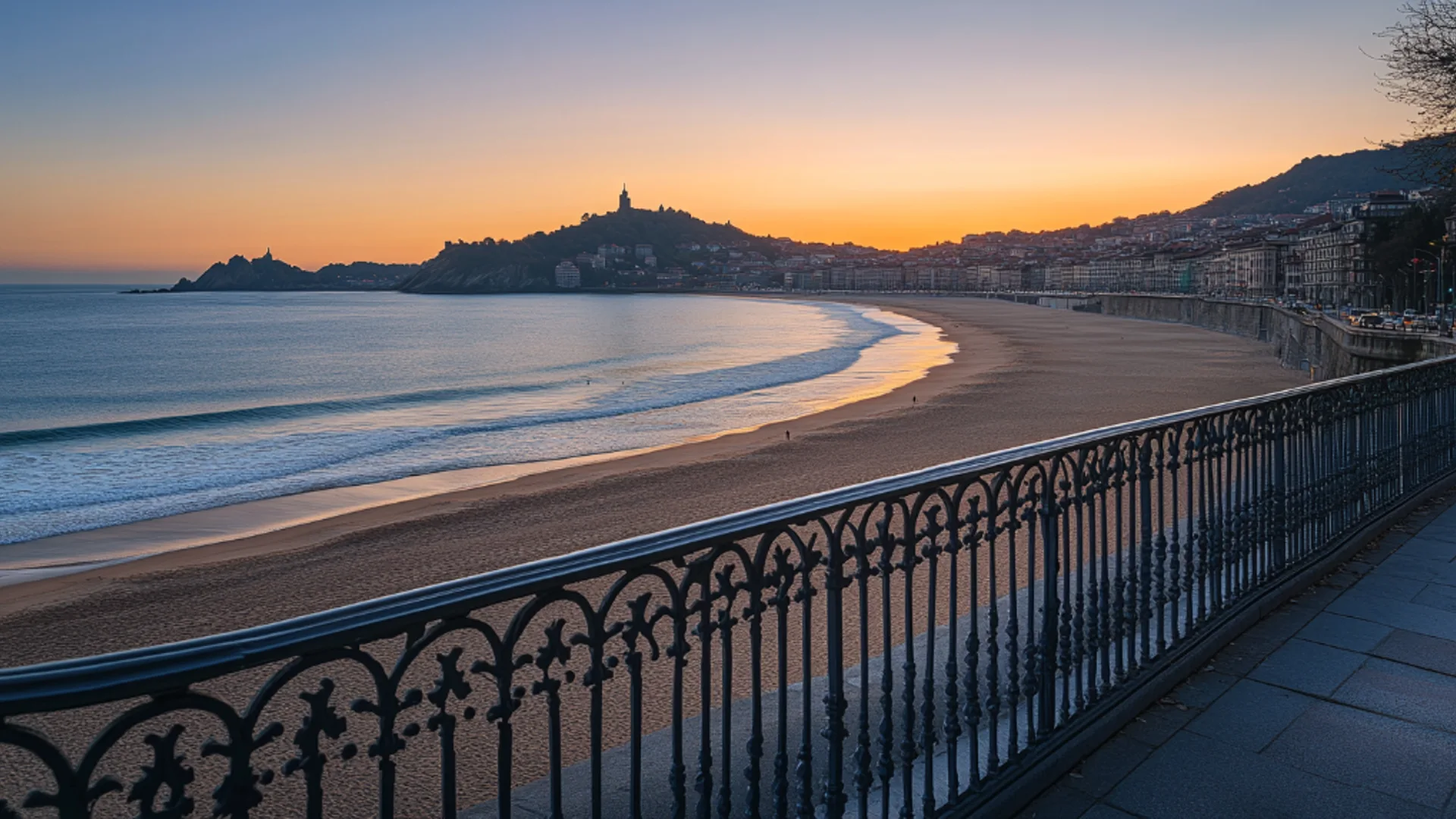
La Concha is not a beach so much as a thesis on beauty. The bay curves in a near-perfect crescent between Monte Urgull to the east and Monte Igueldo to the west, with the small island of Santa Clara sitting in the middle like a period at the center of a sentence. The sand is pale and fine, the water shifts between Atlantic grey and an almost Caribbean turquoise depending on the hour, and the promenade that traces the shoreline — the Paseo de la Concha — is one of the great walks in Europe. Ornate iron railings, Belle Epoque lampposts, and the white balustrade that has appeared in a thousand photographs line the path. In the morning, the beach belongs to swimmers and walkers. By afternoon, families have claimed their patches of sand, and the light begins its long performance: bouncing off the water, catching the facades of the grand hotels along the waterfront, and turning the whole bay into something that feels too composed to be natural but is entirely, stubbornly real.
What makes La Concha extraordinary is not just its shape but its proximity to everything else. You can be eating a pintxo in the old town, cross a street, and have your feet in the sand within ninety seconds. Monte Urgull rises directly behind the Parte Vieja, meaning the beach, the mountain, and the city's densest concentration of food exist in a space you could cover in a fifteen-minute walk. In the evening, the promenade fills with the slow-moving crowd that every Mediterranean and Atlantic coast city produces at dusk — couples, families, elderly men in pressed shirts, teenagers performing indifference. The sun drops behind Igueldo, and the bay holds the afterglow like a bowl of light. People have been comparing La Concha to the Bay of Naples and the Cote d'Azur for over a century, and the comparison is not wrong, but it misses the point. La Concha does not need to be like anywhere else. It is the standard against which other bays quietly measure themselves.
Pintxos and the Crawl
The txikiteo — the ritual pintxos crawl — is the single most important thing you will do in San Sebastian, and getting it right matters. The rules are simple but non-negotiable. You do not sit down and order a meal at one bar. You stand at the counter, eat one or two pintxos, drink a small glass of txakoli or a zurito of beer, and move on. The old town holds more than fifty pintxos bars within a space barely larger than a few football pitches, and the crawl moves through them in a rhythm that feels chaotic but is, for locals, as structured as a symphony. Start on Calle Fermin Calbeton or Calle 31 de Agosto. At Gandarias, take the solomillo — a small steak on bread that has no right to be that good. At La Cuchara de San Telmo, order whatever the chalkboard says: the foie with apple, the slow-cooked cheeks, the risotto of the day. Borda Berri does braised dishes in small cazuelas that redefine what bar food can be. A Fuego Negro plays with modern technique: black cones of squid ink, spherified olives, things that fizz.
The etiquette is its own pleasure. You order at the bar, not at the table. In many places, the cold pintxos are displayed on the counter — skewered on toothpicks, lined up on plates — and you simply point or take. The hot pintxos, which are the ones you want, require ordering and waiting a moment. Keep your toothpicks or your napkin; some bars tally your bill by counting them. Do not linger — the point is movement, the slow migration from bar to bar that turns an evening into a pilgrimage. Two pintxos here, a glass there, then out the door and into the next crowd. By the fourth bar, the rhythm takes hold: the noise, the elbow-to-elbow crush, the bartender who slides your plate across the zinc counter without looking, the friend who insists the next place is better. The txikiteo is not about finding the best bar. It is about the accumulation — the way a dozen small perfections, eaten standing up, add up to the finest meal of your life.
Salt and Fire
The Basque relationship with cooking begins at the source: the fish market, the grill, the salt. The port of San Sebastian still lands catches — smaller now than decades past, but the tradition holds. At the Mercado de la Bretxa, fishmongers lay out hake, sea bream, anchovies, spider crab, and percebes on beds of ice, and the conversations between buyer and seller carry the compressed expertise of generations. The anchovy from the Cantabrian Sea — boquerón in vinegar, anchoa preserved in oil and salt — is a cultural artifact as much as a food. Getaria, thirty minutes down the coast, grills whole turbot over charcoal in a method so simple it feels like a dare: fish, fire, oil, done. In San Sebastian itself, the asadores and parrillas treat meat with the same elemental respect. A txuleta — the massive, dry-aged bone-in rib steak from retired dairy cows — arrives at the table charred on the outside, almost raw at the center, with a depth of flavour that makes you reconsider every steak you have eaten before.
The Basque grill is not barbecue in the American sense; there is no sauce, no rub, no smoke theatre. It is an act of faith in the ingredient. The best asadores — Elkano in Getaria for fish, Bodegon Alejandro or Gandarias in San Sebastian for meat — do almost nothing to the protein except expose it to very high heat and very good timing. This minimalism extends to the whole culinary philosophy. Bacalao al pil-pil achieves its creamy emulsion through nothing but olive oil, garlic, and the collagen of the cod itself, shaken and swirled in the pan until the sauce forms as if by alchemy. Marmitako, the tuna and potato stew of fishermen, needs only good tuna and patience. Basque cooking is not about complexity; it is about the confidence to serve something simple and trust that the quality will speak. When the ingredient is this good, technique is a matter of knowing when to stop.
The Michelin Density
San Sebastian and its immediate surroundings hold more Michelin stars per capita than any other place on earth. This is not a marketing claim; it is a statistical fact that becomes more astonishing the more you consider the scale. The city has roughly 190,000 inhabitants. Within a thirty-kilometre radius sit Arzak, which has held three stars for decades under Juan Mari and now his daughter Elena; Akelarre, Pedro Subijana's clifftop laboratory with views of the Cantabrian Sea that are almost unfair accompaniment to the food; Martin Berasategui, whose restaurant in Lasarte-Oria consistently appears on global best-of lists; and Mugaritz, Andoni Luis Aduriz's conceptual outlier in the hills of Errenteria, where a meal is as much philosophy as sustenance. This is not a coincidence of talent; it is the product of a culture that treats cooking as a high intellectual pursuit, where txoko gastronomic societies have been training passionate amateurs for centuries.
The txokos — private cooking clubs, historically male-only, now gradually opening — are the secret engine of this culture. Members buy ingredients, cook together, eat together, and critique each other with the seriousness of a doctoral defence. A retired bus driver might braise hake cheeks with more skill than a professional chef in another country. This baseline of knowledge and passion means that Michelin-starred restaurants here are not isolated temples; they exist on a continuum that starts with a grandmother's recipe and extends through pintxos bars, asadores, and txokos to the tasting menus of Arzak and Mugaritz. The chefs know each other, trained together, share suppliers. When Arzak invented new Basque cuisine in the 1970s, he did not reject tradition — he electrified it. Every three-star meal in this city carries the ghost of a thousand txoko dinners, and that depth is what you taste.
Txakoli and Sidra
Txakoli is the wine of the Basque coast — light, slightly fizzy, bone-dry, and poured from a height that turns every glass into a small ceremony. The waiter lifts the bottle to shoulder level, sometimes higher, and lets a thin stream of pale green wine arc into a wide glass held at hip height. The pour aerates the wine, releasing its fizz and perfume, and the splash that invariably hits the bar is part of the ritual, not an accident. Txakoli from Getaria, the DO closest to San Sebastian, tastes of green apple, sea air, and something flinty that locals will tell you is the terroir of steep vineyards facing the Cantabrian. It is the only wine that makes sense with a plate of anchovies at two in the afternoon, and it is the default pour at any pintxos bar worth entering. Do not look for depth or complexity in the Burgundian sense; txakoli is about freshness, about the present tense, about a sip that cleans your palate and sends you back to the food.
The cider tradition runs deeper and stranger. The sagardotegiak — cider houses — open from January to April in the hills outside San Sebastian, and the ritual is called txotx. You pay a flat price, sit at long communal tables, and eat a set menu: cod omelette, fried cod with peppers, txuleta, cheese with quince paste and walnuts. The food is secondary to the main event: when someone shouts 'Txotx!', you grab your glass and line up at the enormous kupela barrel, where a stream of cider arcs from a wooden tap into your glass held at knee level. You drink it in a few gulps — the cider is flat, tart, funky, alive — and return to the table until the next shout. The atmosphere is riotous: long tables of friends, cider pooling on stone floors, the air thick with apple and charred meat. It is participatory eating and drinking at its most primal, and it has been happening in these hills for centuries. A sagardotegi evening is not fine dining. It is something older and more honest.
Gros and the Swell
Cross the River Urumea on any of the handsome bridges and you are in Gros, the neighbourhood that the surfers claimed and the rest of the city gradually followed. Zurriola beach faces north and receives the Atlantic swell without the sheltering arms of La Concha's bay, which means the waves are real — head-high on good days, occasionally overhead in autumn storms. The Kursaal auditorium, Rafael Moneo's pair of translucent glass cubes, anchors the eastern end of the beach and catches light like a pair of enormous lanterns at dusk. Between the surf break and the Kursaal, the promenade fills with wetsuit-clad figures carrying boards, joggers, and the particular subset of young Donostiarras who have made Gros their territory. The neighbourhood is less polished than the Centro, more local than the Parte Vieja, and it has the best ratio of excellent pintxos bars to tourist density in the city.
The food in Gros rewards those willing to leave the old town crowds. Topa Sukalderia does small plates with a modern hand — the tuna tataki, the mushroom risotto, things that move beyond traditional pintxos without losing the spirit. Bar Bergara holds its own against any bar in the Parte Vieja, with hot pintxos that arrive freshly made rather than displayed on the counter. Hidalgo 56 serves a txuleta that justifies crossing the river. The wine bars are better here too: less frantic, more conversational, with barkeeps who have time to talk you through a bottle of Rioja Alavesa or a Bizkaiko txakoli you have not tried. After dark, Gros has its own circuit — quieter than the old town, concentrated on Calle Zabaleta and its side streets, with a neighbourhood energy that makes you feel like a local even on your first night. If the Parte Vieja is the performance, Gros is the afterparty where the real conversations happen.
The Parte Vieja After Dark
Something happens to the old town around nine in the evening. The daytime tourists begin to thin, the families retreat, and the bars that seemed busy at seven become genuinely packed. The streets narrow to the point where you can hear laughter from three bars simultaneously, and the crowd shifts to locals — couples in their thirties, groups of friends who have been doing this circuit since university, the older generation who treat the Thursday crawl as sacred. The pintxos change too: the cold displays get replenished with evening specials, the hot kitchens hit full stride, and the chalkboards update with whatever arrived at the market that afternoon. La Vina, on Calle 31 de Agosto, serves its legendary tarta de queso — a Basque burnt cheesecake so good it spawned a global trend — and you eat it standing at the bar, the custard-soft centre collapsing under your fork while the noise of the street pours through the open door.
The night deepens but does not quieten. By eleven, the pintxos crawl transitions seamlessly into drinking, and the bars that served food shift their emphasis to gin-tonics — the Basque Country has embraced the gin and tonic with a seriousness that borders on devotion, served in balloon glasses with botanical garnishes and premium tonic. The streets between Plaza de la Constitucion and the port become a river of moving people, and the air fills with overlapping conversations in Euskara and Castellano. There is no single destination; the movement is the point. You might end at a small bar tucked behind Santa Maria basilica where someone is playing guitar, or in the warren of streets near the port where the bars stay open until the crowd decides to go home. The Parte Vieja does not close at a fixed hour — it fades, reluctantly, as the last clusters of friends finally break apart and wander through the empty streets toward their beds, the sound of their footsteps echoing off the stone facades.
Film and Festival
Every September, San Sebastian transforms. The Zinemaldia — the San Sebastian International Film Festival — has been running since 1953, making it one of Europe's oldest and most prestigious, and its arrival rewires the city's social circuitry. The Hotel Maria Cristina, that wedding cake of Belle Epoque grandeur on the banks of the Urumea, becomes the nerve centre: directors, actors, critics, and press fill its lobby, and the red carpet unfurls from its front door to the Victoria Eugenia theatre across the river. The Kursaal in Gros hosts the main screenings, its cavernous interiors filling with audiences who applaud and boo with Basque directness. Films screen across multiple venues — the historic Principe cinema, the Teatro Victoria Eugenia, smaller halls in the old town — and the city's restaurants reconfigure their reservations around the festival schedule.
What makes Zinemaldia distinct from Cannes or Venice is its accessibility. This is not a fortress of exclusivity; ordinary citizens buy tickets, attend screenings, and share bars with the industry. The festival's Concha de Oro — its top prize — carries real weight in the film world, and the programming balances Hollywood premieres with Basque and Spanish cinema, Latin American voices, Asian auteurs, and the kind of challenging work that major festivals sometimes sideline. For a visitor, September means higher hotel prices but also a city operating at peak cultural intensity: outdoor screenings in the Kursaal plaza, pop-up bars, discussions in cafes where someone at the next table is quietly rewriting a screenplay. The film festival is not an imposition on San Sebastian's identity; it is an expression of a city that has always believed culture is something you participate in, not something you observe from a distance.
Mountains Behind the Beach
The defining trick of San Sebastian's geography is that wildness is always at your back. From any bar in the Parte Vieja, you can look up and see the green shoulder of Monte Urgull. The climb takes fifteen minutes — a stone path winding through old fortifications, past cannon emplacements and crumbling walls, through dappled woodland — and delivers you to the Cristo de la Mota statue and a panoramic view that puts the entire bay at your feet. La Concha curves below, Igueldo rises to the west, the island of Santa Clara sits in the water like a green coin, and the city arranges itself in miniature. It is the single best free experience in San Sebastian, and in the morning, you will share the paths with joggers and dog walkers rather than tourists. Urgull is not a mountain in the alpine sense — it barely clears a hundred metres — but its position, rising directly from the old town, makes it feel like a wilderness embedded in the city's heart.
Monte Igueldo, on the western end of the bay, offers the postcard view and comes with a funicular that has been climbing the slope since 1912. At the summit sits a small amusement park of genuine vintage — the kind with creaking rides, a photo opportunity tower, and a charm that modern theme parks have been engineered to eliminate. The view from the top is the one you will see on every poster: the full sweep of La Concha, the city stacked along the shore, the green hills rising behind. Between the two mountains, the coastal path to Monte Ulia heads east from Gros along the cliffs, passing through native forest and emerging at viewpoints where the Cantabrian Sea crashes against rock with theatrical force. All three walks are achievable in a morning, and they fundamentally alter your understanding of the city. San Sebastian is not just a beach town or a food capital; it is a place where the wild Atlantic and green Basque hills press against the urban edges, and a pintxo is never more than twenty minutes from a mountain path.
Euskara and Identity
You will hear Basque before you understand what you are hearing. In a pintxos bar, in the street, on the radio drifting from a shop doorway — Euskara, the oldest living language in Europe, with no proven connection to any other language family on earth. Street signs are bilingual or Basque-only: Donostia alongside San Sebastian, kalea instead of calle, jatetxea for restaurant. The language is not decorative; it is structural, an assertion of identity that survived Franco's prohibition, emerged from clandestinity, and is now taught in ikastolak schools, spoken by the young, and used in official business. Roughly a third of Gipuzkoa's population speaks Euskara fluently, and in San Sebastian the proportion is growing. When a waiter greets you with 'Kaixo' instead of 'Hola', it is not a performance for tourists — it is the natural register of a city that lives in two languages simultaneously.
Basque identity extends beyond language into a way of being that shapes everything from politics to gastronomy. The txokos, the Athletic Club loyalty, the cider houses, the pelota courts, the herri kirolak traditional sports — these are not folklore preserved for cameras; they are living practices. The political dimension is complex and deeply felt: decades of conflict have left marks that the visitor should approach with respect and curiosity rather than casual inquiry. What you will notice is a fierce localism — a pride in doing things the Basque way, a preference for local products, a quiet resistance to homogenization. The restaurants source from Basque farmers. The wine is Basque. The language on the menu is Basque. This is not nationalism in the ugly sense; it is the insistence of a culture that has existed for millennia on continuing to exist on its own terms. Understanding this context transforms your visit from tourism into something approaching encounter.
Markets and Morning Ritual
The Mercado de la Bretxa sits on the edge of the old town in a building that combines a modern supermarket above with a traditional food hall below, and it is the lower level that matters. Fishmongers in rubber boots arrange the morning's catch with the precision of jewellers: whole sea bass with eyes still clear, trays of glistening anchovies, spider crabs the colour of rust, percebes that look alien and taste of concentrated ocean. The cheese stalls carry Idiazabal — the smoky, firm sheep's cheese of the Basque highlands — in wheels of varying age, and the vendor will cut you a sliver before you buy. Produce stalls stack Gernika peppers, fat tomatoes, white asparagus in season, and the tiny guindilla peppers that arrive pickled in every pintxos bar. The market is not a tourist attraction dressed up as authenticity; it is where cooks buy their mise en place, where the day's menus are determined by what the sea and the hills have offered.
Morning in San Sebastian starts with coffee — cortado or cafe con leche — taken standing at a bar counter with a piece of tortilla or a croissant. The city does not do elaborate breakfast; the morning meal is functional, a staging ground for the real eating that begins at one. But the cafe ritual matters: the hiss of the espresso machine, the morning paper, the brief conversation with the barista who already knows your order if you have been in twice. By ten, the Bretxa is in full swing, the fish auction at the port has concluded, and the old town's kitchens are beginning their prep. The smell of olive oil heating in pans drifts from open kitchen windows, and the first pintxos bars start setting their counters for the lunch crowd. San Sebastian does not rush its mornings. The city understands that the hours before eating are part of eating — the anticipation, the preparation, the slow assembly of ingredients that will become, by noon, reason enough to be alive.
Day Trips
Getaria is thirty minutes west on the coast road and it contains, in a small fishing village of barely three thousand people, one of the best restaurants on the planet. Elkano grills whole turbot over charcoal with a technique that has not changed in decades, and the result — the skin blistered and crisp, the flesh falling from the bone in clean white sheets, the flavour tasting of nothing but itself and the sea — is worth organising a trip around. The village itself climbs a hill to the church of San Salvador, and the harbour smells of salt and engine oil, and the txakoli vineyards cling to the slopes above town. Zarautz, a few kilometres further, has a long beach popular with surfers and a handful of serious restaurants. Hondarribia, in the other direction toward the French border, is perhaps the most beautiful small town on the Basque coast: a walled old quarter of painted wooden balconies, a fishing port, and Alameda, a Michelin-starred restaurant in a former powder magazine that handles local ingredients with extraordinary precision.
The French border is close enough for lunch. Bayonne and Biarritz sit just across, and the cultural shift is gentler than you might expect — the Basque identity bridges the frontier, and you will find pintxos and txakoli on the French side too. Inland, the txakoli vineyards of Getaria and the rolling green hills of rural Gipuzkoa offer drives that feel like entering a different century: stone farmhouses, sheep on hillsides, small towns where the fronton court is the centre of civic life. The Basque coast between San Sebastian and Bilbao is one of Europe's great drives — cliffside roads, hidden coves, fishing villages that have not yet been discovered by the tour bus circuit. A car gives you the coast; the train gives you Bilbao and the Guggenheim in under an hour. But the finest day trip requires nothing more than the bus to Astigarraga and an evening in a sagardotegi, eating txuleta and catching cider from the barrel until you forget that cities exist.
Rain and Green
San Sebastian gets more rain than London. This is not a warning; it is a key to understanding the city. The green hills that make the landscape so beautiful are green because water falls on them regularly, and the culture that makes the food so extraordinary developed partly because people needed excellent reasons to be indoors. The pintxos bar is, among other things, a shelter — a warm, bright, noisy shelter where the rain on the cobblestones outside becomes atmosphere rather than inconvenience. The cider houses exist because apples thrive in this climate. The txokos function partly as winter refuges where friends cook and eat and wait out the Atlantic weather systems that roll in from the northwest. Rain in San Sebastian is not an interruption of the experience; it is the condition that produced it. The city smells different in the rain — stone and salt and the particular green of wet eucalyptus drifting down from the hillsides.
The practical advice is simple: bring a jacket, expect showers, and do not let them alter your plans. The rain here tends to arrive in bursts rather than all-day grey, and the sky clears with a speed that can be almost comical — one moment you are sheltering in a doorway, the next the sun is out and the wet streets are throwing light in every direction. Summer is the driest season, but even July and August get their share. The upside is that San Sebastian never feels parched or dusty the way southern Spanish cities can, and the temperature stays mild year-round — warm enough for the beach in summer, cool enough for a jacket in winter, and always with that Atlantic freshness that makes the air feel like it has been recently laundered. The green hills visible from every vantage point are the city's constant backdrop, and they would not exist without the rain. Accept the weather. Embrace the bars. Understand that the rain and the food are not separate stories — they are the same story, told in water and olive oil.
Agur, for Now
Agur is the Basque goodbye, and it carries a warmth that 'adios' does not quite match. Leaving San Sebastian produces a specific kind of ache — not the sadness of leaving a beautiful place, which fades, but the nagging certainty that you did not eat enough. There was that bar someone mentioned on your last night that you did not reach. There is the cider house season you missed by three weeks. There is the whole question of Mugaritz, which you decided was too experimental and which you now, on the plane home, desperately wish you had tried. The city does this to everyone. It is too small to feel overwhelming and too deep to feel finished. You could spend a week eating two pintxos at every bar in the old town and still not complete the circuit, because three new bars would have opened and two would have changed their menus.
What you take home is not just memory but recalibration. Your standards for seafood have permanently shifted. You now know what a txuleta should taste like, and the steakhouse near your home will never quite recover from the comparison. You pour wine from a height without thinking about it. You look for that particular density of culinary excellence — the fifty-bar crawl, the three-star restaurant twenty minutes from a cider house, the market where the anchovies were swimming that morning — and you do not find it, because it does not exist anywhere else at this scale. San Sebastian is not the best food city in the world by default; it earned the title through centuries of obsession, and that obsession is contagious. You will go back. Everyone goes back. Agur, Donostia — but only for now.