The Market as Foundation
Everything in Mexico City's kitchen begins at the mercado, and if you do not understand this you will not understand the food. The Mercado de la Merced — the largest market in the Americas, a sprawling labyrinth of stalls covering an area that would swallow several European city blocks — is where the supply chain becomes visible: mountains of dried chiles organized by variety and heat (ancho, guajillo, pasilla, chipotle, morita, arbol, habanero), their colors running from blood-red to nearly black; produce stalls where nopales (cactus paddles) are trimmed of their spines while you wait; herb vendors selling epazote, hoja santa, and papalo in bundles that perfume an entire aisle. The market operates on a logic that predates refrigeration — freshness is assumed, not advertised, and the relationship between vendor and buyer is built on decades of daily transactions. The woman who sells you tomatoes at La Merced sold tomatoes to your mother, and her mother sold to your grandmother.
The mercado-to-table tradition is not a concept or a movement in CDMX — it is the default. Restaurants like Maximo Bistrot build their entire operation around a morning market run, the menu composed after the chef sees what arrived, the dishes changing daily because the produce changed daily. Even the taco stands operate on this principle: the al pastor meat is prepared that morning, the salsa is made fresh, the tortillas are pressed and cooked to order. The industrial food chain that dominates eating in most global cities has not displaced the market system in Mexico City because the market system produces better results and everyone knows it. When Enrique Olvera at Pujol sources native corn from small producers or Elena Reygadas at Rosetta builds her bread program around heritage grains, they are not innovating — they are continuing a tradition that begins with a vendor at a stall in a market that opens before dawn.
The neighborhood mercados — Mercado Roma (the gentrified food hall version), Mercado Medellin (Colombian, Cuban, and Caribbean ingredients alongside Mexican staples), Mercado de Coyoacan (tostadas and traditional sweets) — each have their own character and clientele. But the essential visit is to a traditional working market, not a curated one. Mercado de la Merced, Mercado de Jamaica (the flower market, which is also a food market of extraordinary range), or the Mercado de San Juan (where chefs and restaurants source exotic proteins and imported ingredients). Walk through without a plan, eat what the vendors offer, and understand that this is not the supply chain supporting the restaurants — it is the culture the restaurants are built upon.
Pre-Hispanic Ingredients, Living
Huitlacoche — the blue-black corn fungus that grows on rain-soaked maize ears — is the ingredient that most efficiently separates those who understand Mexican food from those who do not. To European and American palates trained to reject fungal infection, huitlacoche looks diseased. To Mexican cooks, it is the truffle of the Americas: earthy, inky, with a mushroom-corn complexity that elevates quesadillas, tamales, and sauces into something that no other cuisine can replicate. The fact that huitlacoche has been eaten in Mesoamerica for millennia while European colonizers attempted to eradicate it as crop disease tells you everything about whose culinary intelligence was more sophisticated. At Quintonil, it appears in refined preparations; at a market stall, it fills a blue corn quesadilla. Both applications are equally valid.
The pre-Hispanic pantry is not a museum exhibit in Mexico City — it is the living, daily vocabulary of cooking. Chapulines (grasshoppers, toasted with chile and lime) are the bar snack that accompanies mezcal in oaxaqueno-influenced bars across Roma and Condesa. Escamoles (ant larvae, sometimes called Mexican caviar) appear at Pujol and Quintonil as luxury preparations, but they have been harvested from maguey roots in the central highlands for centuries. Epazote — the herb with an aggressive, almost medicinal flavor — is indispensable in black beans and quesadillas, and its absence is immediately detectable to any Mexican palate. The chile system alone constitutes an encyclopedia: anchos for sweetness and depth, guajillos for brightness, chipotles for smoke, arboles for direct heat, habaneros for floral fire, each with a specific culinary function that has been refined over thousands of years of use.
What makes CDMX unique among global food cities is that these ingredients are not revival projects or nostalgic gestures — they never disappeared. The colonization disrupted many things, but it did not displace the corn, the chile, the cacao, the maguey, or the techniques that transform them. When Xaman Bar builds cocktails from cacao and nixtamalized corn, or when a market vendor grinds fresh masa on a metate, they are using ingredients and methods with an unbroken lineage that extends centuries before European contact. The contemporary restaurant scene has elevated these ingredients into forms that attract international recognition, but the grandmother making tamales de rajas in her kitchen was using them all along, without the recognition and without needing it.
The Cantina as Democratic Institution
The cantina operates on a social contract so radical it barely exists anywhere else in the world's drinking cultures: you order a drink, and the kitchen feeds you for free. The botanas tradition — small plates of chicharron in salsa verde, tostadas with tuna, consomme, pickled vegetables, sometimes a full plate of rice and beans — arrives automatically with each round, unbidden, unasked, a system that predates the Spanish tapas revival by decades and operates on the assumption that drinking without eating is uncivilized. At Cantina La Mascota, which has been running this contract since 1932, the tiles on the floor are original, the neon signs advertise beer brands that no longer exist, and the tables hold businessmen in suits beside construction workers in boots, all eating from the same botanas kitchen, all drinking the same cold Victoria.
The cantina was legally a male-only institution until 1982 — a fact that explains both the culture's particular energy and its ongoing transformation. The old cantinas in Centro Historico — La Mascota, Salon Corona, the cantinas around Garibaldi — retain the masculine democratic spirit while slowly opening to a broader clientele. The modern cantinas in Roma and Condesa — La Bipo, and their proliferating imitators — translate the botanas tradition for a generation that expects women at every table and mezcal alongside the beer. But the essential proposition has not changed: the cantina is the room where social class dissolves, where the only hierarchy is between people who have ordered a drink and people who have not, and where the kitchen feeds everyone equally regardless of what they are wearing or what they do for a living.
Salon Corona, operating since 1928, distills the cantina to its most elemental form: cold draft beer in a frosted mug, a torta de jamon on a white plate, fluorescent lighting, and a room full of people who have nothing in common except thirst and hunger and the particular contentment that comes from both being satisfied cheaply and simultaneously. There is no cocktail menu, no wine list, no tasting notes, no Instagram moment. The torta costs less than a dollar. The beer costs about the same. The room is loud with the sound of conversation — real conversation, not performed — and the light is terrible and the furniture is old and none of it matters because the cantina exists not to be experienced but to be inhabited, daily, as a fact of urban life rather than an occasion.
Mezcal as Philosophy
Mezcal is not tequila's smoky cousin, and the fact that this sentence needs to be written is evidence of how badly the spirit has been marketed outside Mexico. Tequila is a subcategory of mezcal — made exclusively from blue agave in a defined region — while mezcal encompasses any spirit distilled from agave, of which there are over forty varieties used in production, each with a distinct flavor profile shaped by the species, the soil, the altitude, the climate, and the decisions of the palenquero (the mezcal maker). A tobala mezcal from the mountains of Oaxaca and a tepextate from the coastal lowlands are as different as a Burgundy and a Barossa shiraz, and the complexity — fruity, herbal, mineral, smoky, floral — makes mezcal one of the most terroir-expressive spirits in the world.
La Clandestina, the Condesa mezcaleria that helped launch CDMX's modern mezcal culture, treats each bottle as the product of a specific person in a specific place. The palenqueros whose names appear on the labels are not corporate brands but individual craftspeople, often working with wild agave that took fifteen to thirty years to mature before harvest. The roasting of the agave hearts in underground pits, the crushing by horse-drawn stone wheel or hand-wielded mallet, the fermentation in open wooden vats exposed to wild yeasts, the double distillation in copper or clay stills — each step is a decision that shapes the final spirit. The industrialization that transformed tequila into a global commodity threatens mezcal through the same mechanisms: increased demand encourages shortcuts, wild agave species become overharvested, and the market incentivizes volume over craft.
Drinking mezcal in CDMX is, at its best, an act of terroir appreciation as deliberate as any wine tasting — the orange slice and sal de gusano (worm salt) that accompany each pour are palate cleansers, not garnishes, and the practice of sipping slowly while conversing is the traditional format. The bars that understand this — La Clandestina, Bosforo, the mezcal programs at Departamento and Bar Montejo — present the spirit with the respect it earns. The bars that do not — serving mezcal in cocktails so sweet the agave disappears, or pouring industrial espadin as if all mezcal were interchangeable — miss the point entirely. The best mezcal you will drink in Mexico City will taste like a place you have never been, made by a person you will never meet, from a plant that grew on a hillside for a generation. That is not marketing. That is the literal truth of the spirit.
Roma and Condesa: Neighborhoods as Lifestyle
Roma Norte and Condesa occupy adjacent colonias west of the Centro Historico, divided by Avenida Insurgentes and united by the particular lifestyle they have generated: tree-canopied streets, art deco and Porfirian architecture, sidewalk cafes, specialty coffee, mezcal bars, restaurants that range from world-ranked fine dining to exceptional taco stands, and a creative-class population that treats the neighborhood as both home and stage. The transformation from earthquake-damaged residential neighborhoods (the 1985 quake devastated both colonias) to CDMX's most desirable addresses happened over two decades and accelerated after 2010, driven by the same forces that transformed Williamsburg, Kreuzberg, and Shoreditch: cheap rent in beautiful buildings attracting artists and chefs, followed by the restaurants and bars, followed by the international attention, followed by the rent increases that threaten the ecosystem that created the appeal.
The distinction between the two neighborhoods is real but subtle. Roma Norte is denser, louder, more gastronomic — Contramar, Rosetta, Maximo Bistrot, Licoreria Limantour, and the taco stands of Alvaro Obregon and Orizaba establish a restaurant concentration that rivals any neighborhood on earth. Condesa is greener, quieter, more residential — Parque Mexico and Parque Espana provide the green center, Avenida Amsterdam's oval running path traces the old horse-racing track, and the brunch culture (adopted from California, adapted to Mexican ingredients) has become its own institution. The art nouveau apartment buildings of Condesa, with their curved facades and ornamental ironwork, give the neighborhood a European grace that Roma's more eclectic Porfirian mansions do not attempt.
The gentrification conversation is unavoidable and honest residents acknowledge it. The digital nomads and remote workers who arrived during and after the pandemic — drawn by the favorable peso exchange rate, the excellent wifi, and the lifestyle — have accelerated a rent increase that displaces the Mexican middle class that built these neighborhoods' culture. A coffee that costs 80 MXN is cheap for someone earning dollars; it is expensive for someone earning pesos. The restaurants that made Roma famous employed chefs and servers who could afford to live in the neighborhood; increasingly, they cannot. This tension does not diminish the neighborhoods' excellence — it contextualizes it, and the visitor who enjoys Roma's restaurants without acknowledging the economic dynamics beneath them is enjoying only half the story.
Despite the tensions, the Roma-Condesa axis remains the most rewarding neighborhood experience in the Americas for the food-driven traveler. The density of excellent eating within a thirty-minute walk — from Pujol-level fine dining to thirty-peso street tacos, from specialty pour-over coffee to ancient pulque, from Italian-Mexican fusion to pure pre-Hispanic ingredients — is unmatched. The architecture rewards aimless walking. The parks reward sitting. The bars reward staying late. And the morning after, Cafe El Jarocho or Buna or Almanegra will be there to start the cycle again.
The Taco Taxonomy
The taco is not a single food — it is a format, and the variations across Mexico City alone constitute an encyclopedia. Tacos al pastor — the marinated pork cooked on a vertical trompo (spit), descended from Lebanese shawarma brought by immigrants in the early twentieth century, served with pineapple, cilantro, and onion on a small corn tortilla — is the city's signature and its most visible street food. The trompo is the beacon: if you see the rotating cone of meat beside a gas flame, the taquero shaving thin slices with a long knife, you stop. El Huequito, which claims to be one of the originators, has been running this operation since 1959, and the precision of the cut — meat thin enough to be translucent, pineapple flicked from the crown of the spit — is a culinary skill that takes years to master.
Suadero — beef brisket slow-cooked until it can be shredded, then crisped on a flat plancha until the edges caramelize — is the taco of the late-night stands, the post-midnight fuel of taxi drivers and the after-hours crowd. El Vilsito, the mechanic-shop-turned-taqueria in Narvarte, serves the definitive version: the suadero arrives on a doubled tortilla, glistening with rendered fat, the exterior crisp and the interior melting. Tacos de canasta (basket tacos) are the breakfast and mid-morning option — soft tortillas steamed in a cloth-lined basket, filled with chicharron, beans, potato, or mole, sold from bicycle-mounted baskets by vendors who circulate through office districts and markets. Carnitas — whole-pig cookery, the pork braised in its own fat until every piece from snout to rib can be ordered separately — come from Michoacan but find their CDMX expression at weekend markets and dedicated carnitas stands.
The taxonomy extends further: tacos de guisado (stew tacos, where the filling is a home-style preparation like tinga, rajas, or picadillo, served from steaming cazuelas behind a counter), tacos de barbacoa (lamb or goat slow-cooked in maguey leaves, traditionally in an underground pit, served on weekends with consomme on the side), tacos arabes (another Lebanese-influenced variant, using a flour-based pita-like bread instead of corn tortilla, specific to Puebla but available in CDMX). The corn tortilla itself varies by region and vendor — some use blue corn, some white, some yellow; some press thick, some thin; some cook on a comal (griddle), some on a clay surface. The taco is infinite in its variations and specific in each execution, and the visitor who says they have 'had tacos' after eating at a single stand has barely opened the first page.
The Michelin Bib Gourmand awarded to El Califa de Leon — a taco counter, not a restaurant — represents the global recognition of what CDMX residents have always known: that the taco at its best is not street food in the dismissive sense but rather one of the most refined food formats in the world, requiring precision, quality ingredients, and years of technique to execute at the highest level. The difference between a good taco al pastor and a great one is as significant as the difference between good and great sushi, and the taquero who has spent twenty years at the trompo has invested the same dedication as any fine-dining chef. The taco is democratic in price and access, and aristocratic in the skill required to make it sing.
Altitude and Light
Mexico City sits at 2,240 meters above sea level — higher than Denver, higher than Bogota, higher than any European capital — and the altitude shapes everything from how your lungs feel on the first morning to how the light falls on the Zocalo at four in the afternoon. The air is thinner, which means the sun is stronger, the shadows are darker, the sky is a deeper blue than any sea-level city can produce, and the golden hour lasts longer and burns more intensely. The muralists understood this: Diego Rivera and Jose Clemente Orozco painted for walls lit by high-altitude light, and their color choices — the saturated blues, the burning oranges, the blood reds — make full sense only when you see them in the light they were designed for.
The altitude also shapes the food in ways most visitors do not consider. Water boils at a lower temperature, which affects cooking times and textures. Bread rises differently, which is one reason Mexico's pan dulce tradition developed its particular character — the conchas, the cuernos, the polvorones that fill every panaderia are products of a baking tradition calibrated to altitude. The fermentation of pulque and the production of mezcal both respond to the altitude and temperature of the central highlands. Even the chile — the foundational ingredient of Mexican cuisine — expresses differently at altitude than at sea level, the capsaicin hitting your palate with a sharpness that the humid lowland versions lack. The lightness of a CDMX morning, when the sun cuts through air that is clean and thin and impossibly bright, is an altitude experience as much as a visual one.
Visitors feel the altitude physically and should not pretend otherwise. The shortness of breath on the first day is real — climbing the Pyramid of the Sun at Teotihuacan will humble a marathon runner who has not acclimatized. Alcohol hits harder and faster at 2,240 meters, which is worth knowing before your second mezcal. Dehydration accelerates. Sleep may be disrupted the first night. The practical response is simple: drink water aggressively, go easy on alcohol for the first 24 hours, take the stairs slowly, and accept that the city will ask more of your body than you expected. By the third day, your lungs adjust, and the light that seemed merely bright on arrival reveals itself as the defining quality of the city — the reason the architecture looks the way it does, the reason the murals use the colors they do, the reason the golden hour over the Zocalo stops you mid-step and makes you look up.
The Palimpsest City
Mexico City is built on top of Mexico City, which is built on top of Mexico City. The Metropolitan Cathedral on the Zocalo — a massive colonial structure that took 240 years to complete — sits directly on the foundations of the Aztec Templo Mayor, which itself was built in successive layers over two centuries, each emperor adding a new facade over the previous one like Russian nesting dolls of sacred architecture. When electrical workers in 1978 struck the eight-ton stone disc of the goddess Coyolxauhqui beneath a downtown street, the excavation that followed revealed not just a temple but a principle: that this city has always been built on top of its own past, each civilization using the stones and the soil of the previous one as its foundation.
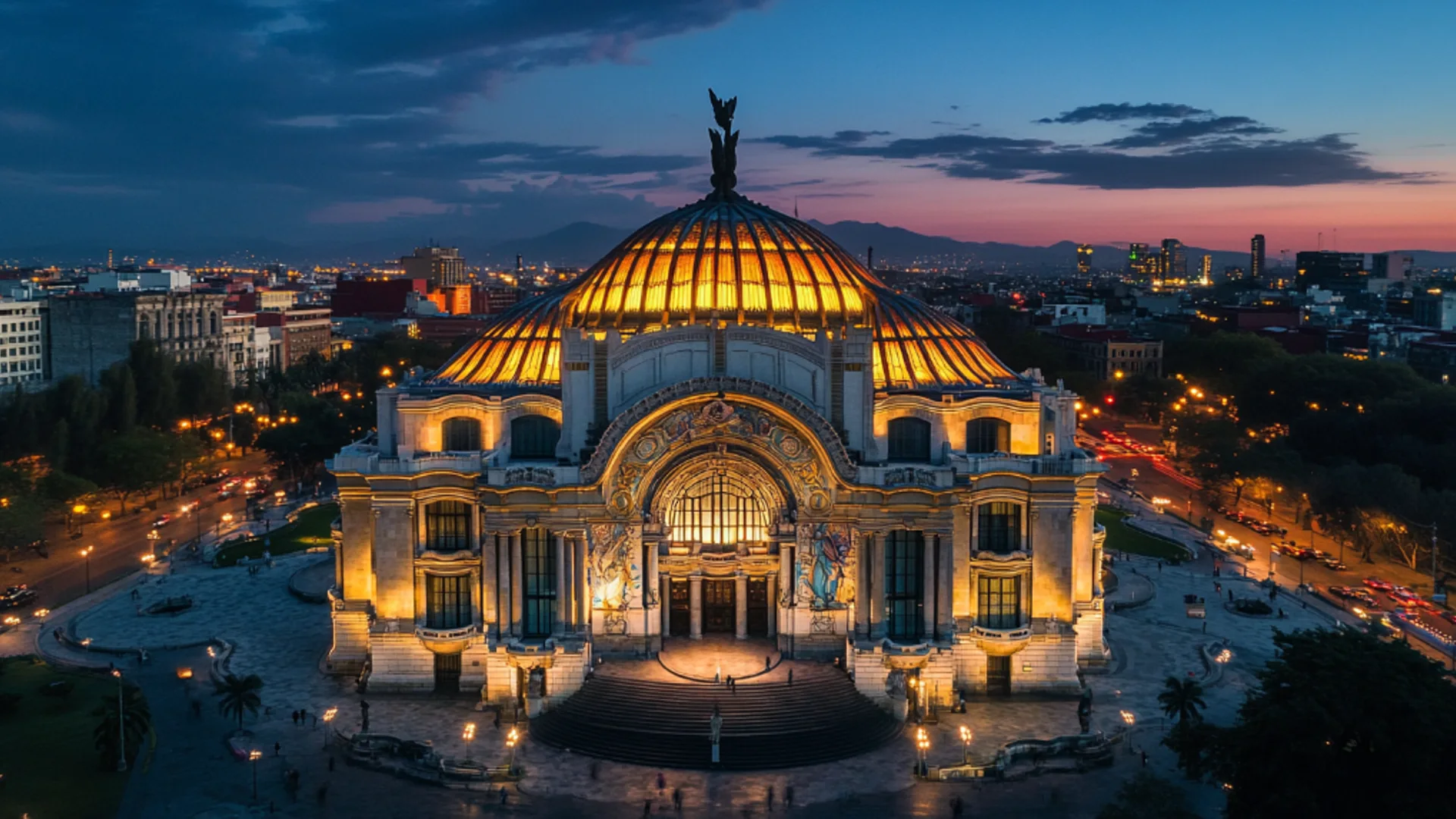
The layers are visible if you know where to look. The tilting of the Metropolitan Cathedral — visibly off-vertical, one side sinking faster than the other — is caused by the soft clay of the drained lakebed, which is itself the evidence that the Spanish destroyed the Aztec lake system and built their colonial capital on the resulting mud. The Palacio de Bellas Artes has sunk over a meter since construction began in 1904, for the same reason. The entire Centro Historico is slowly subsiding, and the periodic earthquakes — 1985, 2017 — accelerate the process, revealing Aztec foundations beneath collapsed colonial buildings, the past literally rising through the present. The archaeologists who work beneath the Zocalo describe their excavations in temporal layers: colonial rubble, then Aztec ceremonial offerings, then earlier construction phases, then the lake sediment itself.
This palimpsest extends beyond architecture into culture. The Day of the Dead is a pre-Hispanic practice absorbed into Catholic ritual — the altars with their marigolds, sugar skulls, and offerings of food and mezcal for the departed are indigenous traditions that the Church could not eliminate and eventually integrated. The corn tortilla you eat at any taco stand is made from nixtamalized maize using a process developed in Mesoamerica over three thousand years ago. The Virgin of Guadalupe — the patron saint of Mexico, whose basilica draws more pilgrims than any Catholic site except the Vatican — appeared on the hill of Tepeyac, which was previously the site of a temple to the Aztec mother goddess Tonantzin. Layer upon layer, the new absorbing the old, the old surfacing through the new, the city unable to erase its past because the past is literally the ground it stands on.
Street Food as Serious Cuisine
When Michelin arrived in Mexico City in 2024, it did something the guide has almost never done elsewhere: it awarded recognition to a taco stand. El Califa de Leon, a counter with a plancha and a queue, received a Bib Gourmand, which in any other city would go to a bistrot or a trattoria. The award was not charity or publicity — it was an acknowledgment of what Mexican food culture has always known and what the global culinary establishment was slow to recognize: that a tortilla, a piece of perfectly grilled meat, and a salsa made from freshly roasted chiles can constitute a dish of genuine sophistication, prepared with a technique refined over decades, and that the absence of walls, tablecloths, and a wine list does not diminish the craft.
The street food economy of CDMX operates on a scale and a quality level that no other city approaches. The estimate is over 100,000 street food vendors in the metropolitan area, each specializing in a narrow range of preparations — the al pastor taquero who has spent twenty years at the trompo, the tamale vendor who starts steaming at 5am, the elote (corn) man who roasts and dresses cobs at the Metro exit, the basket-taco cyclist who circulates a fixed route each morning. The specialization is the key: these are not generalist cooks but experts in a single format, and the repetition produces a precision that culinary school cannot teach. The woman making tlacoyos (thick corn cakes stuffed with beans, topped with nopales and cheese) at a market stall has made fifty thousand of them, and her hands know the exact thickness, the exact amount of filling, the exact time on the comal.
The serious food traveler in CDMX must therefore abandon the hierarchy that places restaurant above street, table above counter, menu above taquero's verbal list. The best taco you will eat may cost twenty pesos and be served on a paper plate. The best tamale may come from a steaming basket at a Metro station at 7am. The best elote may be the one roasted on charcoal by a vendor outside the Anthropology Museum. These are not lesser experiences than Pujol or Quintonil — they are parallel experiences, part of the same food culture, separated by price and format but not by craft or seriousness. The city's genius is that it sustains both without asking you to choose, and the ideal day of eating in CDMX moves between them freely: Contramar for lunch, a street taco at four, Handshake for cocktails, El Vilsito at midnight.
Celluloid and Silver
Mexico City's relationship with cinema runs deeper than most visitors expect. Cineteca Nacional in Xoco is one of the most important film institutions in Latin America — a multi-screen complex with an outdoor amphitheatre, a national archive, and programming that treats Mexican and international cinema with equal rigour. The original Cineteca burned in 1982, destroying a significant portion of Mexico's film archive — the rebuilt institution carries that loss as a mandate, screening and preserving with the intensity of a culture that knows what it almost lost. Filmoteca UNAM extends the archive onto the UNESCO-listed university campus, where screenings are often free and the audience is a mix of film students and cinephiles who treat the programme as an extension of their education. Between the two institutions, Mexico City sustains a film culture that honours its golden-age heritage (Buñuel made his greatest films here; the golden-age melodramas of the 1940s and 1950s are foundational Mexican culture) while giving space to the contemporary voices — Cuarón, del Toro, Iñárritu, Lucrecia Martel — who emerged from these screening rooms.
The neighbourhood cinemas tell another story. San Rafael's art deco movie palaces — the Cine Opera, the Cine Cosmos — are architectural monuments of a mid-century entertainment district that once rivalled any in the Americas. Some have been restored, others crumble, and the contrast between the two states mirrors CDMX itself: a city that builds on top of its own past, sometimes preserving, sometimes forgetting, always layering. A screening at the Cineteca on a weekday afternoon — the programme dense, the tickets almost free, the audience attentive and argumentative — is as essential a Mexico City cultural experience as the murals or the markets. The darkness of the screening room and the darkness of the pre-Hispanic obsidian share something: both are surfaces on which the city projects its understanding of itself.
Frida, Diego, and the Mural as Public Art
The Mexican muralist movement — Diego Rivera, Jose Clemente Orozco, David Alfaro Siqueiros, and the dozens of painters who followed them — represents the most ambitious public art program of the twentieth century: the deliberate decision, supported by the post-revolutionary government, to place art on the walls of public buildings where anyone could see it, free of charge, as a democratic act that rejected the gallery and the private collection as the proper home for serious painting. The murals in the National Palace, in the Palacio de Bellas Artes, in the Secretaria de Educacion Publica, in the UNAM campus, in hospitals and markets and government offices across the country — these are not decorations. They are arguments, painted in fresco on wet plaster by artists who believed that art belonged to the people and that the wall of a public building was a more legitimate canvas than any museum.
Rivera's mural on the grand staircase of the National Palace — a sweeping narrative of Mexican history from the Aztec marketplace to the industrial present — is the single most ambitious work of public art in the Americas. It took Rivera years to complete, and the detail is encyclopedic: specific historical figures, specific battles, specific injustices, the history of a nation rendered in paint at a scale that demands you stand at the bottom of the staircase and look up, neck craning, as the story ascends around you. Orozco's work at the Hospicio Cabanas in Guadalajara and his panels at Bellas Artes carry a darker, more anguished energy — where Rivera celebrates, Orozco laments, and the tension between their visions is the tension of Mexico itself.
Frida Kahlo painted at a different scale but with equal intensity — self-portraits as autobiography, the body as canvas of suffering and survival, the personal made universal through a symbolic language that drew from pre-Hispanic art, Catholic iconography, and the surrealist tradition simultaneously. Casa Azul in Coyoacan, where she lived and worked, is not a gallery but a home, and the experience of standing in her studio — the wheelchair at the easel, the mirror she used to paint her own face, the medical corsets displayed like armor — collapses the distance between the myth and the human. The contemporary mural tradition continues in CDMX's street art — the walls of Roma, Condesa, and especially Mouraria-equivalent neighborhoods carry painted arguments about politics, identity, and belonging that the muralists would recognize as their direct descendants.
The Earthquake and Resilience
On September 19, 1985, an 8.1-magnitude earthquake struck Mexico City, collapsing over 400 buildings, killing between 10,000 and 40,000 people (the true number is disputed and will never be known), and revealing the consequences of building a modern city on a drained lakebed of soft clay. The clay amplified the seismic waves — the effect was like shaking a bowl of gelatin — and the buildings that collapsed were disproportionately the mid-rise concrete structures of the 1960s and 1970s, built during the era of rapid, regulation-light development. Roma Norte and Condesa, which today are the city's most desirable neighborhoods, were among the hardest hit. The Multifamiliar Juarez housing complex, a modernist landmark, collapsed entirely. For a generation of chilangos (Mexico City natives), September 19 is a date that divides time into before and after.
On September 19, 2017 — the thirty-second anniversary of the 1985 earthquake, on a day when the annual earthquake drill had already been conducted that morning — a 7.1-magnitude earthquake struck again. Over 350 people died, buildings collapsed across Roma, Condesa, and the southern colonias, and the city experienced the sickeningly specific horror of the same catastrophe returning on the same date. The response, however, revealed something that 1985 had not: the citizen brigades that formed spontaneously — thousands of volunteers clearing rubble with their bare hands, organizing supply chains, rescuing survivors — demonstrated a civic solidarity that the government could not match. The raised fist became the symbol: a closed fist held overhead meant silence, because someone might be trapped beneath the rubble and listening for voices.
The rebuilt neighborhoods carry the earthquake's memory in their architecture. The renovated buildings in Roma and Condesa — the Porfirian mansions that survived because their flexible wooden frames absorbed the shaking, the new construction built to stricter seismic codes, the empty lots where collapsed buildings have not been replaced — are a map of what the earthquake took and what the city rebuilt. The memorial plaques on buildings throughout Roma note the names and addresses of the dead. The annual drill on September 19 empties every building in the city at 11am, and the sound of the seismic alarm — a rising, pulsing tone that every resident recognizes immediately — is the most viscerally affecting sound in CDMX. The city's relationship with the ground beneath it is never abstract. The clay remembers.
Sunday in Coyoacan
Sunday is Coyoacan's day, and the neighborhood wears it with the self-conscious pride of a village that knows its charm and deploys it strategically. By mid-morning the cobblestoned streets around Plaza Hidalgo fill with the particular Sunday crowd: families with children in their best clothes, couples sharing helados (ice cream) on the benches, craft vendors laying out their silver and textiles on the plaza's perimeter, and the inevitable cluster of mimes, jugglers, and musicians who stake out their performance territory with the territorial precision of market traders. The fountain in the Jardin Centenario attracts children and pigeons in equal measure. The sixteenth-century Iglesia de San Juan Bautista anchors one side of the plaza with the quiet authority of five hundred years of continuous worship.
The food circuit on Sunday is ritualized: Cafe El Jarocho first, for a standing espresso that costs less than anything else you will buy that day, the queue moving fast, the styrofoam cup hot in your hands, the roasted-bean smell carrying half a block. Then the Mercado de Coyoacan, where the tostada vendors compete for your attention — the tostada de tinga (shredded chicken in chipotle), the tostada de ceviche, the tostada de pata (pigs' feet, for the brave) — each stall manned by women who have been assembling these since before dawn. The churros from the plaza stands, piped fresh into hot oil and rolled in cinnamon sugar, are the afternoon punctuation. A mezcal or a pulque at one of the bars framing the plaza as the sun begins to drop.
What makes Coyoacan's Sunday distinct from the rest of Mexico City's weekend life is the village scale. Coyoacan was a separate town until the twentieth-century expansion absorbed it, and the colonial center — low buildings, cobblestones, a church, a plaza, a market — retains the proportions and the pace of a settlement that was never designed for millions. Walking from the plaza to Casa Azul takes ten minutes on streets lined with bougainvillea and jacaranda. The UNAM campus — the largest university in the Americas, with its own UNESCO-listed murals by Juan O'Gorman and Siqueiros — is a short drive away. Leon Trotsky's house, where he was assassinated in 1940, is a five-minute walk from Frida's. The concentration of twentieth-century Mexican history within these few blocks is absurd, and the fact that it plays out against a Sunday market selling churros and silver earrings is the specific CDMX experience of the monumental and the mundane coexisting without tension.
By late afternoon the plaza begins to thin, the families drift homeward, the vendors pack their tables, and Coyoacan returns to itself — the residents reclaiming the streets from the weekend crowd, the dogs returning to their favored benches, the evening quiet settling over the cobblestones with the particular gentleness that only a neighborhood accustomed to this weekly rhythm can achieve. The last coffee at El Jarocho, the walk back through streets that are now cool and shadowed, the Uber back to Roma as the city lights come on — this is how a Sunday in Coyoacan ends, and it is how it has ended for decades, and that continuity is itself the charm.