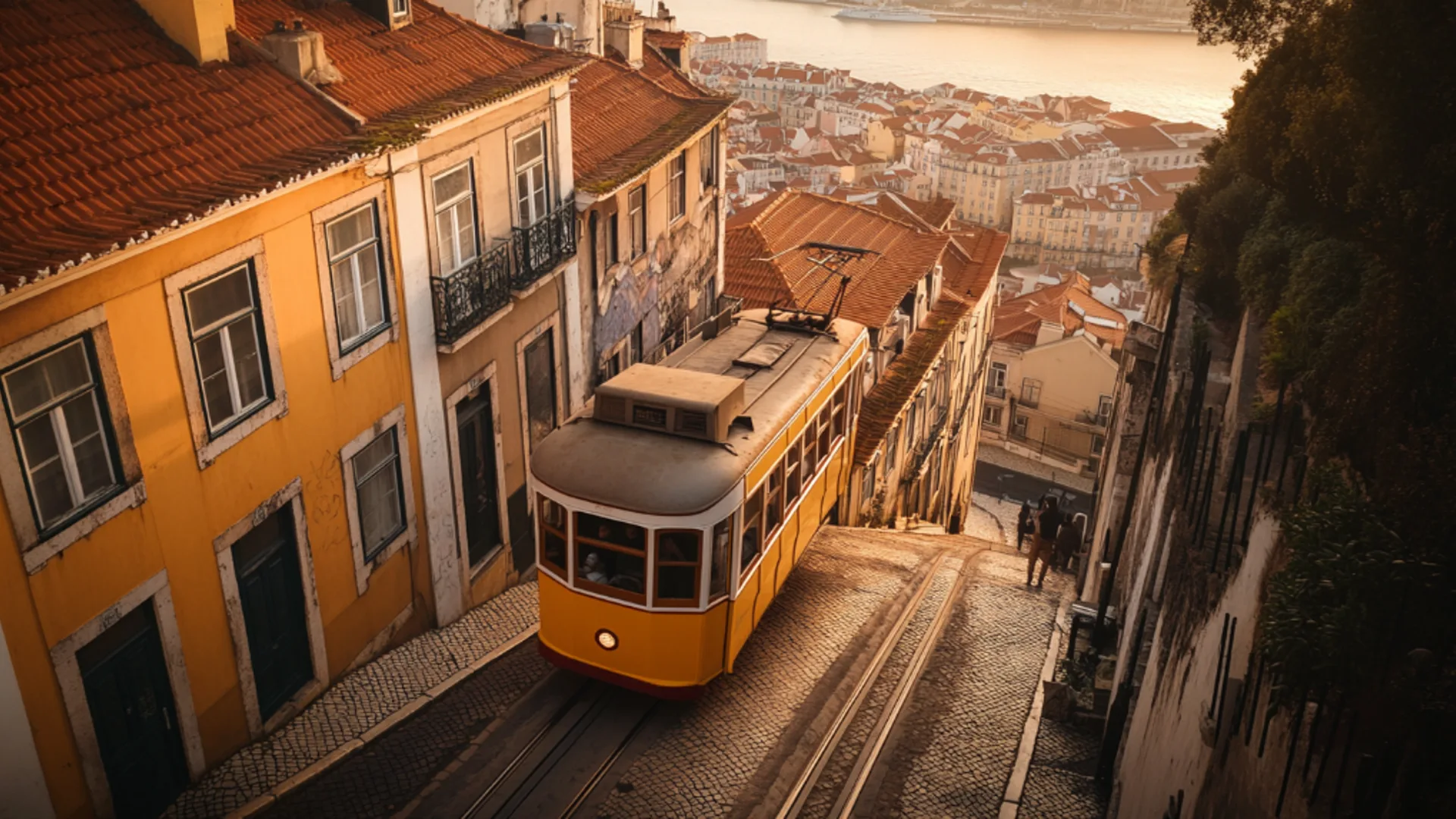
The Tilt
Lisbon does not sit on its hills so much as cling to them, and everything about the city follows from this single fact of gravity. Seven hills — Sao Jorge, Sao Vicente, Sant'Ana, Santo Andre, Chagas, Santa Catarina, and Sao Roque — rise from the banks of the Tejo, and between them the streets pitch and plunge with a steepness that makes your calves burn and your eyes widen simultaneously. There is no flat walk in Lisbon, or rather, there is one — the grid of Baixa, between Rossio and Terreiro do Paco — and it exists only because an earthquake flattened everything and an engineer rebuilt it level. Everywhere else, you are ascending or descending, turning a corner to find a staircase where you expected a street, grabbing an iron railing as the calcada portuguesa cobblestones — those beautiful, treacherous black-and-white mosaics — threaten to send you sliding downhill on a damp morning. The tilt is not an inconvenience; it is the organising principle. Every neighbourhood exists at a specific altitude, and the transition between them is always vertical.
What the hills give Lisbon is a city of constant reveals. You climb a narrow rua in Alfama, breathing hard, sweat on the back of your neck, and then you turn — and the Tejo opens below you in a sheet of silver that stretches to the far bank where the Cristo Rei stands with arms spread, and the Ponte 25 de Abril hangs its red suspension cables across the water like a quieter cousin of the Golden Gate. Every miradouro — and there are dozens — earns its panorama through effort, and this transaction between exertion and beauty is Lisbon's fundamental contract with the visitor. The city tilts, and in tilting, it reveals itself in layers: the river from Graca, the castle from Chiado, the rooftops from Senhora do Monte, each viewpoint reframing the same city into something different. Flat cities give you one perspective. Lisbon gives you thirty, and you pay for each one with your legs. The locals know this. Watch an older Lisboeta navigating the Calcada da Gloria or the steps of Beco do Carneiro — they move with an economy of effort that comes from a lifetime of negotiating gradient, a rolling, unhurried gait that conserves energy while tourists grip handrails and gasp.
Earthquake and Grid
On the morning of November 1st, 1755, Lisbon was one of the wealthiest cities in Europe. By the afternoon, it was rubble. The earthquake struck during All Saints' Day mass, when the churches were full of candles and congregations; the tremor brought the ceilings down, the candles started fires, and the tsunami that followed drowned what the flames had not reached. An estimated thirty to forty thousand people died in a city of roughly two hundred and fifty thousand. The destruction was not merely physical — it cracked European philosophy, challenged the idea of a benevolent God, and prompted Voltaire to write Candide. What rose from the ruins was the Baixa Pombalina, the grid of rational streets designed by the Marques de Pombal and his engineers, built with the world's first earthquake-resistant construction: the gaiola pombalina, a flexible wooden cage inside the masonry walls, designed to sway rather than collapse. Walk the Rua Augusta, the Rua da Prata, the Rua do Ouro — these streets exist in their precise widths and right angles because a catastrophe erased everything that came before and a rationalist rebuilt from zero.
But Alfama survived. The oldest quarter, climbing the slope between the river and the Castelo de Sao Jorge, largely escaped the earthquake because it sits on solid bedrock rather than the alluvial deposits that liquefied beneath Baixa. This accident of geology means Lisbon contains two cities in one: the planned and the grown, the grid and the labyrinth, Pombal's Enlightenment geometry and the Moorish-medieval tangle that predates the nation itself. You feel the seam most acutely walking from Baixa into Alfama — the streets narrow abruptly, the right angles dissolve into curves and dead ends, the buildings lean toward each other overhead, and the logic shifts from cartographic to organic. The Convento do Carmo, roofless since the quake, stands on the hill above Baixa as a deliberate wound left open — its Gothic arches frame the sky where the nave ceiling used to be, and the city chose not to rebuild it, preserving it as a monument to the day the ground betrayed the city. It remains the most eloquent ruin in Lisbon, and one of the most unsettling beautiful spaces in Europe.
Tiles as Language
Azulejos arrived in Portugal from Moorish Spain — the word derives from the Arabic al-zulaij, meaning polished stone — but what the Portuguese did with them belongs to no other culture. The tradition begins in the fifteenth century with geometric patterns imported from Seville, evolves through the blue-and-white narrative panels of the seventeenth and eighteenth centuries, and arrives at the present day in the form of street art, contemporary installations, and the particular Lisbon habit of tiling entire building facades in repeating patterns that turn an ordinary apartment block into something shimmering. The Museu Nacional do Azulejo, housed in the Madre de Deus convent in Xabregas, holds the definitive collection — from early Hispano-Arab fragments through the astonishing panoramic panel of pre-earthquake Lisbon, a twenty-three-metre ceramic rendering of the city's waterfront that survives as the most detailed visual record of what the earthquake destroyed. But the museum is not where you experience azulejos at their most powerful. That happens on the street, unexpectedly, turning a corner in Graca or Mouraria to find a wall of nineteenth-century tiles in perfect condition, their glaze catching the light and throwing it back in that particular blue-white shimmer.
Learning to read Lisbon's tiles is learning to read the city's history on its skin. The geometric patterns of the sixteenth century speak of Moorish influence. The blue-and-white figurative panels of churches and palaces — saints, battles, allegories — borrow from Dutch Delftware but push the scale to something monumental: entire cloister walls covered in narrative ceramic that functions like a graphic novel in glazed clay. The art nouveau tiles of the early twentieth century, with their organic curves and muted greens, mark the facades of shops and residential buildings in Avenidas Novas. The contemporary interventions are harder to categorise — Add Fuel's geometric reworkings of traditional patterns, the illegal street-art tiles that appear overnight on crumbling walls, the deliberate clash between old pattern and new context. What is consistent across five centuries is the impulse itself: to cover surfaces, to make the city reflective, to refuse the bare wall. Lisbon's ceramic skin breathes with the weather — tiles darken in rain, blaze in sun, and on an overcast day hold a cool, matte stillness that is its own kind of beauty. The city without its tiles would be a different city entirely, as if you had removed its voice.
The Tram Myth and the Real Walk
Let us be direct about Tram 28. It is a beautiful thing — the wooden-bodied remodelado cars date from the 1930s, they grind through the narrowest streets of Alfama and Graca with centimetres of clearance on each side, and the route passes through some of the city's most atmospheric quarters. It is also, in practice, a miserable experience for the visitor. The queues at Martim Moniz or Praca Luis de Camoes regularly exceed forty minutes. The trams, designed for an era of thinner passengers, carry perhaps fifty people in conditions that make a rush-hour Metro seem spacious. Pickpockets work the crowded carriages with professional efficiency — Lisbon police issue specific warnings about Tram 28, and the State Department mentions it by route number. You will spend your ride with one hand on your wallet and the other wedged against a stranger's shoulder, seeing the city through a window too fogged by body heat to photograph. Take it once, early in the morning, if you must complete the pilgrimage. Then walk. Walking is the point.
Lisbon moves vertically, and the infrastructure built to manage this is more interesting than any tourist tram. The Elevador da Bica hauls its yellow funicular up the steep Rua da Bica de Duarte Belo — ride it for the gradient, but more importantly for the view down the narrow street toward the river that has appeared on a thousand postcards. The Elevador da Gloria climbs from Restauradores to the Miradouro de Sao Pedro de Alcantara, a useful shortcut and a beautiful piece of nineteenth-century engineering. The Elevador de Santa Justa, that neo-Gothic iron tower in Baixa designed by a student of Eiffel, is worth seeing as architecture even if the queue for the lift is absurd — take the back entrance from the Convento do Carmo instead. But the real transport in Lisbon is your feet, and the specific walk this city demands: the constant awareness of gradient, the choice between stairs and cobbled ramp, the moment when you surrender to the climb and let your breathing find its rhythm. Lisbon pedestrians develop a particular pace — slower than Madrid, more purposeful than Rome, calibrated to the fact that the next hundred metres might rise fifteen. The city is three-dimensional in a way most European capitals are not, and walking it is an athletic act disguised as sightseeing.
Tascas and the Counter
A tasca is not a restaurant. It is a room, usually small, often with fluorescent lighting and tiled walls, where a counter separates you from a kitchen that might consist of one woman and two gas burners. The menu, if it exists, is handwritten or spoken aloud: caldo verde, bacalhau a Bras, feijoada, bitoque — the canon of Portuguese comfort food, served on heavy plates with a basket of bread and a bottle of house wine that costs less than a coffee at a tourist cafe. The tasca is democratic in a way that no contemporary dining concept has managed to replicate. The retired dockworker and the architect eat the same meal at the same counter, and the food is judged not by innovation but by fidelity — does this taste the way it is supposed to taste, the way it tasted last week and last year and when someone's grandmother made it thirty years ago? At Tasca do Chico in Bairro Alto, the tables are so close you are effectively dining with strangers, and on fado nights the room contracts further into a shared intimacy. At Ze da Mouraria or O Velho Eurico, the bifana — that pork sandwich in a soft roll, drenched in garlicky marinade — is the platonic form of working-class food.
The tascas are closing. This is not nostalgia speaking; it is arithmetic. A tasca in Alfama or Mouraria pays rent that has tripled since 2015, serves meals priced for Portuguese wages, and depends on a clientele that is being displaced by the same short-term rental market that drives the rent increases. When a tasca closes, what replaces it is typically a brunch spot, a craft cocktail bar, or a concept store — fine in themselves, but representing a vocabulary of consumption imported from Brooklyn or Berlin that has nothing to do with the neighbourhood's alimentary history. The tascas that survive do so through stubbornness, familial ownership, or the occasional protection of regulars who eat there daily and would riot if the doors shut. Documenting them matters: recording names, addresses, what they serve, what they cost, because the map of Lisbon's tascas is a map of a city that is disappearing in real time, one lease termination at a time. Eat at them while they exist. Stand at the counter, order the bifana, drink the house red, and understand that this is not quaint — it is urgent.
Atlantic Kitchen
The Portuguese claim 365 ways to prepare bacalhau — one for each day of the year — and this is not hyperbole but rather a conservative estimate. Bacalhau a Bras, with its golden tangle of shredded salt cod, matchstick potatoes, and scrambled eggs, is the version you encounter first and the one you return to. Bacalhau com natas layers the fish with cream and potatoes in a gratin that shatters every rule of dietary restraint. Bacalhau a Gomes de Sa, from Porto but beloved in Lisbon, folds the cod with onions, potatoes, olives, and hard-boiled eggs into something that tastes like the sea refracted through a farmhouse kitchen. The paradox of bacalhau is that it is not a local fish — cod comes from the North Atlantic, from Newfoundland and Norway, and the Portuguese sailed thousands of miles to catch it before salting and drying it for the journey home. It is a food of empire, of maritime ambition, of a small country's extraordinary reach, and eating it in Lisbon is eating history. The cervejarias — those tiled, fluorescent-lit beer halls — serve it best: Cervejaria Ramiro for the full seafood spread, but any neighbourhood cervejaria will give you honest bacalhau and cold Sagres.
But Lisbon's kitchen extends far beyond the Atlantic catch. The colonial centuries drew flavours from three continents, and the city's contemporary food map reflects this inheritance with a honesty that other former imperial capitals might envy. Mozambican piri-piri chicken — fiery, charred, marinated in bird's-eye chilli and citrus — is as much a Lisbon staple as bacalhau, served at churrasqueiras in Mouraria and Intendente. Goan curries appear in restaurants around Martim Moniz, where the Indian communities established themselves decades ago, and the xacuti and vindaloo carry a recognisably Portuguese framework beneath the spice. Angolan moamba de galinha — chicken in a rich palm oil and okra sauce — is comfort food in neighbourhoods with Cape Verdean and Angolan populations. The petiscos tradition — small dishes shared at the table, Portugal's answer to tapas — draws from all of these threads: pataniscas de bacalhau alongside pica-pau beef, chourico flambado beside samosas, a table that narrates the empire's reach without editorial comment. In summer, the smell of sardinhas assadas — grilled sardines on open-air charcoal — fills entire streets during the Santos Populares festivals, and you eat them on bread, head and all, standing on a pavement thick with the sweet smoke.
Ginjinha to Natural Wine
The drinking arc of Lisbon begins at A Ginjinha, a closet-sized bar on Largo de Sao Domingos that has served cherry liqueur since 1840. The ritual is elemental: you stand at the tiny counter, order a ginjinha com elas (with the cherries) or sem elas (without), receive a small glass of dark ruby liquid, drink it in two sips, and leave. The liqueur is sweet, boozy, and medicinal in the way that nineteenth-century drinks often are, and it tastes of a Lisbon that predates tourism by a century and a half. From this starting point, the city's drinking culture arcs through the garrafeira tradition — those family-owned wine shops where bottles of aged Bairrada and Dao gather dust on wooden shelves, and the owner will discourse for thirty minutes on the merits of a particular Colares from sandy phylloxera-resistant vines — through the port wine lodges that spill across from Vila Nova de Gaia in Porto but maintain outposts in Lisbon, to the contemporary scene that has made the city one of Europe's most important natural wine capitals.
Lisbon's natural wine moment is not a trend; it is a movement with roots in Portugal's extraordinary but historically undervalued viticultural diversity. The country has over 250 indigenous grape varieties, many of them unknown outside their home regions, and a new generation of winemakers — in the Douro, the Dao, the Lisboa region, the Alentejo, the Azores — is farming them organically, fermenting with native yeasts, and bottling wines of startling originality. In Lisbon, bars like By the Wine, Comida Independente, Taberna da Rua das Flores, and the bottles-only shop Garrafeira Nacional stock these producers alongside the classics, and the conversation at the bar is as likely to concern a skin-contact Arinto from Bucelas as a conventional reserva. The Bairro Alto and Principe Real concentrations are densest — Pavilhao Chines for surreal ambiance among a million curios, Pensao Amor for cocktails in a former brothel, the countless tiny bars where the door is open and the wine is poured from bottles you have never heard of from regions you need to look up. The drinking culture here is omnivorous, historically layered, and as serious about a two-euro ginjinha as a forty-euro bottle of aged Baga. It does not choose between tradition and modernity; it pours both.
Fado Without the Tourist Menu
Fado, in its tourist-menu incarnation, goes like this: you book a table at a casa de fado in Alfama, pay fifty euros for a prix fixe dinner of indifferent food, and at a designated hour a woman in a black shawl sings three songs while you eat. The lighting dims. A placard requests silence. The guitarists — one with the Portuguese guitarra, its tear-shaped body and twelve wire strings, the other with the viola, a classical guitar — provide accompaniment. It is professional, competent, and about as emotionally authentic as a theme park. Real fado does not work like this. Real fado happens in Mouraria, the neighbourhood where the genre was born in the early nineteenth century among the marginalised — sex workers, sailors, the urban poor — and where it still surfaces in ways that cannot be programmed. At Tasca do Chico, in Bairro Alto, the fado vadio nights bring amateur singers out of the audience to perform, and the quality ranges from transcendent to shaky, which is exactly the point: fado vadio means wandering fado, fado without a fixed performer, and the vulnerability of an untrained voice reaching for the right note is closer to the genre's origins than any polished house singer.
To understand fado, you must first abandon the translation of saudade as mere nostalgia. Saudade is the presence of absence — the ache for something that may never have existed, a future that will not arrive, a person who is here but already somehow gone. It is not sadness; it is a richer, more paradoxical emotion, and when a fadista finds it in a song — not performs it, but finds it, in the moment, as if the lyrics had just occurred to her — the room changes temperature. You feel it in your sternum. The best fadistas working today — Ana Moura, Carminho, Gisela Joao, Mariza — carry the tradition forward without embalming it, and their concerts in Lisbon's smaller venues are the best way to encounter fado at full force. But the most intimate experience remains the unannounced session in a tasca, where someone stands up, the conversation stops, the guitarrista plays the introduction, and a voice fills a room of twenty people at midnight with a sound that is simultaneously ancient and completely alive. You do not applaud between verses. You hold still. You let it work on you.
Mouraria: The Other Lisbon
If Alfama is the Lisbon that tourists photograph, Mouraria is the Lisbon that actually lives. The neighbourhood climbs the steep slope between Martim Moniz square and the back walls of the Castelo de Sao Jorge, and its streets — Rua do Benformoso, Rua do Capelao, the Escadinhas de Sao Cristovao — hold a concentration of languages, cuisines, and human stories that no other quarter of the city can match. Mouraria takes its name from the Moorish community confined here after the Christian reconquest in 1147, and that founding act of marginality has defined the neighbourhood ever since: it was where the outsiders lived, the communities that the centre city would not absorb. Today, the outsiders are Bangladeshi shopkeepers, Chinese grocers, Mozambican hairdressers, Cape Verdean families, Pakistani spice merchants, and the remaining elderly Portuguese residents who remember when every building was occupied by someone they knew by name. The food follows the demographics: you can eat Nigerian jollof rice, Indian biryani, Chinese dim sum, and Mozambican matapa within a five-minute walk, and the cumulative effect is of a neighbourhood that makes the rest of Lisbon look monocultural.
Mouraria is also honest about tension, and any guide that presents it as a multicultural paradise without friction is lying. The gentrification pressures that have transformed Alfama and Bairro Alto are reaching Mouraria now — renovated apartments appearing between the crumbling facades, a new cocktail bar on a street where the nearest neighbour is a Bangladeshi textile shop, rents climbing in a neighbourhood whose residents earn the least. The street art that covers many walls — murals by Vhils, paste-ups and stencils on every available surface — is simultaneously an expression of neighbourhood identity and, some residents argue, a gentrification signal that makes the area more attractive to the very market forces displacing its people. The Largo da Severa, named after Maria Severa, the fadista and prostitute who is considered fado's founding voice, has been renovated into a small cultural space, and whether this represents preservation or the aestheticisation of poverty depends on whom you ask. What is undeniable is that Mouraria contains Lisbon's multicultural future in raw, unfinished form, and walking its streets is as close as you can get to the city's genuine social complexity.
Light and Crumble
The light in Lisbon is not Mediterranean. It is Atlantic — filtered through moisture, softened by the river's reflective surface, golden in a way that has more warmth than Seville's glare but more clarity than London's diffusion. Photographers know this: the hour before sunset turns the calcada cobblestones into sheets of pale gold, catches the azulejo facades and throws back a doubled luminosity, and wraps the whole city in a quality of illumination that makes even a crumbling wall look like a painting. The Tejo acts as a vast reflector, bouncing light upward into the streets that face the water, and this is why the river-facing facades of Alfama and Graca have a particular radiance in late afternoon that the inland streets lack. It is also why the miradouros face south and west — the city has always oriented its viewing platforms toward the light. In winter, the angle drops lower and the shadows lengthen through the narrow ruas, creating corridors of deep shade interrupted by shafts of gold where the sun finds a gap between buildings. In summer, the light is everywhere, insistent, bleaching the pastel facades to near-white by midday and only softening into beauty as the day tilts toward evening.
The crumble is the other half of Lisbon's aesthetic equation, and it demands honesty. The peeling facades, the exposed brick beneath fallen plaster, the buildings held together by scaffolding and prayer — these are photogenic, and Instagram has turned Lisbon's decay into a global aesthetic product. But behind every crumbling facade is a story of deferred maintenance, absent landlords, frozen rents under the old lease laws, and residents who lived for decades in buildings that were slowly falling around them. The rehabilitation that began in earnest after Portugal's 2011 economic crisis and accelerated with the tourism boom has renovated thousands of buildings, and the result is a city of jarring contrasts: a pristine renovation next to a ruin, a boutique hotel beside a building whose upper floors have collapsed into themselves. The tension between preservation and renewal is genuine and unresolved. Some crumbling buildings are heritage worth saving; others are simply uninhabitable. The ruin that tourists find beautiful is often the home that a family could not afford to repair and eventually had to leave. Lisbon's beauty and its displacement are not separate stories; they are the same story told at different volumes.
Miradouros and Earned Views
The miradouro system is Lisbon's most elegant social architecture, and it operates on a principle of exchange: the city gives you a panorama, but you must climb to collect it. The Miradouro da Graca, reached by the steep streets above the Largo da Graca, opens onto a terrace shaded by pine trees where the entire river-facing city unfolds — the castle walls above, the Baixa grid below, the Tejo and the Ponte 25 de Abril beyond, and on clear days the Serra da Arrabida to the south. The kiosk serves beer and coffee, the benches fill with couples and students, and the light at sunset is the colour of aged honey. From here, you can walk ten minutes to the Miradouro da Senhora do Monte, the highest viewpoint in the city, where the panorama widens to include the full span of Lisbon from the Aqueducto das Aguas Livres in the west to the Parque das Nacoes in the east. It is less visited, more local, and on a still evening the sound of the city rises from below in a murmur that makes you feel genuinely elevated above the noise.
The miradouros closer to the tourist centre have different personalities. The Miradouro de Santa Luzia, with its bougainvillea-draped pergola and azulejo panels depicting the pre-earthquake city, is postcard-perfect and almost always crowded. The adjacent Portas do Sol catches the morning light and looks directly down into Alfama's rooftop maze — you can trace the streets from above and understand the labyrinth's logic in a way impossible at ground level. The Miradouro de Sao Pedro de Alcantara, at the top of the Elevador da Gloria, faces east across Baixa toward the castle and provides the classic composition of Lisbon layered against its principal hill. Each earns its view differently: some by staircase, some by funicular, some by streets so steep they require handrails. The miradouro at the Jardim do Torel, hidden in a residential neighbourhood above Avenida da Liberdade, rewards the seeker with a quiet garden, a small pool, and a view that feels like a secret because so few tourists find it. The system as a whole functions as a distributed observation network, turning the city's topographic difficulty into its greatest pleasure — every hill is a lookout, every climb is an investment, and Lisbon always pays its debts in views.
River and Edge
The Tejo is not a river in the way the Seine or the Thames is a river — contained, bridged, domesticated, lined with quays and made to behave. The Tejo at Lisbon is an estuary three kilometres wide, more sea than river, and its presence is atmospheric rather than picturesque. You feel it before you see it: a quality of openness in the air, a light bouncing off water you cannot yet glimpse, a sense of margin. Lisbon sits at the western edge of continental Europe, and the Tejo is the threshold between the land and the Atlantic, between the known continent and the vast emptiness that Portuguese navigators sailed into five centuries ago. Belem makes this explicit: the Torre de Belem, that confection of Manueline stonework standing in the shallows, was the last thing departing sailors saw, and the Padrao dos Descobrimentos monument on the waterfront celebrates the departures without adequately accounting for what happened when the ships arrived. The Age of Discovery is Lisbon's founding narrative and its most complex inheritance — the wealth that built the Jeronimos Monastery came from spice routes sustained by violence, and the monument's triumphalism sits uneasily beside the historical record.
The best way to understand the river is to cross it. The ferry from Cais do Sodre to Cacilhas takes ten minutes, costs the price of a Metro ticket, and delivers you to the south bank where the perspective inverts: now Lisbon is the view, stacked up on its hills across the water, the castle at the summit, the Baixa grid pale in the middle distance, the Ponte 25 de Abril sweeping overhead. The south bank — the Margem Sul — is working-class, industrial in character, and provides the honest counterpoint to the north bank's touristic polish. Cacilhas has fish restaurants that serve the river's bounty without the markup, and the Cristo Rei statue, that outstretched figure modelled on Rio's Christ the Redeemer, stands on its pedestal above the water with a view that encompasses the whole city. The bridge itself is a constant presence — visible from dozens of viewpoints, its red cables catching the light, its traffic a permanent hum — and it functions as a visual anchor, the line that connects Lisbon to the world beyond the river. At night, its lights reflect on the water, and the city's edge — that feeling of being at the end of something, of facing outward — becomes luminous.
Pessoa's City, Still
Fernando Pessoa spent most of his life within a few square kilometres of Baixa and Chiado, and the city he inhabited — the cafes, the streets, the particular quality of loneliness available to a man who invented seventy-two versions of himself — is still navigable. The Cafe A Brasileira on Rua Garrett has a bronze Pessoa seated at an outdoor table, one of the most photographed statues in Lisbon and, like much about the city's literary culture, both genuinely felt and thoroughly commercialised. But the real Pessoa territory is less obvious: the rented rooms in various addresses across Baixa and Campo de Ourique where he wrote obsessively, the office buildings where he worked as a commercial translator, the bars where he drank more than was good for him. The heteronyms — Alberto Caeiro, Ricardo Reis, Alvaro de Campos, and dozens more, each with a distinct biography, poetic style, and worldview — are the most extraordinary literary invention of the twentieth century, and they make Pessoa not one writer but an entire literature. Reading The Book of Disquiet while sitting in a cafe on Rua dos Douradores, where the fictional Bernardo Soares supposedly worked, is one of the more productive forms of literary tourism.
Lisbon's literary identity extends beyond Pessoa into a tradition of bookish melancholy that the city actively cultivates. The Livraria Bertrand on Rua Garrett, operating since 1732, holds the Guinness record for the world's oldest bookshop, and its rooms — connected by archways, lined floor to ceiling with Portuguese and international titles — have the quality of a private library opened reluctantly to the public. The Ler Devagar bookshop in LX Factory, a converted industrial space in Alcantara, fills a former printing warehouse with books, art, and a bicycle suspended from the ceiling, and represents the newer, design-conscious end of the literary spectrum. Between these poles, the alfarrabistas — secondhand booksellers — cluster around Rua do Alecrim and the Chiado, selling yellowed Portuguese editions of novels you have never heard of alongside first editions of Eca de Queiros and Saramago. The cafe tradition that nurtured Pessoa persists: Fabrica Coffee Roasters, Copenhagen Coffee Lab, the historic Pastelaria Versailles on Avenida da Republica with its mirrored walls and uniformed waiters. The particular Lisbon melancholy — not depression, not sadness, but a productive, reflective quality that comes from living in a beautiful city aware of its own decline — finds its fullest expression in these spaces, where the act of sitting alone with a book and a coffee is understood not as loneliness but as a civilised form of engagement with the self.
The Projection Room
Lisbon's cinema culture carries the same productive melancholy that defines its literature and its fado — a city that watches films the way it reads Pessoa, with attention and a tolerance for ambiguity. The Cinemateca Portuguesa on Rua Barata Salgueiro programmes with the rigour of a national archive: Portuguese film history from Manoel de Oliveira's extraordinary seven-decade career through contemporary independents like Pedro Costa and Miguel Gomes, alongside international retrospectives screened for an audience that treats cinema as seriously as the city treats its tiles and its pastéis. The attached bookshop sells Portuguese film publications that exist nowhere else, and the screening rooms have the intimate focus of a cine-club that happens to be a national institution.
Cinema São Jorge on Avenida da Liberdade offers the grand counterpoint — a restored 1950s movie palace with a 600-seat main auditorium that retains the proportions and acoustic warmth of an era when cinema exhibition was architectural spectacle. São Jorge serves as the primary venue for DocLisboa (October) and IndieLisboa (April), making it the beating heart of Lisbon's festival circuit. Between the Cinemateca's scholarly devotion and São Jorge's grand-scale exhibition, Lisbon sustains a film culture that mirrors the city's broader character: modest in volume, serious in commitment, and best experienced in the evening when the light outside the cinema has turned the colour of the Tejo and the walk home passes through streets that look like they were lit by a cinematographer who understood exactly what this city deserves.
Boa Noite
The city at dusk, from any miradouro, performs the same trick every evening and it never diminishes. The light drops, the river turns from silver to copper, the facades shift from white to gold to amber, and then the street lamps come on — not all at once, but in a scattered sequence, as if the city were remembering where it left its lights. The Castelo de Sao Jorge glows on its hilltop, the bridge becomes a line of red and white traffic lights suspended over dark water, and the sounds of the day — the trams, the construction, the chatter of tourists — give way to the sounds of the evening: fado from an open door, laughter from a terrace, the clink of glasses in a tasca, the particular acoustic of footsteps on calcada cobblestones that carries differently after dark. Lisbon softens at night. The crumbling facades lose their specificity in the half-light and become simply beautiful. The gradients that punished your legs all day become mysterious — you climb a dark staircase and emerge at a viewpoint you did not know existed, where the river lies below you like a breathing, luminous thing.
Lisbon is the city people move to. Not just visit, not just pass through on a European itinerary, but actually relocate to — writers, artists, remote workers, retirees, people fleeing more expensive cities, people chasing something they sensed on a three-day visit and could not shake. This is not without consequences: the same arrivals that energise the city also displace it, and the Lisbon that draws people is partly being eroded by their coming. But the pull is real, and it has something to do with the tilt — the way the city leans toward you, the way its topography forces intimacy, the way you cannot walk its streets without engaging physically with its surface. Flat cities allow you to pass through them abstractly, as if on a conveyor belt. Lisbon demands your body: your legs, your lungs, your balance on the cobblestones. In return, it offers something that the great flat capitals do not — the constant sensation of perspective shifting, of seeing the same city from a new angle, of finding, at the top of yet another hill, a view that makes the climb make sense. The particular ache of leaving Lisbon is not saudade in the Portuguese sense — it is something more physical, as if the city had tilted toward you and then, as the plane lifts off, tilted away.