Two Continents, One Appetite
Istanbul straddles the Bosphorus, which means it straddles everything: Europe and Asia, Christianity and Islam, the ancient and the aggressively modern. The strait is a mile wide and a thousand years deep in meaning. Container ships from the Black Sea pass under suspension bridges while ferries carry commuters between continents for less than the price of a tea. The city's geography is its personality — divided, connected, and in constant negotiation with itself.
This is not a city you master in a week. Fifteen million people live here across a sprawl that extends far beyond the tourist triangle of Sultanahmet-Beyoglu-Karakoy. But within that triangle and the surrounding neighborhoods, the density of history, food, and human energy per square meter is unmatched by any city in the Mediterranean or beyond.
Light on Water
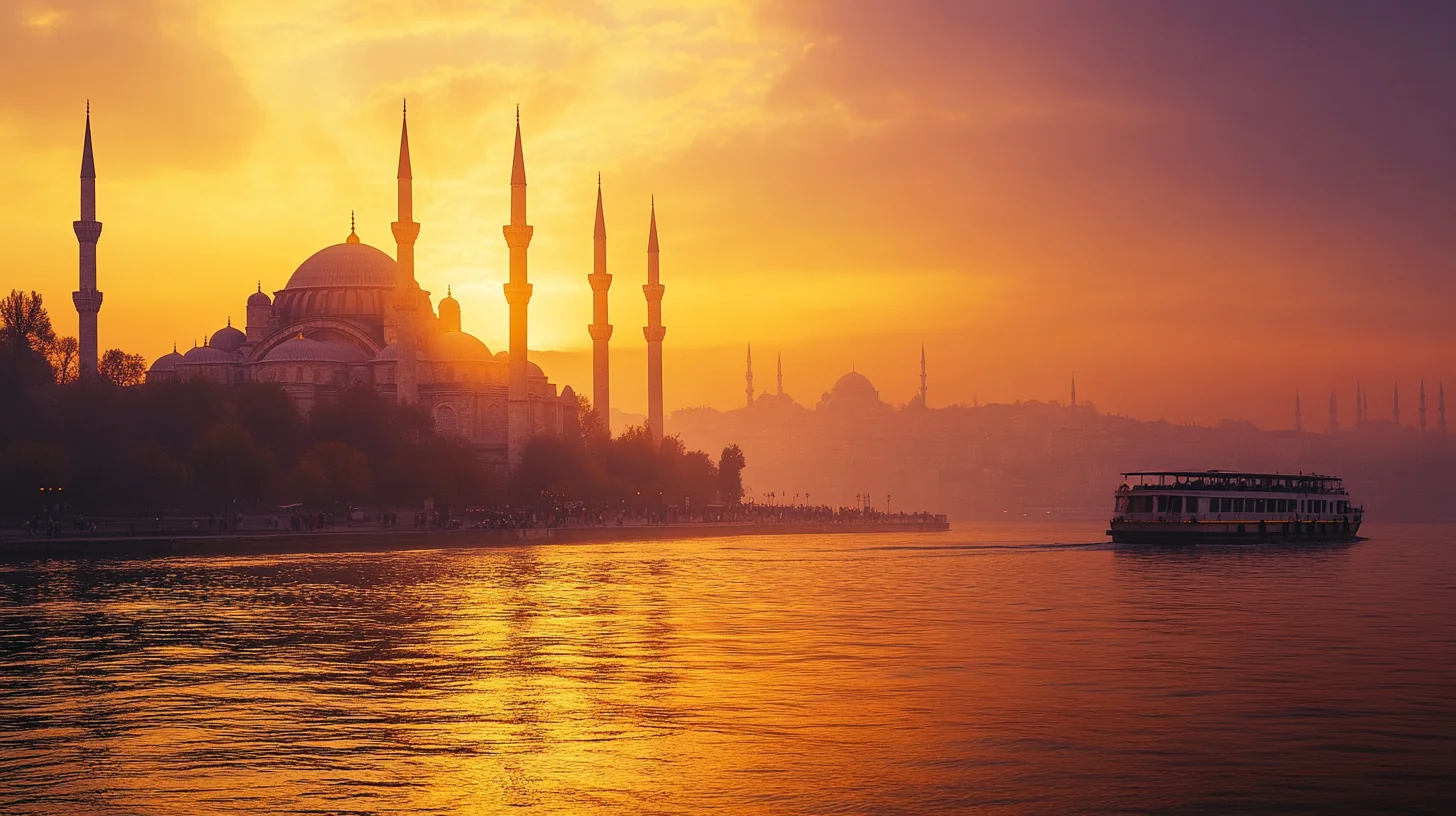
The light is the first thing and the last thing. Morning light off the Bosphorus turns mosque domes gold and makes the Asian shore shimmer like a promise. Evening light drops behind the minarets of Sultanahmet and paints the Golden Horn in colors that explain why painters kept coming back. Between those hours, the light shifts with the water — silver in fog, electric blue in summer, soft grey in winter rain.
The water defines movement. Ferries are not just transport; they are the city's best public spaces. The twenty-minute crossing from Eminonu to Kadikoy offers more visual beauty than most cities manage in a year. Seagulls follow the boat. Tea vendors work the aisles. The skyline rotates as the ferry turns. At sunset, the crossing becomes something closer to ceremony.
Layers of Empire
Walk through Sultanahmet and you walk through time in layers. Roman hippodrome beneath Ottoman parkland. Byzantine cisterns under modern streets. Greek columns repurposed as mosque foundations. The city has been continuously inhabited for over 2,600 years and continuously rebuilt by whoever was in charge. Constantine, Justinian, Mehmet the Conqueror, Suleiman the Magnificent, Ataturk — each added their layer without fully erasing what came before.
This layering is not academic. It is physical. You descend stairs into the Basilica Cistern and you are in the 6th century. You climb the Galata Tower and you are in Genoese Genoa. You cross the Golden Horn and you are in the Belle Epoque embassy district that still looks like Paris tried to colonize a hill. Istanbul does not separate its eras — it stacks them.
Breakfast as Philosophy
Turkish breakfast (kahvalti) is the meal that explains the culture. It is not a quick affair. A full spread includes twenty or more small dishes: white cheese, aged kasar, olives in five varieties, honey with kaymak (clotted cream), tomatoes, cucumbers, sucuk (spiced sausage), eggs prepared multiple ways, jams, butter, and unlimited tea from a samovar. The bread arrives warm. The tea arrives constantly.
The philosophy is abundance without sharing without counting. You eat slowly, talk between bites, and let the meal fill the morning. Weekend breakfast in neighborhoods like Cihangir or Kadikoy can start at 10am and end past noon without anyone feeling rushed. This is not inefficiency — it is the city's way of saying that time spent at a table with food and conversation is never wasted.
The Kebab Spectrum
Kebab in Istanbul is not one thing. It is a spectrum that runs from the southeast Anatolian charcoal traditions of the ocakbasi to the thin-wrapped durum of street vendors to the refined preparations of palace-inspired restaurants. The adana kebab (hand-minced lamb on a flat skewer, spiced with Urfa pepper) is the benchmark — spicy, fatty, and charcoal-smoky. The urfa kebab is the same meat without the heat. The beyti is wrapped in lavash with tomato sauce and yogurt.
The key distinction locals make: is the meat hand-minced (zirh) or machine-ground? The former has texture, character, and costs more. An ocakbasi — a restaurant built around a charcoal grill where you sit around the fire and watch the grillmaster work — is the best context for understanding what kebab can be. Zubeyir and Sur Ocakbasi are the standard-setters.
Meyhane Nights
The meyhane is Istanbul's version of a tavern, but the format is specific: meze first, fish or grilled meat second, raki throughout. Raki is anise-flavored spirit that turns milky white when you add water — it is called 'lion's milk' (aslan sutu) and it is the city's secular communion drink. The meze arrive in waves: cold dishes first (hummus, ezme, yogurt, stuffed vine leaves), then warm (fried mussels, borek, calamari), then the main course.
The rhythm of a meyhane dinner is cumulative. You do not order everything at once. You graze, you talk, you add another round of meze, you decide on the fish. The waiter brings what is fresh; you trust the kitchen. In neighborhoods like Beyoglu's Nevizade Sokak or along the Bosphorus, meyhane culture is alive every night but peaks on weekends when families and friends commit to long, raki-fueled evenings that end when the table decides, not the clock.
Tea and Coffee Rituals
Tea (cay) is the city's universal solvent. It is offered at every shop, every meeting, every pause in the day. The small tulip-shaped glass holds just enough to drink quickly and refill — a rhythm rather than a quantity. Sugar is optional; milk is not done. The tea comes from the eastern Black Sea coast, brewed strong in a double-stacked caydanlik pot, and diluted to taste.
Turkish coffee is the city's other ritual, older and more ceremonial. Ground extremely fine, cooked slowly in a copper cezve (often on heated sand), and served unfiltered with the grounds settling in the cup. The foam on top is the mark of a well-made cup. After you drink, turning the cup over onto the saucer and reading the grounds for fortune-telling (fal) is a tradition that persists in cafes and homes. Coffee is slower than tea, more intentional, and increasingly coexists with Istanbul's growing third-wave specialty scene.
The Bazaar Logic
The Grand Bazaar operates on a logic that predates modern retail. Shops are organized by trade — jewelers in one lane, leather in another, ceramics in a third — because the bazaar was built as a guild system, not a mall. Prices are flexible because the transaction includes conversation, tea, and the performance of negotiation. Starting at 40% of the asking price is not insulting; it is expected.
The Spice Bazaar (Egyptian Bazaar) follows a similar logic but in a smaller, more aromatic space. The key skill in both is knowing what you want before you enter, because the bazaar's design — no maps, no clear exits, no straight paths — is intentionally disorienting. This is architecture as sales technique, refined over five centuries. Getting lost is part of the experience, but having a mental budget and a target purchase keeps the experience from becoming overwhelming.
The Asian Side
Most tourists never cross the Bosphorus, which is a mistake. Kadikoy is where Istanbul eats, drinks, and shops without performing for visitors. The food market (balik pazari) is dense with produce, fish, street food, and preserved everything. Moda, the coastal neighborhood south of Kadikoy center, offers a waterfront promenade with Sultanahmet views and a slower pace that makes the European side feel frantic by comparison.
Uskudar, further north, is more conservative and residential but has the best Bosphorus views looking back at the European shoreline. The Maiden's Tower sits on an islet between the two sides, lit up at night. The ferry crossing itself is the point — twenty minutes on the water recalibrates your sense of what a city can be. Go for lunch, walk the market, drink coffee, take the ferry back at sunset. The round trip is worth the entire day.
Mosque Etiquette
Istanbul's mosques are active places of worship, not museums. The Blue Mosque, Suleymaniye, and even Hagia Sophia hold regular prayers five times daily, and visiting hours work around the prayer schedule. Remove shoes at the entrance. Women should cover hair, shoulders, and knees — scarves and wraps are available free at most major mosques. Men should avoid shorts.
The call to prayer (ezan) sounds five times from every minaret in the city and is not a performance for tourists — it is the city's clock. Dawn, midday, afternoon, sunset, and night. After a few days, you begin to mark time by it rather than by your phone. Visiting between prayer times (especially mid-morning or mid-afternoon) gives you space to look without feeling like you are intruding. Photography is generally permitted outside prayer times but silence is always expected.
Hamam Culture
The Turkish bath (hamam) is not a spa treatment. It is a social institution that has been part of daily life since the Ottoman period and traces its roots to Roman bathing culture. The format is specific: hot room (sicaklik), marble slab (gobek tasi) where you lie down, scrub (kese) with a rough mitt that removes more dead skin than you believed you had, and soap wash (kopuk). The experience is vigorous, not gentle.
The historic hamams — Cagaloglu (1741), Kilic Ali Pasa (1580, restored), Suleymaniye (1557) — offer the experience in Ottoman architectural spaces that are as impressive as any mosque. Tourist-oriented hamams charge more but provide towels, guidance, and a less intimidating experience. Local neighborhood hamams are cheaper, rougher, and gender-separated on different days. Either way, the kese scrub is the point. You will feel cleaner than you have ever felt.
Getting Around
The Istanbulkart is non-negotiable. This reloadable transit card works on everything — metro, tram, bus, ferry, Marmaray tunnel — and costs a fraction of individual tickets. Load it at machines in any metro station. The T1 tram connects Sultanahmet to Eminonu to Karakoy to Kabatas. The M2 metro runs from Taksim north through Sisli and Levent. The Marmaray tunnel crosses under the Bosphorus from Europe to Asia in four minutes.
Taxis are abundant and cheap by European standards, but the overcharging game is real. Use BiTaksi or similar apps to avoid meter manipulation, or insist firmly on the meter (say 'taksimetre'). Traffic on the bridges and major arteries during rush hour can triple journey times — the metro and ferry are genuinely faster during peak hours. Walking is the best way to understand neighborhoods, but the hills between Karakoy and Beyoglu will test your calves.
Costs and Currency
Istanbul is inexpensive by European standards for food and local experiences, but luxury hotels and fine dining approach Western prices. A full Turkish breakfast at a neighborhood cafe runs 200-400 TL. A kebab lunch is 100-200 TL. A fine dining dinner at Mikla or Neolokal can reach 2000+ TL per person. Transit is very cheap. Taxis are reasonable. The Grand Bazaar charges what it can get away with.
The Turkish lira fluctuates significantly, which means prices in lira can change between visits. Credit cards are widely accepted at restaurants and hotels; carry cash for small shops, market vendors, street food, and tea. Tipping is not as structured as in the US — round up at casual places, 10-15% at upscale restaurants, and leave the coins from your change on the tray when paying for tea or coffee.
Seasons and Timing
Spring (April-May) and autumn (September-October) are ideal — warm but not brutal, with manageable tourist crowds. Summer (June-August) brings heat, humidity, and peak tourist season; the upside is long evenings on rooftop terraces and waterfront meyhanes. Winter (December-February) is cold, occasionally snowy, and atmospheric — fewer tourists, lower prices, and the city's indoor culture (hamams, bazaars, tea houses) at its best.
Ramadan affects restaurant hours and mosque access but adds atmosphere — the iftar (fast-breaking) meals at sunset are festive and generous. Friday is the main prayer day; mosques are crowded and sometimes closed to visitors around midday prayer. Plan major mosque visits for weekday mornings. The best light for photography is early morning and the hour before sunset, when the minarets catch gold.
Safety and Common Sense
Istanbul is a safe city for visitors. Petty crime exists in tourist areas, especially around Sultanahmet and the Grand Bazaar — standard urban awareness applies. The taxi scam is the most common tourist annoyance: drivers who take long routes, forget to turn on the meter, or switch large bills for smaller ones. Using apps eliminates most of this.
Political demonstrations occur occasionally around Taksim and Istiklal — these are generally avoidable and rarely affect tourists. The city is generally walkable and well-lit in central areas. The Asian side feels noticeably calmer. Solo women travelers should exercise standard awareness, particularly late at night in quieter neighborhoods, but Istanbul is no more dangerous than any large European city.
Night and the Bosphorus
At night, the Bosphorus becomes a corridor of light. The mosques are illuminated — Sultanahmet glows blue, Suleymaniye commands its hilltop in amber, the smaller mosques along the waterfront add pinpoints across the ridge. The bridges are lit in changing colors. Container ships slide through, running lights reflecting on black water. From a rooftop bar in Beyoglu or a waterfront seat in Kadikoy, the nightscape is quietly spectacular.
Istanbul's nightlife ranges from meyhane dinners that stretch past midnight to cocktail bars on Beyoglu rooftops to dive bars in Kadikoy where the music is loud and the prices are honest. The city does not have a single nightlife center — it distributes energy across neighborhoods and expects you to choose your register. A quiet raki dinner and a loud Kadikoy bar crawl are both correct answers to the same evening.