Latin America's Capital City
Miami is not an American city that happens to speak Spanish. It is a Latin American capital that happens to sit inside the United States, and this distinction — which every visitor eventually grasps but few guidebooks state plainly — explains the food, the architecture, the rhythms of daily life, the political arguments in the coffee lines, and the particular energy of a place that faces south rather than north. The Cuban exile community that arrived after 1959 did not assimilate into an existing American city; they rebuilt a city in their image, layering Havana's rhythms onto a subtropical resort town until the original was unrecognizable. And then the Haitians came, and the Colombians, and the Venezuelans fleeing Chavez and Maduro, and the Brazilians, and the Argentines, and each wave added another frequency to the signal until Miami became something unprecedented: a city where English is the second language in most neighbourhoods, where the news broadcasts in Spanish carry more authority than their English counterparts, and where the question of identity — American? Latin? Caribbean? All of these? — is the animating tension of civic life.
This is not a melting pot in the American mythos sense, where differences dissolve into a common broth. Miami's communities maintain their distinctions with a fierceness that can confuse visitors expecting homogeneity. Little Havana is Cuban, not generically Hispanic. Little Haiti is Haitian, not generically Caribbean. The Peruvian restaurants in Downtown serve food that is specifically Peruvian — ceviche and lomo saltado and causa limena — not a pan-Latin approximation. The Venezuelan arepas in Doral are made by Venezuelans for Venezuelans, and the fact that Americans have discovered them is incidental. This specificity is Miami's culinary and cultural wealth: it is not a city where everything blends but a city where everything coexists, sometimes harmoniously, sometimes in creative friction, always at volume.
The implications for the visitor are practical. You can eat your way from Havana to Lima to Port-au-Prince to Buenos Aires without crossing a body of water. You can hear salsa, reggaeton, kompa, samba, and cumbia in a single evening without visiting a tourist venue. You can drink Cuban espresso at a walk-up window at 7am, Peruvian pisco sours at lunch, Haitian rum punch at dinner, and Argentine Malbec at midnight, and at no point will you feel that you have left a single city. Miami's Latin American identity is not a cultural overlay on an American base; it is the base itself, and the American elements — the English, the dollars, the constitutional framework — are the overlay. Understanding this inversion is the first step toward understanding the city.
The Exile Story
The Cuban exile community did not arrive in Miami as immigrants in the conventional sense. They arrived as professionals — doctors, lawyers, professors, business owners, engineers — who expected to return within months, perhaps a year, once Castro's regime collapsed under its own contradictions. That collapse never came, and the temporary became permanent, and the community that had parked itself in a sleepy Florida resort town began to build. They built restaurants that tasted like the Havana they remembered. They built businesses that replicated the commercial networks they had lost. They built political organizations that kept the dream of return alive through three generations, long past the point where most of the dreamers had ever set foot on the island. They built, in short, a city — not a neighbourhood within a city, but a city within a city, with its own economy, its own media, its own social hierarchy, and its own relationship to the American political system that gave them shelter.
The result is visible everywhere but understood best in Little Havana, on the corridor of SW 8th Street that the community named Calle Ocho. Maximo Gomez Park, where elderly men play dominos under a pavilion, is not a cultural attraction — it is daily life, the same game played in the same park by the same men (and now their sons and grandsons) for decades. The ventanita at Versailles, the walk-up window where coladas are poured and arguments about Cuba are conducted simultaneously, is not a coffee shop — it is a public square compressed to the dimensions of a counter. The Bay of Pigs memorial on the street is not a historical marker — for the families who lost fathers and brothers at Playa Giron, it is a wound that has never fully closed. To walk Calle Ocho with any sensitivity is to understand that exile is not a political category but an emotional condition, and that Miami's Cuban community has built one of the most successful immigrant communities in American history on the foundation of a loss they have never stopped feeling.
The newer waves complicate the story without replacing it. The Venezuelans who began arriving in the 2000s and accelerated after 2014 share some of the exile psychology — they too left involuntarily, they too maintain the fantasy of return — but their integration into Miami's Latin fabric is different, less politically organized, more economically diverse. The Colombians have been a quieter presence for decades, building businesses in Doral and Kendall without the political theatrics that characterize the Cuban community's public life. The result is a city where Latin American identity is not monolithic but layered, where the Cuban founders set the cultural tempo but the orchestra has expanded to include instruments they did not anticipate.
Art Deco as Preserved Accident
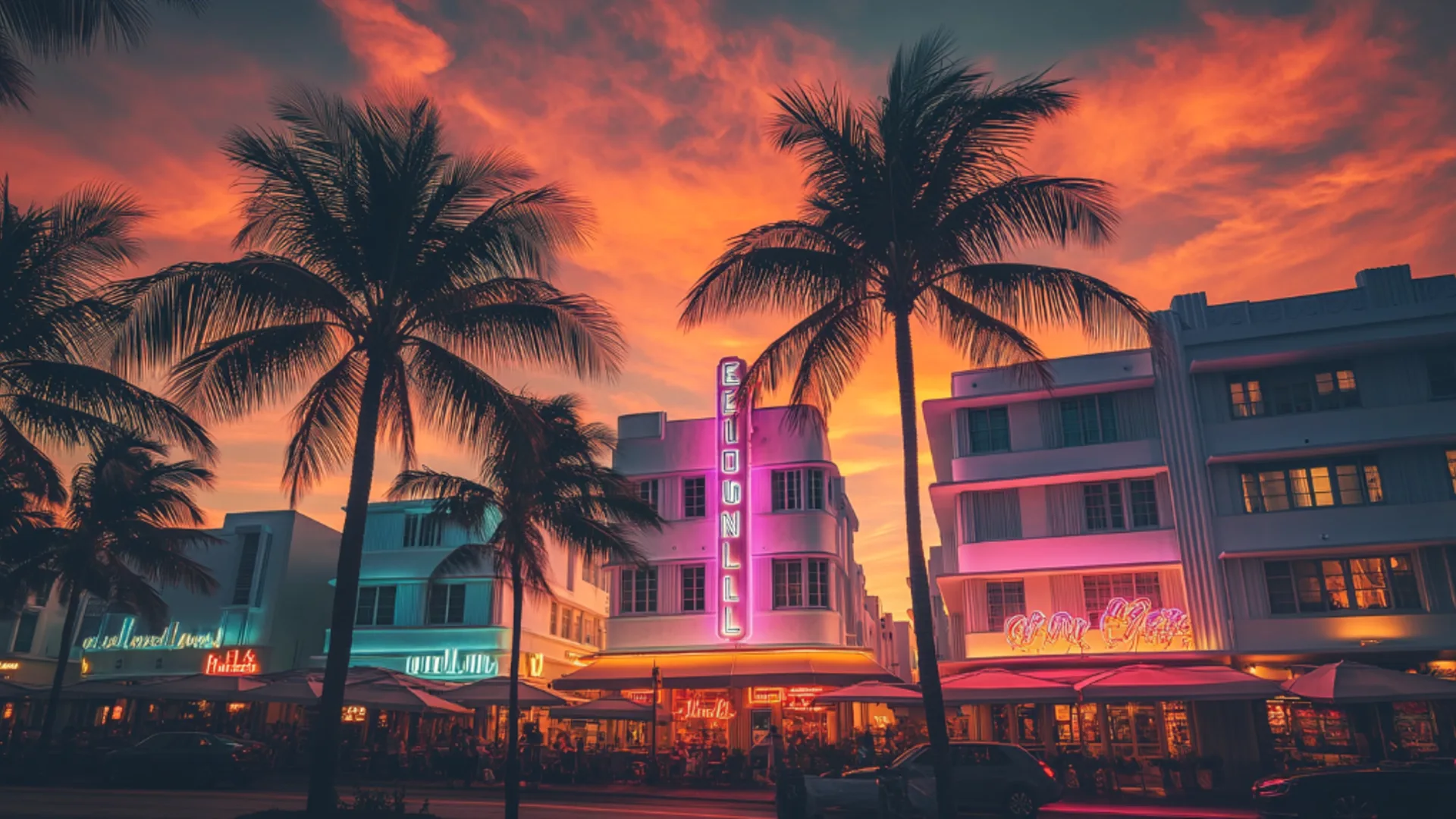
The Art Deco Historic District on South Beach — over 800 buildings in pastel Streamline Moderne, the largest concentration of Art Deco architecture in the world — exists because of one woman's obstinacy and the real estate market's indifference. By the 1970s, South Beach had declined from a glamorous resort destination to a decaying retirement community. The hotels were rooming houses. The restaurants were cafeterias. The elderly residents who occupied the Deco buildings were dying off, and the developers who circled the neighbourhood saw not architecture worth preserving but land worth clearing. The plan was demolition: raze the pastel relics, build high-rise condominiums, and remake South Beach in the image of the concrete towers already marching up Collins Avenue to the north.
Barbara Capitman saw something else. A journalist and activist with no formal architectural training, Capitman recognized that the Deco buildings were not kitsch but a coherent architectural vocabulary — Streamline Moderne curves, ziggurat rooflines, porthole windows, bas-relief tropical motifs, the particular exuberance of a style that translated European modernism through a subtropical American lens. She founded the Miami Design Preservation League in 1976 and spent a decade fighting developers, city commissioners, and the widespread conviction that the buildings were worthless. The Miami Beach Art Deco District was listed on the National Register of Historic Places in 1979 — the first 20th-century district to receive the designation — and the protection that listing provided gave the buildings time to be rediscovered by a new generation of designers, hoteliers, and visitors who recognized what Capitman had always known: that the architecture was the attraction.
The irony of the Art Deco district today is that the preservation succeeded almost too well. The pastel facades that Capitman fought to save are now the backdrop for Ocean Drive's restaurant-and-nightclub strip, where the architecture is reduced to set dressing for a scene that has nothing to do with the buildings' original purpose. The real Deco experience is a block or two inland, on Collins Avenue and Washington Avenue, where the hotels and apartment buildings retain their original proportions and the street life has not been entirely colonized by tourism. Walk these streets early in the morning, before the noise, and the architecture speaks for itself: the curves, the colours, the optimism of a style that believed the future would be beautiful. Capitman died in 1990 and did not live to see the full flowering of what she had saved, which is the particular cruelty that preservation imposes on its champions.
The district also contains the seeds of a broader lesson about Miami's relationship to its own past. This is a city that has historically demolished rather than preserved, that has treated architecture as disposable and land as the only permanent value. The MiMo (Miami Modern) buildings of the 1950s and 1960s — the motels and apartment blocks on Biscayne Boulevard, the hotels in North Beach — are the next generation of threatened architecture, and the fight to preserve them echoes Capitman's battle in structure if not yet in outcome. Miami builds fast, discards faster, and occasionally pauses to notice that what it was about to destroy was irreplaceable. The Art Deco district is the monument to that pause.
Wynwood's Transformation
In 2009, Wynwood was a garment warehouse district — low-slung industrial buildings, loading docks, fabric wholesalers, and the particular emptiness of a neighbourhood that existed to store things rather than to host human life. By 2019, it was one of the most Instagrammed neighbourhoods in the Western Hemisphere, a destination for global tourists who came to stand in front of murals and post photographs to platforms that did not exist when the first murals were painted. The transformation was not organic; it was engineered by Tony Goldman, the developer who had already turned South Beach and the Wynwood Building in New York into cultural destinations, and whose method was consistent: buy cheap, invite artists, let the art attract people, let the people attract commerce, sell expensive.
Goldman's Wynwood Walls project, launched in 2009, converted a cluster of warehouses into an outdoor gallery of large-scale murals by internationally recognized street artists — Shepard Fairey, Os Gemeos, Retna, Kenny Scharf, and dozens of others. The compound was deliberately curated: the artists were invited, the walls were prepared, and the results were photographed and promoted with the same professionalism that a gallery applies to its exhibitions. The effect radiated outward. Other building owners invited artists to paint their facades. Galleries opened. Restaurants followed. Breweries arrived. The neighbourhood's population shifted from warehouse workers to artists to tourists to residents, and the property values followed the same trajectory. Goldman died in 2012, before the transformation was complete, but the machine he built continued to operate.
The Wynwood of today is a study in the paradoxes of art-driven gentrification. The street art that made the neighbourhood famous is also the instrument of its commercialization. The murals attract visitors who spend money at restaurants and shops that pay rents that displace the artists who made the murals. The galleries that lend cultural credibility operate at margins that depend on Art Basel week and the collector class rather than the neighbourhood's daily economy. The breweries and cocktail bars that fill the warehouse spaces serve a clientele that has no memory of what the neighbourhood was before. This is not unique to Wynwood — the same cycle has played out in Williamsburg, Shoreditch, and the Marais — but the speed and completeness of Wynwood's transformation make it a particularly vivid case study. What remains genuinely alive is the art itself: the murals rotate, new artists arrive, and the streets between 20th and 29th continue to function as an open-air gallery that rewards walking and looking rather than merely photographing.
The Ventanita and Why It Matters
The ventanita — literally 'little window' — is a walk-up window on the side of a restaurant or cafe where Cuban coffee is served to a line of pedestrians and drivers without the ceremony of entering, sitting, ordering from a menu, or any of the other rituals that the American cafe experience has accumulated. You approach the window. You order a colada, a cortadito, or a cafecito. The coffee appears in seconds. You pay — often in cash, often under three dollars. If you ordered a colada, you receive a large cup and a stack of small plastic cups; you pour for yourself and whoever is with you, or you offer a cup to the stranger beside you, because the colada is a social instrument, not an individual drink. The transaction is complete in ninety seconds. You walk away caffeinated, connected, and in possession of an understanding of Miami that no museum or walking tour can provide.
The coffee itself is specific: Cuban espresso, brewed strong and sweetened with demerara sugar that is whipped into the first drops of the extraction to create the espumita — a caramel-coloured foam that floats on the surface like crema but tastes of burnt sugar and concentrated coffee. The sweetness is not optional in the traditional preparation; it is structural, a fundamental component of the flavour rather than an addition to it. Ordering Cuban coffee without sugar is like ordering a martini without gin — technically possible, culturally dissonant, and missing the point. The cortadito adds a small amount of steamed milk; the colada is the pure communal format; the cafecito is the single shot for the person in a hurry. Each has its context, its hour, its appropriate setting.
The ventanita matters because it is the last surviving form of a public culture that Miami's car-dependent, air-conditioned, privatized landscape has otherwise eliminated. There are no piazzas in Miami, no boulevards designed for promenading, no public squares where strangers gather by accident. The ventanita creates what the urban design does not: a moment of shared space, of face-to-face transaction, of coffee handed from one human to another through a window that connects inside to outside, private to public, the kitchen to the street. Versailles' ventanita is the most famous, but they exist throughout Little Havana, Hialeah, Westchester, and increasingly in Brickell and Downtown, where the younger generation has rediscovered the format. The ventanita is not nostalgia; it is infrastructure — the social infrastructure that a car-dependent city needs to remain human.
Caribbean Crossroads Kitchen
Miami's food cannot be understood through a single national lens because the city's kitchen is not national but hemispheric. The Cuban foundation — croquetas, ropa vieja, lechon, the Cuban sandwich, the ventanita coffee — provides the bass note, but the melody comes from everywhere south: Peruvian ceviches and lomo saltado at Cvi.che 105, Haitian griot and diri ak djon djon at Chef Creole, Colombian arepas in Doral, Venezuelan cachapas on every other block, Argentine empanadas and Malbec in Brickell, Brazilian picanha at churrascarias along Biscayne Boulevard, Nicaraguan gallo pinto in Sweetwater. The Caribbean basin drains into Miami's dining rooms with a directness that no other American city can match, because the communities that cook the food are not performing their cuisine for American audiences — they are feeding their own, and the Americans who discover the restaurants are the fortunate beneficiaries of proximity.
The specificity matters. A Cuban frita at El Rey de las Fritas on Calle Ocho is not a hamburger with a Latin accent; it is a distinct preparation — seasoned beef and chorizo blended, formed small, griddled fast, crowned with shoestring potato fries — that exists in the specific context of Havana's street food culture transplanted to SW 8th Street. A Haitian griot is not Caribbean pork but a precise technique of marinating, braising, and frying that produces a texture and flavour that no other cuisine replicates. The Peruvian ceviche is not Mexican ceviche or Ecuadorian ceviche but a specific relationship between fish, lime, aji amarillo, and red onion that Peruvians consider a national art form and defend with corresponding passion. Miami does not blur these distinctions; it amplifies them, because the communities that cook are large enough, concentrated enough, and proud enough to maintain their culinary vocabularies in full.
The fusion, when it happens, is genuine rather than contrived. Phuc Yea's Vietnamese-Cajun cooking works because Vietnamese and Louisiana cuisines share a structural grammar — bold flavour, generous spice, the centrality of broth and rice — that Ani Meinhold recognized and built a restaurant around. The Cuban-American refinements at Ariete work because Michael Beltran grew up eating croquetas and ropa vieja and his fine-dining interpretations carry the emotional weight of memory rather than the academic distance of research. The worst Miami food happens when the fusion is purely conceptual — when a chef combines two traditions they do not inhabit — and the best happens when the combination is biographical, when the cook's life contains both ingredients. In a city where almost everyone comes from somewhere else, biography is the richest source material.
The Beach Is Not the Point
The central misconception about Miami is that it is a beach city. The beach exists — twelve miles of Atlantic sand from South Pointe to Bal Harbour — and it is beautiful, and you should swim in it, and then you should walk away from it and discover the city that the beach has been obscuring. The tourism industry's original sin was to brand Miami as a beach destination, a tropical escape, a place where the primary activities are horizontal: lying on sand, floating in water, lounging by pools. This branding worked commercially but flattened a city of extraordinary complexity into a postcard, and the visitors who arrive expecting only beach leave without having experienced the thing that makes Miami genuinely interesting, which is the city itself — its communities, its food, its architecture, its contradictions, its furious energy.
The city behind the beach is vertical, dense, and operating at a velocity that the beachfront's indolence conceals. Brickell's glass towers house an international financial district that processes more Latin American capital than any other location in the United States. Wynwood's warehouses contain a contemporary art scene that rivals Brooklyn's in ambition if not yet in institutional depth. Little Havana's corridor is a living museum of exile culture. The Design District is an open-air architecture gallery. Coconut Grove's banyan-canopied streets contain Miami's oldest bohemian community. Little Haiti's Caribbean architecture and emerging creative scene represent the city's next cultural frontier. None of these experiences involve sand or saltwater, and collectively they compose a city that would be fascinating even if it were landlocked.
This is not to dismiss the beach. The beach is the stage on which Miami performs its public self — the bodies, the fashion, the music, the preening spectacle of a city that believes beauty is a civic obligation. Ocean Drive at night, for all its noise and vulgarity, is a kind of urban theater that no other American city produces. The beach itself, particularly south of Fifth Street or north of 46th, is genuinely beautiful in the morning before the crowds. But the beach is the introduction, not the substance. The substance is Cuban coffee at a walk-up window. It is stone crab claws at Joe's in season. It is a mural on a Wynwood side street that you will not find in any guidebook. It is the sound of dominos at Maximo Gomez Park. It is the Everglades beginning thirty minutes from the financial district. The beach is not the point. The city is the point.
The Heat as Design Constraint
From May through October, Miami's heat and humidity operate not as weather but as architecture, shaping every decision about when to move, where to eat, how to dress, and what is physically possible in a given hour. The temperature hovers in the low nineties Fahrenheit, the humidity rarely drops below eighty percent, and the combination produces a heat index that routinely exceeds a hundred degrees. This is not the dry heat of the desert Southwest or the brief heat waves of northern cities; this is the sustained, saturated, oppressive heat of the subtropical Atlantic margin, and it does not break until late October. The locals have adapted by organising their entire lives around air conditioning — from house to car to office to restaurant to car to house, with minimal exposure to the exterior environment. The visitors who refuse to adapt suffer visibly: the wilting tourists on Ocean Drive at noon, the red-faced couples walking Wynwood at 2pm, the joggers on the Venetian Causeway who started with ambition and ended with heatstroke.
The heat explains Miami's architecture, its nightlife, and its relationship to time. The buildings are designed to manage solar gain: the Deco eyebrows (horizontal ledges above windows that shade the glass from direct sun) are not decorative but functional, invented by Miami architects who understood that a window facing the tropical sun without shade is an oven. The contemporary towers in Brickell and Downtown are glass and steel because modern air conditioning makes them habitable, but the energy cost is extraordinary — Miami's per-capita electricity consumption for cooling is among the highest in the nation. The nightlife starts late because the evenings are the only tolerable hours for outdoor activity: dinner at 9pm, clubs at midnight, the streets alive at 2am because the temperature has finally dropped to the low eighties and the city exhales.
The practical implications for the visitor are non-negotiable. Schedule outdoor activities — walking tours, Wynwood murals, Calle Ocho, the Everglades — for early morning or late afternoon. Reserve the middle of the day for air-conditioned experiences: museums, restaurants, indoor galleries, the Metromover ride that gives you aerial views without heat exposure. Carry water everywhere. Accept that you will sweat, that your clothes will be damp by 10am, and that the cold blast of air conditioning when you enter a restaurant is as much a part of the Miami dining experience as the food. The heat is not an obstacle to overcome but a condition to design around, and the city's best experiences — the ventanita coffee at dawn, the evening cocktail on a rooftop as the sun drops, the late-night walk on Ocean Drive when the neon reflects off rain-wet pavement — are calibrated to the hours when the heat relents.
Brickell's Vertical City
Stand on the Brickell Avenue bridge and look south: the glass towers rise in a density that would be unremarkable in Hong Kong or Singapore but is startling in a city that was swampland within living memory. Brickell is Miami's ambition made vertical — a financial district that processes more international capital than any other in the Americas outside New York, built on reclaimed land in a hurricane zone, populated by a global workforce that conducts business in Spanish, Portuguese, and English in equal measure. The neighbourhood barely existed fifteen years ago in its current form; the cranes that built it have only recently been removed, and new ones are already being erected. Brickell is the physical expression of Miami's conviction that the future is being constructed here, now, at speed, and that the risk of building tall in a place where the sea level is rising and the hurricanes are intensifying is a risk worth taking.
The vertical city has its own culture, distinct from the horizontal Miami of beaches and bungalows. The rooftop bars — Sugar at EAST Miami, Area 31 at the Epic — trade on elevation as their primary product, offering cocktails with skyline views that flatten the city's complexity into a panorama of lights and water. The Brickell City Centre mall is a vertical village: shops, restaurants, offices, and a climate-controlled pedestrian environment that eliminates the need to engage with the street. The Metromover — free, elevated, air-conditioned — connects Brickell to Downtown in a continuous loop, and riding it is the best way to understand the neighbourhood's scale: tower after tower, each one a thousand apartments, each apartment a household that chose Miami over São Paulo, Bogotá, Mexico City, or New York.
The criticism of Brickell is that it is generic — that the glass towers could exist in any global city, that the restaurants and bars serve a cosmopolitan clientele that has more in common with its counterparts in Dubai and London than with the Cuban community in Little Havana ten minutes away. The criticism is partly fair. But Brickell's genericness is itself a Miami story: this is a city that has always been about aspiration, about the belief that you can build something from nothing in a place where the ground is uncertain and the weather is adversarial. The towers may look like towers everywhere, but the people inside them — the Venezuelan banker, the Colombian tech entrepreneur, the Brazilian art dealer, the Argentine restaurateur — are specifically Miami, and the financial ecosystem they have built is the engine that powers the city's transformation from regional resort to global capital.
Wildness at the Edge
The most extraordinary fact about Miami is this: thirty minutes from the financial district, past the last subdivision and the last gas station, the Everglades begin — 1.5 million acres of subtropical wilderness, a river of grass flowing imperceptibly southward from Lake Okeechobee to Florida Bay, populated by alligators, crocodiles, manatees, Florida panthers, roseate spoonbills, wood storks, and the particular silence of a landscape that has not changed in fundamental character since the last ice age. The proximity is the astonishment. You can eat stone crab claws at Joe's at noon and be staring at an alligator from ten feet away by 2pm. You can close a real estate deal in Brickell and kayak through a mangrove tunnel before sunset. The wildness is not Miami's hinterland; it is Miami's edge, and the edge is closer than anyone who has only seen the beach suspects.
The Everglades resist the conventions of scenic beauty. There are no mountains, no dramatic waterfalls, no red-rock canyons. The landscape is flat, vast, and horizontal — sawgrass to the horizon in every direction, broken only by tree islands (hammocks) that rise a few feet above the water and support hardwood forests in miniature. The beauty is in the scale and the strangeness: the feeling of standing at the Shark Valley observation tower and seeing nothing man-made in any direction, the surface of the water dimpled by fish and turtles, the V-wake of an alligator moving through the sawgrass with the unhurried authority of a creature that has been doing this for sixty million years. The airboat rides that tourists take are loud and fast and fun, but the real Everglades experience is quiet — a canoe in the mangrove tunnels of the Nine Mile Pond trail, where the roots arch overhead and the water is tannin-dark and the only sound is your paddle and the occasional splash of a fish.
The Everglades are also dying, or rather, being killed — by water management decisions made decades ago that diverted the natural flow, by agricultural runoff from the sugar industry to the north, by sea-level rise that is pushing saltwater into the freshwater system, and by the accumulated indifference of a state that has historically valued development over conservation. The restoration efforts are real and ongoing, and the Comprehensive Everglades Restoration Plan is the largest environmental restoration project in American history, but the timeline is decades and the political will is inconsistent. Visiting the Everglades is not merely a nature excursion; it is an encounter with the environmental crisis that defines South Florida's future, condensed into a landscape that is simultaneously ancient and urgently contemporary.
Art Basel Changed Everything
In 2002, Art Basel — the Swiss art fair that is to the contemporary art market what Wimbledon is to tennis — launched its Miami Beach edition, and the city's cultural trajectory changed permanently. The fair itself occupies the Miami Beach Convention Center for four days in early December, filling its halls with the world's most important galleries presenting works for sale to collectors, museum curators, and the merely curious. But the fair is the least interesting part of Art Basel Miami Beach. The satellite fairs — NADA, Untitled, Pulse, Scope, Art Miami, and a dozen others — spread across the city from Wynwood to the Design District to Downtown to North Beach, each carving out a different niche of the market. The private collections open their doors. The galleries mount their most ambitious exhibitions. The hotels host installations in their lobbies. The restaurants and bars fill with artists, dealers, critics, and the particular species of wealthy enthusiast who follows the art calendar like a sport.
What Art Basel gave Miami was not merely an annual event but a permanent identity shift. Before Basel, Miami's cultural reputation was beaches, nightclubs, and Miami Vice. After Basel, the city could credibly claim a position in the global contemporary art conversation, and the infrastructure that grew to support that claim — the Perez Art Museum, the Institute of Contemporary Art, the Rubell Museum, the de la Cruz Collection, the Margulies Collection, the galleries in Wynwood and the Design District — exists year-round, not just during fair week. The collectors who came for Basel and liked the weather stayed, buying properties and establishing foundations. The artists who came for residencies and found cheap studio space (now less cheap) built communities. The curators who visited discovered a city where the Latin American and Caribbean art worlds intersected with the North American and European ones in ways that no other location could replicate.
The Art Basel effect also accelerated Wynwood's transformation, gentrified the Design District into a luxury enclave, and created a December week that is simultaneously Miami's cultural apex and its most expensive, crowded, and exhausting experience. The tension between Basel's cultural contribution and its commercial impact — between art as expression and art as commodity, between the fair's democratizing impulse and the velvet-rope exclusivity of the private events — is Miami's version of a conversation happening in every art capital. But the net effect is undeniable: a city that was culturally dismissed thirty years ago now hosts one of the three most important art fairs in the world, and the reverberations have made Miami a permanent fixture on the global cultural calendar.
Little Haiti's Emergence
Little Haiti occupies the blocks north of the Design District and east of Little River with an energy that is simultaneously rooted and precarious. The Haitian community established itself here beginning in the 1980s, building a neighbourhood of botanica shops, Caribbean restaurants, Creole-language churches, colourful concrete architecture, and the particular resilience of a diaspora that has faced more obstacles than most — political instability at home, indifference or hostility abroad, and in Miami, the constant pressure of real estate speculation on land that the community transformed from neglect into something alive. The Caribbean architecture — painted concrete, wrought iron balconies, hand-lettered signs in Creole and French — creates a visual identity that is unlike any other neighbourhood in the city.
The cultural infrastructure is real and hard-won. The Little Haiti Cultural Complex hosts exhibitions, performances, and community events. The Caribbean Marketplace, modelled after the Iron Market in Port-au-Prince, provides a gathering space. The botanicas along NE 2nd Avenue sell the herbs, candles, and spiritual supplies that connect the diaspora to Vodou traditions that predate the colonial encounter. Chef Creole serves Haitian food — griot, lambi, diri ak djon djon — to a clientele that is overwhelmingly Haitian, and the flavours carry the weight of a cuisine that is one of the Caribbean's most distinctive and least understood. The neighbourhood's creative scene is growing: Churchill's Pub has been booking punk, indie, and experimental music for decades, and the spillover from the Design District and Wynwood is bringing galleries, studios, and artist-run spaces that add to the cultural density without (yet) displacing the existing community.
The threat is real and present. The Design District's luxury development has pushed northward, and the property values in Little Haiti have multiplied in the last decade. The proposed Magic City Innovation District — a massive mixed-use development on the neighbourhood's southern edge — represents either economic opportunity or cultural displacement depending on whom you ask, and the community's response has been vocal, organized, and split between those who see development as inevitable and those who see it as erasure. Little Haiti is Miami's most vivid example of a broader American story: a community that built something valuable from nothing, only to find that the value they created has made the neighbourhood unaffordable for the people who created it. Visiting Little Haiti with awareness of this tension is not political tourism; it is honest engagement with a neighbourhood that is fighting, in real time, for its right to remain itself.
The Everglades at the Edge
The relationship between Miami and the Everglades is not metaphorical; it is hydrological. The city sits on the Biscayne Aquifer, a porous limestone formation that is recharged by the freshwater flowing southward through the Everglades. The drinking water that comes out of every Miami tap has filtered through the same sawgrass and limestone that the alligators swim through, and the saltwater intrusion that threatens the aquifer — pushed inland by sea-level rise and exacerbated by the drainage canals that the Army Corps of Engineers cut through the Glades in the mid-twentieth century — is not an environmental abstraction but a direct threat to the city's water supply. Miami and the Everglades are the same system, and the health of one determines the health of the other.
This connection is invisible to most visitors, who experience the Everglades as a day trip — an airboat ride, some alligators, a gift shop — and then return to the city without understanding that the wildness they drove through is the reason the city exists at all. The Shark Valley section of the park, accessible via Tamiami Trail forty minutes from downtown, provides the most compressed encounter with the river of grass: a fifteen-mile loop road through sawgrass prairie where alligators sun on the tarmac and the observation tower at the midpoint offers a 360-degree view of undeveloped Florida that is genuinely shocking in its completeness. The mangrove sections — accessible by kayak from Flamingo or the Nine Mile Pond trail — provide the intimate version: narrow waterways tunnelling through prop root forests where the light filters green and the only sound is water.
The Everglades are not a park in the conventional sense of a bounded recreational space. They are a biological system that extends from central Florida to the coral reefs of the Florida Keys, and their degradation — through decades of drainage, agricultural pollution, and development — has consequences that reach far beyond the park boundaries. The Comprehensive Everglades Restoration Plan, authorized in 2000, is a multi-decade, multi-billion-dollar effort to restore the natural water flow, and its progress is measured in inches of water level and parts per million of phosphorus. For the visitor, the practical implication is simple: go. See the river of grass before the grass is gone. Understand that the wildness at Miami's edge is not a scenic amenity but a life support system, and that the alligator you photographed from the Anhinga Trail boardwalk is living in the same watershed as your hotel room.
After Dark
Miami's nightlife operates on a schedule that would concern a physician in any other city. Dinner at 9pm is early. The bars fill at 11pm. The clubs open their doors at midnight and do not peak until 2am. The after-parties run until dawn, and the cafecito at the ventanita at 6am is both the end of one night and the beginning of another day. The late schedule is not decadence; it is climate adaptation. The subtropical heat makes the daylight hours uncomfortable for sustained outdoor activity, and the evening and night hours — when the temperature drops from the mid-nineties to the low eighties, when the ocean breeze crosses the causeways, when the neon activates on the Art Deco facades — are when the city comes alive. Miami after dark is Miami at full volume.
The nightlife geography is stratified by intent. South Beach — specifically the Ocean Drive and Collins Avenue corridor — is the spectacle: bottle-service clubs, celebrity DJs, velvet ropes, and the particular economics of nightlife where a table costs more than a transatlantic flight. This world exists and is globally famous, and if you want to experience it, you can — but understand that it is a performance for a specific audience, and that the audience is mostly tourists and visiting weekenders. The locals drink elsewhere. Wynwood's bars — Gramps, Better Days, Bar Bevy — serve the creative community. Brickell's rooftop lounges serve the financial class. Little Havana's Ball & Chain serves the music lovers. Coconut Grove serves the early-bedtime crowd. The Upper East Side's Anderson and the Design District's quieter bars serve the people who want a good drink without a production.
The live music is the least appreciated dimension of Miami's nightlife. Ball & Chain on Calle Ocho programs live Latin bands that fill the dance floor with people who dance not for the Instagram story but because the music demands physical response. Lagniappe's backyard hosts acoustic and jazz sets under the trees with the intimacy of a house concert. Churchill's Pub in Little Haiti books punk and indie bands in a room that has been doing so since the 1970s. The hotel lobbies — particularly the Faena Theatre — program cabaret and performance art that operates at a higher ambition level than most cities' dedicated venues. Miami's nightlife is not one thing; it is a spectrum from the vulgar to the sublime, and the best nights are the ones that traverse it.