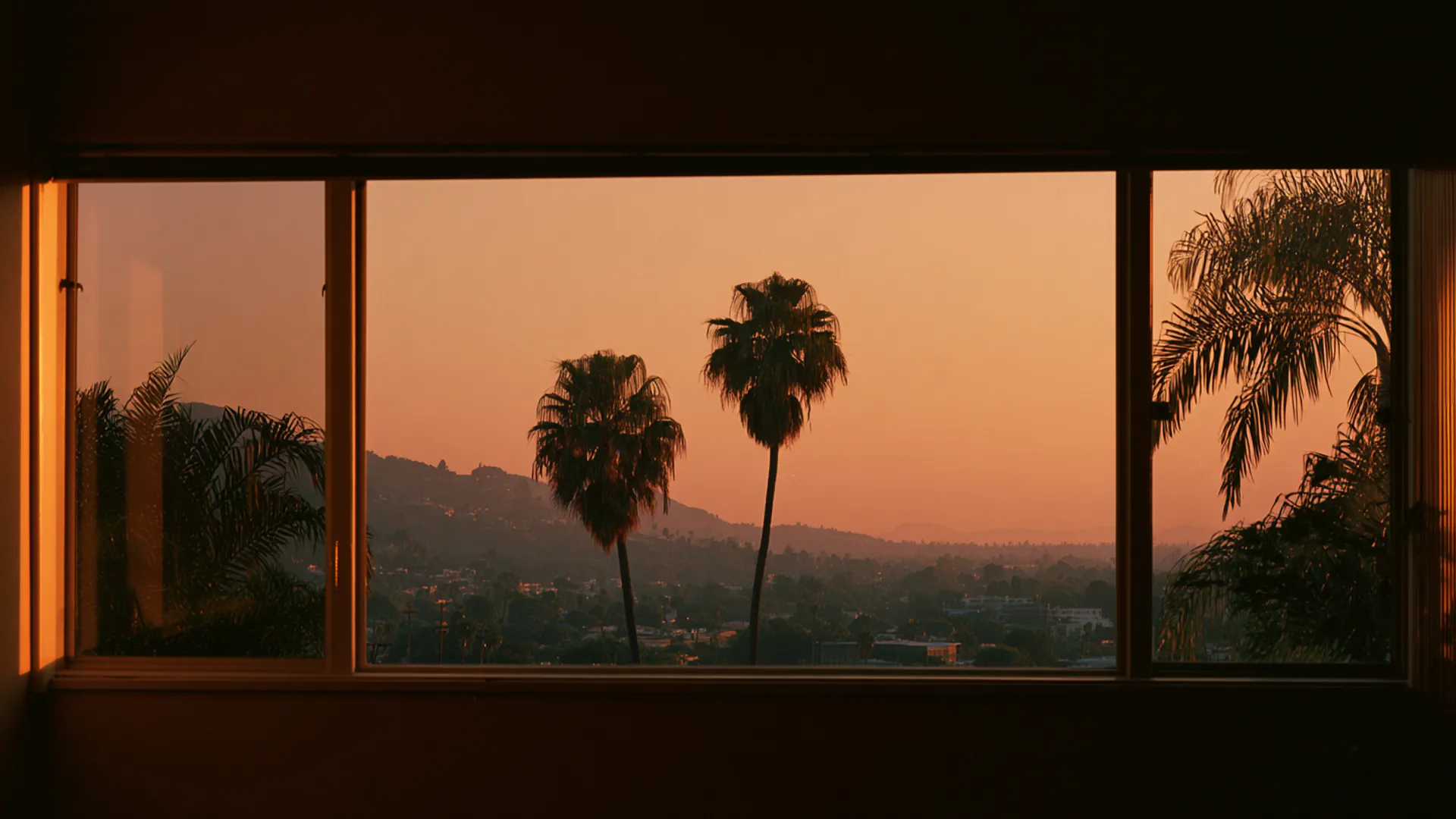
At sunset, when the smog lifts and the Pacific glows amber on the horizon, the white walls of Griffith Observatory catch fire. From this promontory on Mount Hollywood, Los Angeles unfolds in every direction: downtown's glass towers, the Hollywood Sign across the canyon, the mountains and ocean that bracket America's most improbable metropolis. Colonel Griffith J. Griffith, the Welsh-born mining millionaire who donated this land, looked through a telescope at Mount Wilson in 1904 and emerged transformed. 'If all mankind could look through that telescope,' he declared, 'it would change the world.' His observatory was built to make good on that promise—a temple of public science where anyone, rich or poor, could touch the infinite for free.
Griffith's original 1896 land gift came with conditions: the park bearing his name should include an observatory and a theater, open to all. After his death in 1919, the city hired John C. Austin and Frederick M. Ashley—architects already famous for Los Angeles City Hall—to design a building worthy of the site. They chose a style that merged Greek classical forms with the streamlined geometries of Art Deco: three copper domes rising from a white stucco base, ornamented with zodiac symbols and astronomical motifs. The result is neither purely ancient nor strictly modern, but something distinctly Californian—optimistic, democratic, reaching for the sky.
The interior carries that vision forward. Hugo Ballin's monumental murals in the rotunda depict humanity's greatest astronomers, from Ptolemy through Copernicus to Einstein. A Foucault pendulum swings silently in the central shaft, demonstrating Earth's rotation with each circuit. The planetarium—the third ever built in America—still uses a Zeiss projector to wheel the heavens overhead, now supplemented by digital systems that can zoom to the edge of the observable universe. And the telescopes remain free, just as Griffith intended: the 12-inch Zeiss refractor in the east dome has shown more people the night sky than any other telescope in history.
The building is inseparable from Los Angeles mythology. James Dean pondered the cosmos here in Rebel Without a Cause. The Terminator descended these steps. La La Land danced beneath its domes. But the real romance is subtler: families spreading blankets on the lawn for evening telescope sessions, children watching their first moonrise through brass eyepieces, tourists and locals alike standing silent on the terrace as the city lights wink on below. Griffith understood that wonder is not a luxury but a necessity—and that architecture can frame it for everyone.
"If all mankind could look through that telescope, it would change the world."
— Griffith J. Griffith, 1904
A 2006 renovation added underground exhibits and the Leonard Nimoy Event Horizon theater, but the essence of Griffith's vision survived: admission is still free. The telescopes still open every clear night. The planetarium still sells out shows. And the view from the terrace—the same panorama that drew Colonel Griffith a century ago—still makes visitors gasp. In a city built on reinvention and image, the observatory remains stubbornly devoted to something older: the belief that looking up can make us better.