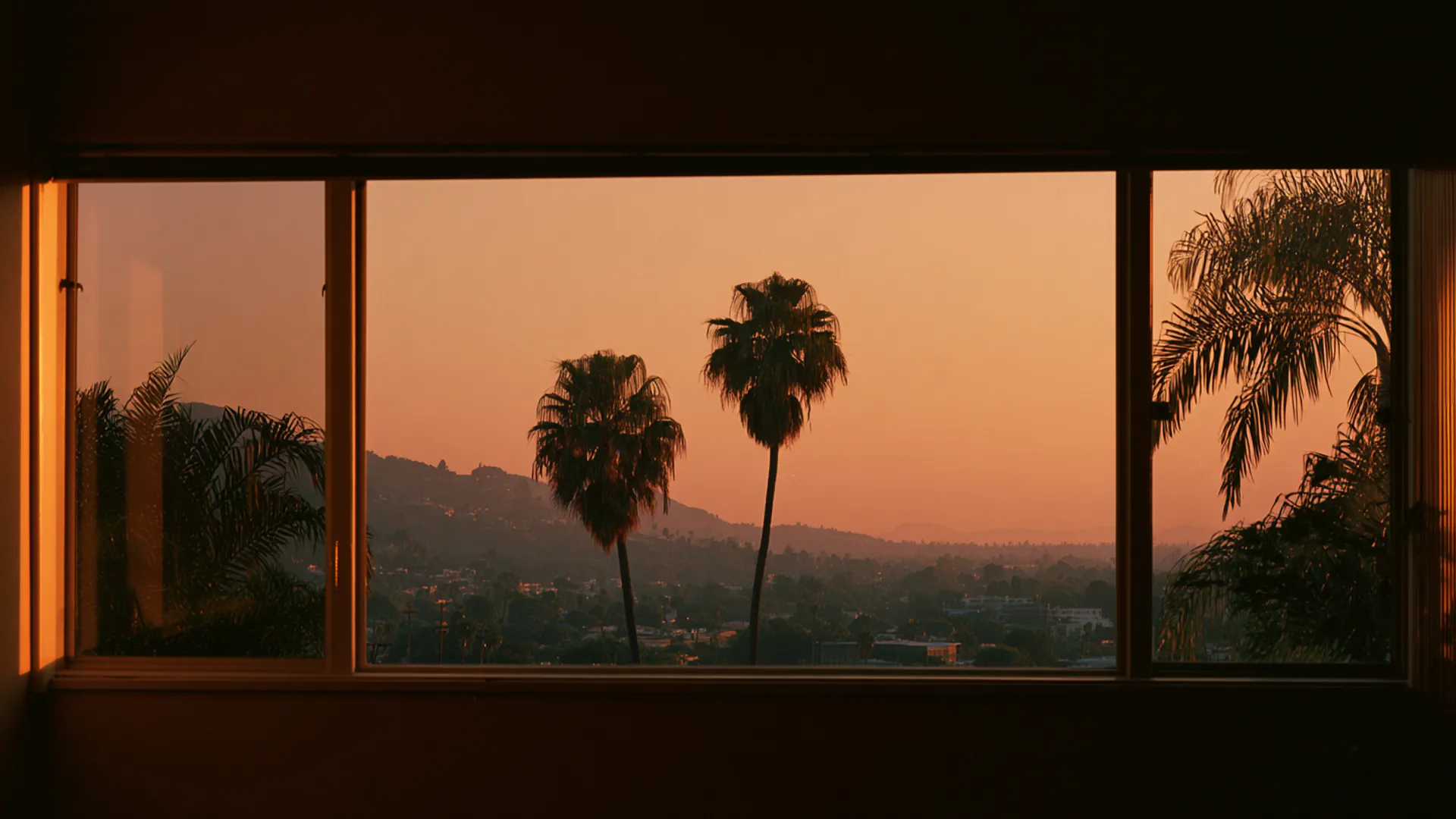
Two women in cocktail dresses sit at the corner of a glass room suspended above a glittering city. The night is clear. The San Gabriel Mountains are visible in the distance. The swimming pool glows turquoise. And Los Angeles—all ten million lights of it—spreads to the horizon like a fallen galaxy. This is Julius Shulman's 1960 photograph of Case Study House #22, the image that defined mid-century modern architecture and made Pierre Koenig's modest steel-and-glass box the most famous house in America.
Buck Stahl was a purchasing agent for Hughes Aircraft and a former professional football player who bought this 'unbuildable' lot in 1954 for $13,500. He and his wife Carlotta spent two years constructing retaining walls by hand before approaching architects. Several refused the commission. Pierre Koenig, just 32 years old and already known for his experimental steel houses, agreed to try. His solution was elegant: cantilever the entire structure ten feet over the hillside, supported by a steel frame so minimal it nearly disappears. The house would not fight the terrain; it would float above it.
Koenig's design was pure Case Study Program philosophy: industrial materials, mass-production potential, and the erasure of boundaries between inside and outside. The steel frame allowed floor-to-ceiling glass on three sides—the largest panels commercially available in 1960. The L-shaped swimming pool wraps the corner of the living room, its water seeming to merge with the city lights below. The 2,200-square-foot house cost $37,500 to build, a demonstration that modernist architecture could be affordable, replicable, and spectacularly sited all at once.
Then came Shulman. The architectural photographer arrived at twilight and set up his view camera. He exposed the negative for five minutes to capture the city lights, then had the women—Ann Lightbody and Cynthia Murfee, friends of Koenig's assistant—assume their poses while he lit the interior with flash. The resulting image was not published in Arts & Architecture's original feature on the house. It appeared months later on the cover of Pictorial Living, won the AIA's first award for color photography, and eventually was named by Time Magazine as one of the most influential images in the publication's 200-year history. The photograph made the house; the house made the photograph; together they became Los Angeles.
"One of the most influential images in 200 years."
— Time Magazine on Shulman's photograph
The Stahl family lived in the house for decades, and Buck and Carlotta's children still own it. Tours are available by reservation; the house is occasionally listed for events. Stand where Shulman stood and frame the same view—city lights replacing orange groves, but the glass and steel unchanged. Consider that this image, this house, this moment of two women in a floating room, became the postcard for an entire way of living: modern, optimistic, cantilevered over the void. Los Angeles has reinvented itself a dozen times since 1960, but the Stahl House remains—still floating, still glowing, still defining what California dreaming looks like.