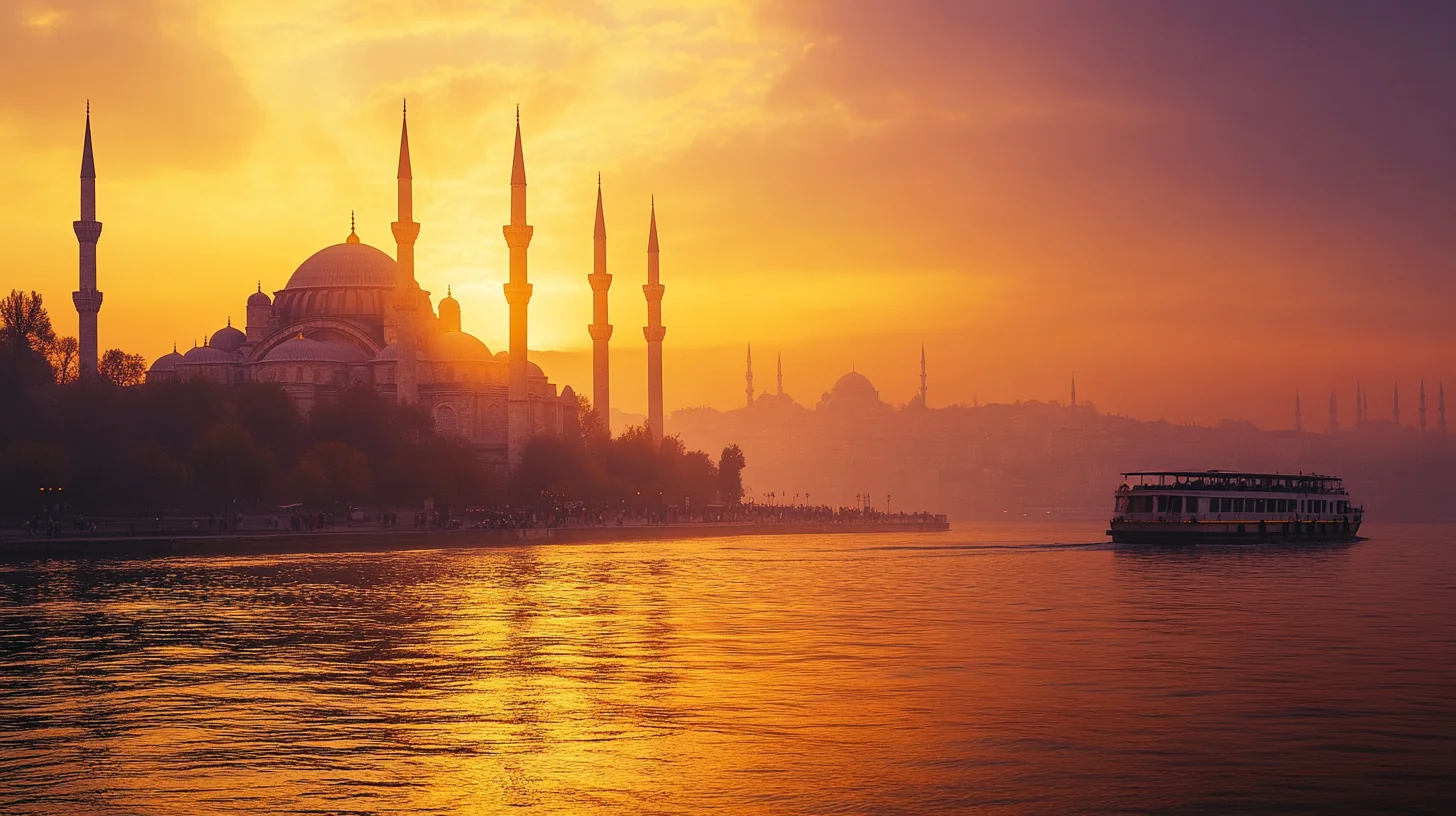
The dome floats. Thirty-one meters across, it appears to hover on a ring of light from forty windows at its base — an architectural trick that has been astonishing visitors since 537 AD, when Emperor Justinian reportedly stood beneath it and said 'Solomon, I have surpassed thee.' He was not exaggerating. Hagia Sophia was the largest enclosed space in the world for nearly a thousand years, and the engineering that holds it up was not replicated until the Renaissance. Built as a Christian cathedral, converted to a mosque when Mehmet the Conqueror took Constantinople in 1453, declared a museum by Ataturk in 1934, and reconverted to a mosque in 2020 — the building carries the entire weight of Istanbul's identity in its walls. Byzantine mosaics partially revealed during the museum era now coexist with Islamic calligraphy medallions, the two traditions literally layered on top of each other. The gold tesserae of a 9th-century Virgin and Child gleam above the apse while Arabic script proclaims the names of Allah and Muhammad from enormous roundels. This is the single most important building in Istanbul and arguably the most significant religious building in the world. Every other structure in the city exists in its shadow.
Location
Sultanahmet, Istanbul
Map
Insider Intel
Enter through the Imperial Gate and look up immediately — the dome is the point, and the first impression is irreplaceable. Walk the ground floor slowly, letting the scale register before seeking details. The Byzantine mosaics are concentrated in the upper galleries (accessible via a ramp in the north aisle when open) — the Deesis mosaic showing Christ flanked by the Virgin Mary and John the Baptist is the finest surviving example of late Byzantine art. The weeping column near the northwest pier has a copper plate with a hole worn smooth by centuries of pilgrims inserting their thumbs. The mihrab indicating the direction of Mecca is slightly off-axis from the building's orientation — a quiet testament to the building's conversion. Most visitors spend 30 minutes; spend 90.
Early morning, ideally first thing when doors open, before the tour buses arrive from the cruise terminal. The building faces east, so morning light through the apse windows illuminates the interior mosaics most dramatically. Avoid Friday midday (prayer time) and weekends in high season. Winter months offer thinner crowds and a quality of interior light — grey Istanbul sky diffused through the windows — that summer cannot match. The exterior is illuminated at night and worth seeing from the Sultanahmet park, but evening access is prayer-dependent.
Hagia Sophia is an active mosque. Remove shoes at the entrance (bags provided). Women must cover their heads and shoulders — scarves are available for loan at the door. Dress modestly: knees and shoulders covered for everyone. The building closes during the five daily prayer times; check the schedule, which shifts seasonally. Entry is free. Photography is permitted but be respectful of worshippers. The upper galleries, which contain the best mosaics, have variable access hours — confirm before visiting. Allow 60-90 minutes minimum. The queue can be long in summer; arrive before 9am or after 3pm.